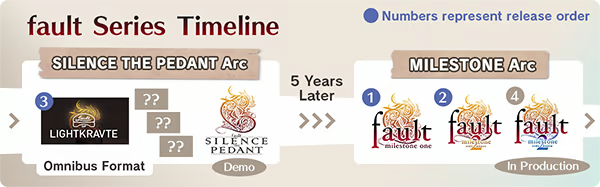
fault - StP - LIGHTKRAVTE is the latest entry in the fault series, which has shipped over 500,000 copies worldwide. LIGHTKRAVTE presents its story through the eyes of Khaji Oberg, an ordinary and unremarkable teenaged boy who finds himself reaching for a dream that slips ever further away from him.
Modeled estimate, not a reported figure. How we estimate →
Media

About


Stats
All-time low is the lowest price we've recorded for this game since we started tracking it.
Languages: Japanese, English, Simplified Chinese
Engagement
Hours played at review time, across 40 reviews with recorded playtime.
Reviews
Themes across 40 recent reviews and how positive each mention is. A keyword signal, not full sentiment analysis.
positive critical· bar length = how often the theme comes up
Reviews
Absolute cinema! Just read it for yourself.
Wow Art and animation is a good improvement from the Main Fault series. Music is amazing as usual. The real highlight of this game is the writing and character development. Starts very slow but about the middle point things get very interesting and by the end you are it in the feelings with the force or a meteor.
第三季拖好久了,快点出吧,游戏流程大约5小时,说实话不打折不值这个价,而且个人感觉也没有正传的剧情令人惊艳。
2,5/5 I mean, it's a nice game, but there's a LOT of story that's not so exciting. The last part of the story is, however, thrilling.
Zajebista, póki co moja ulubiona część :D
演出效果在视觉小说里绝对是独一档了,简直是艺术品。
有点平淡了
fault - StP - LIGHTKRAVTE, developed by ALICE IN DISSONANCE and published by Phoenixx Inc., is a deeply polished kinetic visual novel that prioritizes emotional storytelling, atmospheric worldbuilding, and character introspection over interactivity or branching choices. It is a prequel set within the larger fault universe, yet it stands comfortably on its own as a focused, character-driven narrative. What distinguishes LIGHTKRAVTE from many other visual novels is its remarkable level of presentation: fluidly animated portraits, expressive character movement, rich backgrounds, and a cinematic sense of pacing that makes even quiet scenes feel alive. ALICE IN DISSONANCE has long been known for elevating the visual novel format visually, and LIGHTKRAVTE continues that tradition with some of their most refined work to date. The story centers on Khaji Oberg, an ordinary boy with an extraordinary dream: to become a painter in a world where magic-driven technology has reshaped society. Unlike many VN protagonists, Khaji begins his journey far from admirable. He is insecure, somewhat self-centered, prone to naive idealism, and constantly at odds with both his own limits and the expectations around him. His artistic goals often border on childish obsession, and he harbors impulses that highlight his immaturity. But this intentional characterization becomes the emotional engine of the narrative. Over time, the story uses Khaji’s flaws as a canvas to explore ambition, self-worth, creative frustration, and the painful gap between who we think we are and who we want to become. Watching him stumble, reflect, and gradually evolve becomes one of the most compelling aspects of the experience. The supporting cast is thoughtfully constructed, offering a mix of familiar series characters and newcomers who enrich the emotional landscape of the story. Each interaction pushes Khaji’s arc forward, whether by challenging his worldview, grounding his emotional turmoil, or offering alternative perspectives on creativity and purpose. LIGHTKRAVTE doesn’t rely on dramatic fantasy stakes to create tension; instead, it invests in the quieter but more resonant conflicts of personal growth, family expectation, and discovering one’s place in a rapidly changing world. Even though the setting includes wondrous elements such as mana-based technology (“manakravte”), the narrative remains anchored in human vulnerability and the bittersweet journey toward self-knowledge. Visually, the game is exceptional. The kinetic novel format allows for detailed animated expressions, subtle gesture work, and dynamic compositions that help scenes feel textured and intimate. The backgrounds are lush and atmospheric, and the color palette shifts thoughtfully to support the emotional tone of each chapter. Combined with a gentle, often melancholic soundtrack, the result is an audiovisual presentation that far surpasses what most visual novels attempt. These production values not only elevate storytelling moments but also help maintain momentum in a genre that relies heavily on reading rather than interaction. Structurally, LIGHTKRAVTE is linear, offering no choices, branching routes, or gameplay beyond advancing the text. This places full responsibility on the strength of the writing and direction—and fortunately, those elements hold firm. The prose is graceful and introspective, the pacing carefully measured, and the emotional rhythm deliberate. The absence of player agency may be disappointing for those who prefer choice-driven narratives, but within the kinetic novel framework, the linearity serves its purpose: it ensures an uninterrupted emotional arc and a cohesive thematic journey. The roughly 6–8 hour length allows the story to develop with depth without overstaying its welcome. That said, LIGHTKRAVTE will not resonate equally with all audiences. Its reliance on internal conflict over external action may feel slow to players seeking a more dramatic fantasy plot. Khaji’s early behavior can be off-putting, especially for those expecting a traditionally likable protagonist. The heavy reading load and deliberate pacing may also deter those who prefer visual novels with puzzles, branching paths, or gameplay variety. But for readers who appreciate character-driven storytelling and the introspective exploration of creativity, identity, and adolescence, LIGHTKRAVTE offers a rare level of sincerity and nuance. In the end, fault - StP - LIGHTKRAVTE succeeds as a beautifully crafted, emotionally thoughtful visual novel that thrives on subtlety rather than spectacle. Its strengths lie in its meticulous presentation, its thematic focus on growth and self-doubt, and its ability to transform an initially flawed protagonist into someone worth understanding. It is a work best enjoyed slowly and reflectively, and one that rewards players who engage with its emotional core. For fans of the fault series, it enriches the world and deepens the lore; for newcomers, it stands as an elegant, self-contained story about the pains and triumphs of wanting to create something meaningful in a world that doesn’t always understand you. Rating: 8/10
很好的短篇故事。
主人公カージを知らなかったので導入部分は少しとっつきにくかった。 ※SILENCE THE PEDANTデモ版に出ているらしいが未プレイ しかし、カージについての問題が明らかになってからは一気に面白くなり、また、登場人物それぞれに事情があり葛藤している描写も良く、最後まで楽しく読み進めることができた。 本編の続編が待ち遠しい。
Related
Related
Trends
Modeled estimate over time, reconstructed from Steam's monthly review histogram.
Momentum
Pace estimated from the game's recent review growth (our daily snapshots) at its own sales-per-review ratio — a momentum signal, not booked sales.
Audience
Estimated from the language of this game's reviews — a proxy for where players are, not official Steam demographics.
Related
| For the People | $108.3K | 809 | 74% | $5.09 |
| The Heart of Influencer | $108.3K | 329 | 88% | $12.99 |
| Star Trek Legends | $108.2K | 250 | 67% | $19.99 |
| Zeliria Sanctuary | $108.3K | 702 | 88% | $9.99 |
| A.R.E.S.: Extinction Agenda | $108.2K | 913 | 69% | $4.99 |
| Cardpocalypse | $108.3K | 191 | 88% | $24.99 |