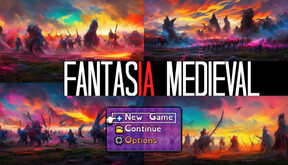
Fantasia Medieval is a compact fantasy visual novel that draws much of its identity from the atmosphere of tabletop role-playing adventures. Developed and published by Paulo Henrique Franqueira, it favors interactive storytelling, player choices, and experimental presentation over the complex systems normally associated with computer RPGs. Its modest scope is important to understand from the beginning. This is not an enormous medieval journey filled with real-time battles, elaborate equipment systems, or a sprawling open world, but rather a short narrative experience intended to capture some of the imagination and unpredictability of participating in a fantasy role-playing session.
The story revolves around a group of characters taking part in a medieval fantasy adventure. Its tabletop inspiration gives the premise a familiar charm, particularly for players who have experience with pen-and-paper role-playing games. Instead of physically navigating large environments, the player progresses primarily through written scenes and decisions. The emphasis is therefore placed on imagining the situations being described, considering the available choices, and seeing where those decisions eventually lead.
Gameplay is intentionally straightforward. Reading represents the majority of the experience, while interactive choices allow the player to influence how particular situations develop. There are elements associated with adventure, role-playing, point-and-click games, and choose-your-own-adventure fiction, but these influences should not create expectations of mechanically elaborate gameplay. The RPG qualities are largely expressed through the setting, characters, decisions, and role-playing atmosphere rather than statistics-heavy character development or tactical combat.
Choices are especially important because the adventure contains different ramifications. A single run can be relatively brief, but alternative decisions provide an incentive to revisit the story. Instead of extending playtime through repetitive battles or resource collection, the game encourages replaying scenes and selecting different responses to discover other possibilities. This structure suits its short format reasonably well, although players who generally complete visual novels only once may find the total amount of content fairly limited.
One of the most distinctive aspects of the presentation is its use of AI-generated artwork. The project was conceived during an earlier period of growing interest in generative image technology, and experimentation with this type of artwork became part of the game's creative foundation. This gives the fantasy scenes a distinctive appearance, although the results naturally come with the inconsistencies that can accompany generated imagery. Whether this visual direction is appealing will depend heavily on the individual player's preferences concerning AI-assisted artwork.
The project itself also has an experimental background. It was created partly as an exercise in developing a complete visual novel within a relatively short production period and as an exploration of how the format might be received by Brazilian players. That context helps explain the intentionally limited scale. Fantasia Medieval feels closer to a personal indie experiment than a commercial production designed to compete with lengthy narrative adventures. Its simplicity can therefore feel charming when approached with appropriate expectations, even though it also exposes areas where additional development could have added depth.
The visual novel format makes the experience highly accessible. There are few complicated systems to learn, allowing players to concentrate almost immediately on the story and decisions. This makes it suitable for newcomers who are interested in fantasy but may not want the mechanical demands of a traditional role-playing game. Support for English and Brazilian Portuguese also helps make the narrative accessible to its intended audiences.
Steam Achievements provide an additional reason to investigate the game's different possibilities, with 12 achievements available for completion-minded players. They complement the branching structure because players interested in obtaining everything are encouraged to explore beyond a single straightforward route. Full controller support is another welcome feature for a game whose interaction does not demand the precision of a mouse or the complexity of numerous keyboard commands.
The main weakness is the limited amount of content. The tabletop fantasy premise has enough potential to support a considerably larger adventure, but the short runtime means that world-building and characterization cannot develop as extensively as they might in a longer visual novel. Players looking for a deep fantasy campaign involving numerous locations, elaborate character arcs, difficult strategic decisions, or extensive lore are likely to leave wanting considerably more.
Genre expectations can create another potential issue. While the game incorporates concepts associated with RPGs, strategy, simulation, adventure, and point-and-click experiences, none of these elements should overshadow the fact that this is fundamentally a visual novel. There is no reason to approach it expecting sophisticated tactical encounters or deep character customization. Its core loop remains reading, choosing responses, and experiencing the consequences of those choices.
Additional material is available through a Deluxe Edition, but this should not be mistaken for a substantial gameplay expansion. The extra content focuses on higher-resolution images and a message of appreciation rather than providing an additional campaign or major mechanical features. The core experience remains the short branching fantasy story.
Steam Deck compatibility does not have an official Valve Verified or Playable classification, so it is best considered unverified for the handheld. The game does provide full controller support and has a lightweight visual-novel structure, both of which are favorable characteristics for portable play. Nevertheless, without an official Steam Deck compatibility assessment, flawless operation should not be assumed.
Fantasia Medieval ultimately works best when viewed as a small creative experiment built around fantasy storytelling and player choice. Its tabletop-inspired premise, branching interactions, controller support, achievements, and unusual visual presentation give it an identity of its own despite its brevity. The experience is accessible and easy to understand, while alternative choices provide some replay value after the initial completion.
Players seeking an enormous medieval RPG or mechanically sophisticated adventure will find the scope far too limited. Those who appreciate short visual novels, interactive fiction, tabletop-inspired fantasy, and experimental indie projects are much closer to the intended audience. It does not attempt to redefine the genre, but within its modest ambitions it provides an enjoyable little fantasy diversion with enough branching possibilities to justify exploring the adventure more than once.
Rating: 7/10