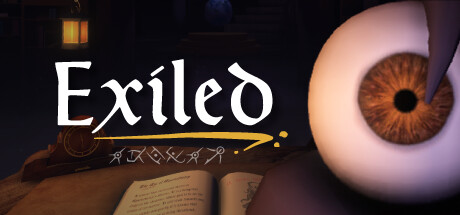
Exiled is a short but tightly crafted horror-puzzle game developed and published by John Szymanski, designed around the unnerving simplicity of being trapped in one room with a mystery that grows more dangerous the deeper you investigate. The story begins with a personal crisis rather than a grand spectacle: your partner, Charlotte, has disappeared after obsessing over an ancient book and leaving behind a cryptic warning about an otherworldly force. What follows is a slow descent into intellectual and supernatural horror as you sit at your desk surrounded by strange artifacts, deciphering an alien language that seems to pull something dark into your world. The setting is minimal, almost claustrophobic, but that very restriction is what makes the experience so tense. There are no sprawling environments or multiple locations to explore—just you, the cursed manuscript, and the growing awareness that every page you translate might draw you closer to something that should have remained sealed.
The gameplay unfolds through a combination of point-and-click interaction and linguistic puzzles, placing you in a single environment that demands your attention to every detail. You pore over fragments of text, translate strange symbols, and use logical deduction to progress through the story. The experience is methodical and cerebral, evoking the feel of studying forbidden knowledge at great personal risk. The puzzle design is both intuitive and atmospheric; each solved symbol feels like a small revelation, yet each revelation comes with the uneasy sense that you are inviting catastrophe. What makes this structure so effective is how it merges the intellectual satisfaction of solving puzzles with the creeping dread of cosmic horror. The player’s curiosity becomes the very source of danger—a reflection of the Lovecraftian idea that the pursuit of understanding is what dooms humanity. The confined perspective amplifies this tension: your entire world is the desk and its surroundings, but within that narrow space lies a story large enough to unsettle the imagination.
The pacing of Exiled is deliberate and precise. The game lasts less than an hour for most players, but within that short span it constructs a full arc of discovery, dread, and confrontation. The brevity serves its atmosphere well; there is no filler, no mechanical bloat, only the slow tightening of narrative and tension as the unseen entity draws nearer. The design thrives on the contrast between stillness and urgency—periods of quiet study punctuated by sudden glimpses of movement or ominous sound. The presence of “The Eye,” the unseen observer hinted at throughout, adds a constant sense of surveillance, making even the act of turning a page feel perilous. The way Szymanski balances puzzle-solving with environmental storytelling shows an understanding of restraint: the horror is never forced, never explicit, but always felt in the background hum of anticipation.
Visually, Exiled adopts a restrained aesthetic that serves its tone perfectly. The room is rendered with sparse detail—dust motes, flickering light, and old wood textures that seem soaked with the passage of time. The color palette leans toward muted browns and greys, emphasizing the decay of both the physical and mental space you inhabit. The interface is unobtrusive, blending naturally into the environment so that every action feels diegetic, as though you are genuinely working at the desk rather than interacting with a game menu. The sound design contributes just as effectively: the quiet hum of the room, the occasional creak of the floor, and the distant suggestion of movement beyond your sight all combine to create a feeling of oppressive solitude. It’s a subtle form of horror that relies on suggestion rather than shock, allowing your imagination to fill in the blanks with far worse images than the game ever shows directly.
While its brevity and simplicity work in its favor, Exiled does come with limitations. The short runtime means that the narrative and character development remain skeletal, leaving players more with impressions than with fully realized arcs. Some may find the puzzles too straightforward, especially those familiar with other decoding-style games. A few technical issues have also been noted, such as occasional soft-locks or unclear instructions for specific tasks, which can briefly pull you out of the immersion. Yet these shortcomings are outweighed by how successfully the game commits to its atmosphere and concept. The experience doesn’t rely on complex mechanics or flashy visuals—it builds its world through tension, silence, and a clever sense of progression that rewards curiosity while punishing it at the same time.
What truly stands out about Exiled is its ability to convey a complete story through minimalism. The relationship between the protagonist and Charlotte, though conveyed mostly through letters and brief moments of reflection, lends emotional weight to the unfolding mystery. Her disappearance feels personal, and your growing obsession mirrors hers as you begin to understand why she was drawn to the forbidden text in the first place. The ending, while brief, is powerful in its ambiguity, leaving you to question whether the knowledge you’ve uncovered has saved anyone or merely condemned you to the same fate. It’s an ending that lingers, much like the distant hum of the Eye still watching from beyond the veil.
Exiled is a compact but memorable experience—an example of how horror can thrive on confinement, restraint, and intellect rather than spectacle. It’s a game that understands the fear of knowledge, the dread of curiosity, and the claustrophobia of being trapped in your own pursuit of truth. Though short and modest in scope, it leaves a lasting impression through its eerie world-building, atmospheric tension, and clever integration of puzzle mechanics with narrative themes. For players who enjoy slow-burning psychological horror or who appreciate games that reward observation and deduction, Exiled offers a chilling and thought-provoking glimpse into the abyss. It’s a small story told with precision and care, proving that sometimes the scariest worlds are the ones confined to a single room and a single mind.
Rating: 8/10