This is my first serious review on a game. I need to say this.
I have played Exanima for a good while now, and I need to admit something: during my first two hours, I was furious. I nearly closed the game, gave up, and considered requesting a refund.
Then something clicked.
I realized that most of my failures were not caused by RNG, lag, broken physics, or unfair enemies. They were caused by me. I was swinging wildly, attacking from the wrong distance, turning the wrong direction, walking directly into attacks, or panic-retreating into walls and tripping over my own feet.
Once I could recognize my mistakes, I could correct them. That is when I started loving this game.
Exanima has one of the most genuinely skill-based combat systems I have ever experienced. Improving does not simply mean finding a weapon with better numbers or hoping the dice favor you. You actually learn how to fight.
You learn spacing, timing, positioning, weapon reach, swing direction, footwork, and when to attack or defend. Sometimes you have only a moment to decide whether you should parry, counterattack, thrust through the middle, or back away and reset the fight.
The game allows me to credit myself for improving.
Equipment and character skills certainly help, but they cannot replace player skill. I could cover myself in the best plate armor and carry the finest weapon in the game, but if I get knocked down, cornered, or repeatedly make bad decisions, I am still going to get destroyed.
I love that.
During my first hours, I seriously considered using cheats or mods to make the game easier. I am glad I did not. Better equipment might have helped me survive temporarily, but it would have taken away the satisfaction of genuinely learning the combat.
Enemies that repeatedly defeated me at the beginning are now opponents I can handle, and it is not only because my equipment improved. I became better at controlling my character and understanding the movement.
The skill ceiling is incredibly high. Someone who has played for several years fights completely differently from a new player. Veteran players move with far more precision, control their weapons better, and understand openings that I do not even notice yet.
Watching skilled players is genuinely entertaining because you are watching real ability rather than button-mashing or an overpowered build. I watched a player who had been playing for around a decade, and his videos helped me improve. I copied some of his techniques, although his fighting style is still far beyond what my brain can currently process.
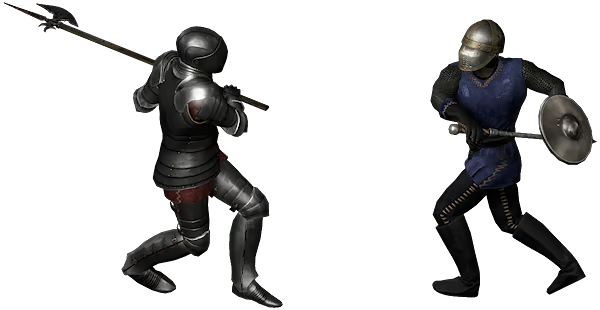
Different weapons also feel meaningfully different. I am much more comfortable with polearms and weapons that give me some reach. I struggle with short weapons, and I am still learning greatswords and large axes. Another player might be excellent at close-range fighting while struggling with the weapons I prefer.
That variety makes combat feel personal. You are not merely choosing a weapon class. You are gradually developing your own fighting style.
The physics are also astonishingly good. Before buying Exanima, I expected a physics-based 3D dungeon crawler to be a buggy, unstable mess. I expected characters to fall through floors, objects to explode across rooms, and the frame rate to collapse.
That has not been my experience.
The physics feel surprisingly consistent. When I trip, it is usually because I panicked, backed into an obstacle, crossed my own movement badly, or got pushed off balance. The game rarely feels as though it randomly decided to throw me onto the floor.
In hours of playing, I became properly stuck only once. Exiting and reopening the game fixed it immediately without costing me any progress.
The environmental interaction is also a lot of fun. I have moved chairs and other objects into defensive positions while waiting for enemies to approach. Sometimes the plan works. Sometimes the enemy refuses to cooperate and I discover that my brilliant furniture fortress was not as tactically sophisticated as I believed.
My companion has also saved my life several times, although he occasionally behaves like an enthusiastic disaster. During one difficult fight, he got trapped on top of some logs and spent most of the battle helplessly ragdolling around. Naturally, the moment I finally defeated the enemy by myself, he escaped and arrived to help.
The camera was confusing at first. I initially tried to position it like a traditional third-person RPG camera, but the overhead perspective makes more sense once you understand how to rotate, zoom, and use it to judge distance. It takes adjustment, but it works well with the combat.
There are multiple ways to play. Story Mode lets you explore the underworld, search for equipment, learn magic, discover lore, recruit a companion, and unlock additional starting archetypes. Arena Mode lets you create and manage fighters, compete in matches, earn money, buy equipment, and work your way through the ranks. There is also a practice mode, which I strongly recommend using while learning the controls.
The magic system is interesting, but it is optional. You can focus entirely on weapons, combine magic with melee combat, or experiment with different supernatural abilities. The game gives you room to develop your character without forcing one specific approach.
I will be honest about the weaknesses. Exanima is still unfinished, and Story Mode can sometimes feel like you are wandering through a dungeon without a clear objective. There is not currently a huge amount of direct storytelling or conversation, especially near the beginning.
The saving and healing systems can also be extremely punishing. Losing hours of progress because of one mistake is frustrating, and the scarcity of healing can make that worse.
But despite those problems, I keep wanting to play.
There have been times when I was exhausted and still wanted to continue, but I knew playing while tired would probably get my character killed. That says a lot about the combat. It requires enough concentration that I sometimes have to plan when I am mentally ready to play.
I originally hesitated to buy Exanima before its full release. I knew the price might increase later, though, and decided I would rather try it now than wait and potentially pay more for a game I might already enjoy.
I am extremely glad I bought it.
Exanima is not the enormous open-world game Bare Mettle originally set out to create. It is a smaller game built with the same technology and serves as a foundation for that larger project. Seeing how well the combat, physics, and movement already function has made me much more excited to see what they eventually accomplish with Sui Generis.
This will not be a game for everyone. The learning curve is steep, the controls are unusual, and the game expects patience. Your first hours may feel frustrating and awkward.
But when the combat finally begins to make sense, it is incredibly rewarding.
If you enjoy games with Kenshi’s you’re just a fleshy guy and atmospheric dungeon crawlers, realistic physics, difficult combat, or games where improvement comes from genuine player skill rather than RNG and button-spamming, I strongly recommend giving Exanima a serious try.
Do not judge it entirely by the first few fights. Use the practice mode, experiment with different weapons, and give yourself time to understand the movement.
I nearly gave up during my first two hours.
Now I cannot get enough of it.