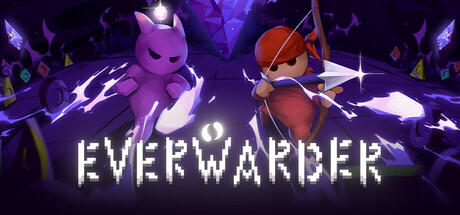
Everwarder is a refreshing take on the tower defense genre, blending roguelite mechanics with a time-based survival concept. Fight against the encroaching darkness and fend off emerging enemies. Collect artifacts, buy upgrades, discover ancient structures, unlock new units and more!
Modeled estimate, not a reported figure. How we estimate →
Media

About

In Everwarder there's you, and a procedurally-generated world covered in darkness. Touch it - and it will spawn a creature that will try to destroy your most precious thing – a crystal with your friend trapped inside.
Every run starts with your crystal and a supply of energy. Then it's up to you how to fight the darkness. Do you steadily expand, clearing the darkness, harvesting its energy, and carefully deploying defenders to deal with whatever emerges from the dark? Or do you play it fast and loose, striking out to locate ancient structures and powerful artifacts hidden within?
Failure is just another word for learning. With every run you gather minerals and unlock new options on the upgrade tree, allowing you to become stronger and last longer against the darkness. After all, time is not on your side: Enemies grow stronger as the seconds tick on - but so do you, gathering new resources, boosts, and upgrading your defenders to last just a bit longer.
Every run is randomly generated, with its own set of challenges and twists that will keep you on your toes. Every upgrade tweaks the experience, creating various synergies. So even if you struggle to keep up with the pressure, there’s always a way to turn the tides of the battle!
Genres
Stats
All-time low is the lowest price we've recorded for this game since we started tracking it.
Languages: English, Simplified Chinese, Ukrainian
Engagement
Hours played at review time, across 40 reviews with recorded playtime.
Reviews
Themes across 40 recent reviews and how positive each mention is. A keyword signal, not full sentiment analysis.
positive critical· bar length = how often the theme comes up
Reviews
Giving up on this because the controls are awful.
Everwarder, developed by qLate and published by indie.io and Paras Games, is a compelling hybrid that expertly weaves together elements of tower defense, roguelite, and survival genres to create a fresh and dynamic strategic experience. Set within procedurally generated environments, the game challenges players to defend a mystical crystal imprisoning a trapped spirit, but it does so with a twist: rather than simply waiting for waves of enemies, players actively control the pace of combat by exploring the world, uncovering hidden areas, and gathering resources. This approach breaks the conventional tower defense mold, encouraging a proactive and tactical playstyle that keeps each run unpredictable and engaging. The gameplay of Everwarder revolves heavily around resource management and adaptive strategy. As players venture deeper into the game’s neon-infused world, they must carefully place defenses while balancing exploration and combat. The procedural generation ensures that no two playthroughs are the same, with constantly shifting layouts, enemy types, and challenges demanding continuous adjustment of tactics. This unpredictability adds a layer of intensity and excitement, as players must remain vigilant and flexible, tailoring their approach based on the environment and resources available. The game rewards quick thinking and clever decision-making, making every moment feel meaningful. A significant strength of Everwarder lies in its roguelite progression system, which offers a gratifying sense of growth across multiple runs. Unlocking new units, artifacts, and upgrades enables players to customize their strategies and create powerful synergies that reflect their preferred style of play. Importantly, failure in Everwarder is not punitive; rather, it serves as an opportunity to gather experience and resources that carry over between attempts. This design choice encourages experimentation and learning, as players refine their tactics and build stronger defenses with each run. The balance between challenge and reward fosters a satisfying cycle of trial and improvement that is a hallmark of successful roguelites. Visually, Everwarder captivates with its striking blend of futuristic and mystical aesthetics, rendered through a neon-lit palette that gives the game a distinct and immersive atmosphere. The detailed environments and fluid animations not only enhance the gameplay but also help immerse players in the game’s unique world. Complementing the visuals is a well-crafted soundtrack that adapts to the intensity of the action—pulsing beats heighten the adrenaline during combat, while softer melodies create moments of calm during exploration. Together, these elements contribute to a cohesive and engaging sensory experience that enriches the game’s strategic core. While the overall reception of Everwarder has been highly positive, there are some areas that could benefit from further refinement. Some players have pointed out the absence of controller support, which can be a limiting factor for those who prefer playing with gamepads. Additionally, the inherent randomness of roguelite mechanics means that difficulty can sometimes feel uneven, with certain runs presenting spikes that may frustrate less experienced players. Nonetheless, these issues are relatively minor in the context of the game’s strengths and do not significantly detract from the enjoyment it offers. In summary, Everwarder stands as a well-crafted and innovative title that successfully blends tower defense and roguelite elements into a cohesive and thrilling experience. Its emphasis on active engagement with the game world, combined with deep strategic layers and rewarding progression, makes it appealing to fans of both genres. With its atmospheric visuals, dynamic soundtrack, and thoughtful design, Everwarder provides a challenging yet accessible adventure that encourages repeated playthroughs and continuous improvement. For players seeking a strategy game that offers both variety and depth, Everwarder is a standout choice worthy of exploration. Rating: 9/10
A creative take on Tower Defense. It's fairly casual, and highly polished. [b]Unique selling points[/b] [list] [*] Mining is a part of game-play loop (either by placing structures, or manually with your "character") [*] You control the flow of enemies, and the type of enemies that spawn (for the most part) [*] Everything except for the crystal that you need to protect can be moved. [*] Rare approach to in-run upgrades. Your units have colored points, and most upgrades scale off of those. Example 4% Damage for every red point. [/list] [b]Other selling points[/b] [list] [*] Don't need to grind to have chance of winning early runs. So far meta-progression is tightly balanced around the difficulty progression. [*] Relaxing due to colors, animations and music. Presentation in general is uncharacteristically good for the genre and price. [/list] The only issue I have with this game is my character is very easy to lose since it's just a white dot that blends in with environment.
tl;dr: Very stylish tower defense with a bunch of interesting ideas and some problems. If you are looking for a tower defense game in which everything from the towers and enemies to the levels and the very UI itself is heavily stylized in the same theme, this is the game for you. It offers a very laissez-faire gameplay where you can expand into whichever direction on each level and have to reach certain targets to unlock that level's boss. As time goes on and the more you exand, the harder it will get. The gameplay loop with upgrades, artifacts to unlock and change "colors" (hard to explain, but makes sense once you play) works really well and I'd very much recommend giving it a go. There are some issues, though: The heavy stylization comes at the cost of clarity and usability quite often. It's all a payoff, depends on you if you prefer usability or the style this brings. >>> Unlocks, artifacts, etc. are all presented in the game's "rotated rectangle" style and you have to hover over everything to get information. >>> The main menu isn't really a UI, but a small level that you move through and interact with stuff as you go there. >>> Enemies are abstract geometric shapes of different colors. But those colors do not seem to correspond with the game's colors for "damage types". That makes everything happening near towers quite impossible to follow precisely. If you plant your three damage types evenly, you'll most likely be fine. One big issue I found is that every level plays exactly the same, really. The three "sectors" differ a bit in how they look, but if there is a difference in gameplay between them, it is either miniscule or non-existent. The levels seem to be procedurally generated, but nothing within that generation has a real influence on what you do. The different damage types are an interesting idea, but as you are basically guaranteed to face all of them anyway, you'll need all of them anyway so the only real move to use all three towers you have somewhat evenly (except for the first ones you place, which should correspond to where you expand first). As such, despite the interesting unlocks and paths to escalate difficulty, I found myself having "seen all there is to see" very quickly.
A very good game ideal to kill some time. Maxing everything takes about 20 hours of playing, then you can challenge yourself with higher chaos levels. [spoiler] Missions can often be pretty luck-based with your spawn and artifacts. At higher chaos levels firerate becomes more important than your damage (somewhat). Even with oneshotting the enemies, if there's more of them you just have to shoot faster. Unfortunately with that upproach, since it's better to complete the level quicker, so you have to spawn more enemies at once, there's too many entities and projectiles present that the game loses a lot of frames. [/spoiler] I might have missed it during the tutorial, but I'm still not quite sure what exactly does that one ruin with 3 activators and circle in the middle. One thing I'd add is a better visualisation of when your core is being hit. I know that there's a sound and screenshake, but you (me) don't always play with sound. Sometimes you listen to music or just with your sound off for some reason or another. Screenshake can be missed when you're breaking cells yourself due to bouncing or just because the game lost frames due to high projectile count. Maybe a frame around your screen appearing with every core hit would help.
Дуже гарна гра, буду продовжувати грати, радий що автор українець!
一款玩着没趣味的游戏,没有任何上瘾打开的理由,不推荐
I cannot lie,i like this game very much,isnt like other tower defence i played and it gets grindy(for me its a good think).the point of the game begin around 3 diferent maps that u can play and farm for each diferent material,adn them upgrade your loadout and the gra[hic style is just beatiful.From other point of view for 5-10 euros you can get +50h of playing if you get into it,i would like more game of this same dev and ill hope he gets the attention he deserves.
Nice Tower Defense with a lot of cool Mechanics
enjoyable take on the game genre.
Related
Related
Trends
Modeled estimate over time, reconstructed from Steam's monthly review histogram.
Momentum
Pace estimated from the game's recent review growth (our daily snapshots) at its own sales-per-review ratio — a momentum signal, not booked sales.
Audience
Estimated from the language of this game's reviews — a proxy for where players are, not official Steam demographics.
Related
| Church Simulator | $14.3K | 105 | 82% | $3.99 |
| Shadowkin | $14.3K | 89 | 71% | $6.99 |
| Sacra Terra: Angelic Night | $14.3K | 299 | 91% | $2.99 |
| Catch Me! | $14.3K | 342 | 52% | $1.99 |
| Christmas Adventure: Candy Storm | $14.3K | 449 | 90% | $0.69 |
| Hand Simulator: Shooter | $14.3K | 149 | 47% | $2.99 |