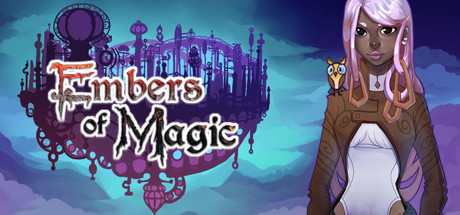
Embers of Magic is a short, adventure visual novel that tells the story of Liana the witch. She takes an airship down to the surface of the dangerous and corrupt earth beneath her flying city home.
Revenue comes from in-game items and microtransactions, which our price-based model doesn't estimate. Copies below reflect the player base, not paid sales.
Media

About

Genres
Stats
Languages: English**languages with full audio support
Engagement
Reviews
Themes across 40 recent reviews and how positive each mention is. A keyword signal, not full sentiment analysis.
Reviews
Коротенька безкоштовна візуалка з мальовкою такою яскравою і різнобарвною, наче це ілюстрована казка. Попри умовний фентезійний постапок і читається, як пригодницька казка для підлітків, що на диво її не псує. Непогане повне озвучення і вигадливий світ, в який приємно зануритися на півгодинки. Прикро, що так мало, бо в наступній грі (Brilliant Shadows) вже почалися спроби в серйозний сюжет і це її вбило. Але цю новелу раджу спробувати, вона чудова.
⠀
good game
Related
Related
Trends
Concurrent players on Steam, sampled daily since tracking started.
Hours played at review time, across 40 reviews with recorded playtime.
positive critical· bar length = how often the theme comes up
Да уж. Это бесплатно. Продолжайте и играйте, всего от получаса до часа. Я имею в виду, ничто не может выбросить вас из воды, и финал не совсем так, поскольку он настраивает гораздо больше, но это приятно. Он немного отполирован, а что нет. У него действительно есть ощущение: «Ну, у нас просто закончились деньги, но вместо того, чтобы выпустить его наполовину, возьмите его бесплатно».
Embers of Magic is not a game, it's not even a full e-book ("Visual novel" is another term that writers use when trying to disguise an e-book as a game) that's been launched on Steam as a game, despite not being one. This is an advertisement/misplaced DLC for another, full e-book called "Brilliant Shadows". As an advertisement for a visual/interactive novel, this doesn't feature any notable gameplay, it's just a lot of clicking through badly written dialogue that would never have been accepted or published in print, which presents the question, "How did something this badly written end up on Steam?". When someone hoping to become an author is unable to get published in print, they spend $100 and dump their high school fan-fiction onto Steam, under the guise of a game. It's a common mistake when unfamiliar with Steam to launch demos/advertisements as full games on Steam instead of tagging them correctly as demos. Here's the instructions for putting a demo up on Steam, to demonstrate that there is a correct process for this, which hasn't been followed here: https://partner.steamgames.com/doc/store/application/demos While it might seem like an inocuous mistake, publishing demos and advertisements as if they are full games is misleading and in some ways harmful. This advertisement is taking up marketing space and visibility that would be better made available to a developer that's done the right thing and created a full game. Instead, that visibility is given over to a demo/advert that's been published incorrectly and is polluting the marketplace. It's unclear if this mistake was made through incompetence or a deliberate intent to mislead gamers, but at the end of the day, I can only recommend full, correctly published games to gamers. It's possible this was intended as a free add-on rather than a separate advertisement, but even that would be no excuse because Steam has features that allow DLC's to be added to games (although, once more, this is not a game). Visual novels/e-books are tedious at best... imagine the best novel you ever read, be that Hitchhikers Guide to the Galaxy or 2001: A Space Odyssey or Twilight (if you have terrible taste in literature), but then translate that to a format where the words dribble out and you have to click your mouse every time you wanted to read the next sentence, instead of just turning the pages. You'd think it was garbage. Now imagine that experience, but with much worse writing (because if these guys could write professionally, they'd be published authors and this would be on shelves in bookstores, and they wouldn't have to pay Valve $100 to self-publish this on Steam), and you have your average Steam e-book. While this is free, it's just an advertisement/misplaced DLC, and badly written. If you're looking for high quality, well written e-books, Project Gutenberg has literally thousands, all much better than this.
Sihir Közü, cadı Liana'nın hikayesini anlatan kısa, macera dolu bir görsel romandır. Uçan şehirdeki evinin altındaki tehlikeli ve yozlaşmış dünyanın yüzeyine bir zeplinle iniyor.
Embers of Magic is a short, adventure visual novel that tells the story of Liana the witch. She takes an airship down to the surface of the dangerous and corrupt earth beneath her flying city home. It is set in the same world as Brilliant Shadows, but happens 300 years beforehand. which is another VN written by these same people I believe. short 45 min read, great story and setting too, I didn't have my headset on but from what i heard i believe there was music or voice acting.
This is a really short & sweet VN. Visually it's great, the imagery feels full of flavour and really helps draw you into this alternative world. The character designs are amazing; colourful, diverse, I kinda wanna cosplay half of them! It was also nice seeing a range of skin tones, and a disabled character without it being a plot point. Exploration into the world really drew me into it, it was engaging but not overwhelming with exposition or too much text. Each segment was small enough to make pausing for breaks easy (great if you have fatigue or kids, or anything that requires you to take pauses randomly etc) you don't really lose the immersion with how this is paced. Only thing I'd want changing is... I want MOAR.
Хорошая новелла
Embers of Magic is a fantasy visual novel developed and published by Ithaqua Labs that focuses on storytelling, atmosphere, and world-building over traditional gameplay systems. Built as a free narrative experience and designed as a prequel to a larger universe, the game delivers a short but engaging adventure that leans heavily into magical mystery and personal growth. Rather than attempting to create a sprawling fantasy epic filled with combat systems and exploration mechanics, it embraces a more focused approach, telling an intimate story that emphasizes emotional progression and discovery. The story centers on Liana, a young witch whose life changes dramatically when she leaves the safety of her homeland above the clouds and enters a world below that feels unfamiliar and dangerous. Earth is no longer the thriving place one might expect from fantasy stories. Instead, it has become corrupted and hostile, forcing Liana to navigate environments filled with uncertainty and hidden dangers. This setup creates immediate intrigue while establishing a sense of vulnerability around the protagonist. The contrast between sheltered innocence and harsh reality gives the narrative emotional weight from the beginning. As a kinetic visual novel, Embers of Magic removes branching decisions and player-driven narrative paths, choosing instead to guide players through a carefully structured story from start to finish. This design choice may disappoint players looking for extensive interaction or multiple endings, but it benefits pacing considerably. Without frequent interruptions for choices, the narrative maintains momentum and delivers a more focused experience. The game feels closer to reading an illustrated fantasy novel brought to life through visuals and voice performances than playing a traditional adventure title. One of the strongest aspects of the experience comes from its setting. The fantasy world feels larger than what players directly see, creating curiosity about its history and lore. Floating societies existing above a damaged world below immediately establish an interesting backdrop that feels distinct enough to leave a lasting impression. Since Embers of Magic exists within a broader fictional universe, longtime followers may appreciate additional context, but newcomers can still enjoy the story without prior knowledge. The game introduces its concepts clearly enough that players never feel excluded from understanding the larger picture. Liana serves as a compelling protagonist because her journey revolves around adaptation and personal growth rather than overwhelming heroism. She enters unfamiliar territory without complete understanding of the world around her, and watching her confront challenges becomes central to the emotional experience. Her struggles create relatable moments despite the fantasy setting. Rather than presenting an invincible magical figure, the story focuses on resilience and learning through hardship. Presentation elevates much of the material. Character artwork effectively communicates personality, while environmental visuals reinforce the fantasy atmosphere. The contrast between magical beauty and underlying danger remains consistent throughout the experience, helping establish mood even during quieter moments. The visual design may not pursue technical complexity, but it succeeds in building immersion and complementing the tone of the narrative. Voice acting also contributes significantly to the experience. Fully voiced dialogue helps characters feel more expressive and gives emotional scenes additional impact. Conversations gain greater personality through performance work, allowing important story moments to land more naturally. For a smaller-scale free visual novel, the production effort becomes particularly noticeable and helps distinguish Embers of Magic from similar narrative-focused releases. Its shorter runtime works both as an advantage and limitation. The story remains focused and avoids unnecessary filler, but some players may wish for more opportunities to explore the world and characters in greater depth. The lore hints toward something much larger beneath the surface, occasionally leaving players wanting additional time inside the setting. However, this restraint also keeps pacing consistent and prevents the experience from becoming repetitive. Players searching for deep gameplay systems, strategic mechanics, or large amounts of interactivity may find the experience too straightforward. Embers of Magic places nearly all its emphasis on narrative delivery. For visual novel fans and players who enjoy fantasy storytelling driven by atmosphere and character development, that focus becomes one of its greatest strengths rather than a weakness. Embers of Magic succeeds because it understands the kind of experience it wants to create. It tells a focused fantasy story supported by strong atmosphere, effective presentation, and an interesting setting without stretching beyond its scope. While brief, the adventure leaves enough unanswered questions and memorable moments to remain engaging after completion. Ithaqua Labs delivers a smaller narrative experience that demonstrates how thoughtful storytelling can often leave a stronger impression than sheer scale. Rating: 7/10
Momentum
Pace estimated from the game's recent review growth (our daily snapshots) at its own sales-per-review ratio — a momentum signal, not booked sales.
Audience
Estimated from the language of this game's reviews — a proxy for where players are, not official Steam demographics.
Related
| House Flipper | $65.8M | 110.8K | 94% | $24.99 |
| Survival Machine | $403.6K | 786 | 72% | $19.99 |
| Caravanners | $308.9K | 802 | 40% | $10.79 |
| Retail Company Simulator | $286.7K | 736 | 91% | $11.99 |
| Coffee Talk Tokyo | $264.3K | 458 | 91% | $14.99 |
| Blazing Beaks | $256K | 2.6K | 83% | $3.74 |