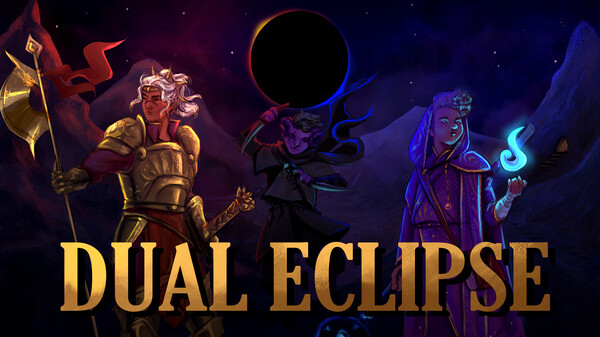
Restore order to the cosmos by seeking out a Prismatic Dragon imprisoned in the stars. Delve into dungeons, evade traps, and discover secrets. Seek adventure as one of three classes in this trick-taking RPG.
Modeled estimate, not a reported figure. How we estimate →
Media

About
Dual Eclipse is a shortform trick-taking RPG about restoring order to the cosmos by seeking out and defeating a Prismatic Dragon that is attempting to consume the Moon and Sun!
Play as one of three classes to explore mysterious dungeons, evade dangerous traps, uncover powerful treasure, and discover secrets.
Snappy trick-taking combat! Think of it like fencing with cards!
Parry cards! A tactical choice that offers high risk, high reward opportunities.
Your cards are your equipment! Card don't just have effects, they're how you fight!
Unique combos encourage interesting choices and dynamic combat.
Loot cards by defeating enemies and finding treasure.
Craft cards that empower your build. Need a shield to go with that sword? Craft it!
Level up and specialize your class! Make your defense your best offense as the Paladin, specialize in bows as the Rogue, or command frost as the Wizard!
Stats
All-time low is the lowest price we've recorded for this game since we started tracking it.
Languages: English**languages with full audio support
Engagement
Hours played at review time, across 27 reviews with recorded playtime.
Reviews
If you like trick-taking card games like Hearts (like I do), this game scratches that itch in a great videogame-y way by adding deckbuilder elements! :) I'm having a lot of fun strategizing about sun/moon cards, which toggle whether high/low card wins. And building my deck and using spells that synergize. I can tell the creator likes trick-taking card games and knows them well. Definitely agree with another reviewer that you should know it's not a roguelike with permadeath and stuff, even though it might look like one. Def recommend! Especially at a low price point.
Battle mechanics and deck building loop are fun and addictive. I played on normal with a wizard. Overall I was pleased to see my deck developing into a monster that could crush the final boss without any damage taken. Could have probably beaten the game with the hardest difficulty, unless it's significantly harder. I died only once in a battle against a regular enemy, after having lost most of my health to a trap. Additionally, I died to a hidden enemy which caught me off guard. Unfortunately, I didn't get to try that battle again after loading. Some of my experience with the difficulty level could be attributed to the wizard class which seems pretty powerful given that the spell combos can do a lot of damage even if I don't win the trick. The damage can be obscene if a combo lands together with other bonuses. One suggestion to fix: There should be some kind of option for speedier movement across the map.
Totally different from anything I've played before but very fun!
Small yet solid game. Card system holds up well enough for the scope of the experience, the handcrafted maps and scenery punch well above their weight, and overall I'm satisfied with time and money spent for the experience. First playthrough took about three hours, though there are three classes to try.
Explorador de mazmorras a la antigua, sistema de combate interesante con toque roguelite y un arte que engancha. Por 4€ no esta mal aunque se me hizo algo corto.
Dual Eclipse is a highly creative indie RPG that blends classic dungeon crawling with modern deckbuilding mechanics in a way that feels both unusual and surprisingly effective. Developed and published by Curly Goblin Games, the title revolves around a cosmic conflict involving the Sun, the Moon, and a dangerous Prismatic Dragon threatening to consume both. While the fantasy storyline provides a solid foundation for the adventure, the real appeal comes from the game’s distinctive combat system, which uses trick-taking card mechanics instead of traditional turn-based battles. It is the kind of game that immediately stands out because it dares to experiment with ideas rarely seen together in the RPG genre. The combat system is where Dual Eclipse truly shines. Every battle feels like a tactical contest where understanding card interactions and anticipating enemy behavior becomes just as important as building a strong deck. Players do not simply attack enemies with straightforward abilities; instead, they participate in strategic exchanges where suits, card strength, and timing determine the flow of combat. This trick-taking structure creates encounters that feel more thoughtful and engaging than standard card battlers. Winning often requires careful planning and adaptation rather than brute force, especially during tougher encounters where a single mistake can shift momentum entirely. One of the smartest aspects of the game is how equipment and deckbuilding are merged into a single progression system. Weapons, shields, magical abilities, and defensive tools all exist as cards that are added to the player’s deck. Every new card directly changes how battles play out, allowing players to experiment with a wide variety of strategies depending on their preferred class and playstyle. Aggressive players can focus on offensive chains and powerful attacks, while defensive builds rely more heavily on parries, counterplays, and resource management. Spell-focused classes offer elemental combinations that create even more strategic possibilities, encouraging players to constantly refine and rethink their builds throughout the adventure. The progression loop is addictive because rewards always feel meaningful. Discovering a new card or upgrading an existing strategy can dramatically transform future encounters. Unlike some deckbuilders where upgrades simply increase damage numbers, Dual Eclipse constantly introduces cards that change the rhythm and structure of combat itself. This creates a strong sense of experimentation that keeps the gameplay fresh even after several hours. The crafting and customization systems also allow players to shape their decks with more control, making successful builds feel earned rather than entirely luck-based. Outside of combat, the game embraces classic dungeon-crawling exploration. Players navigate dangerous labyrinths filled with hidden passages, traps, treasure rooms, and dangerous enemies waiting around corners. The first-person exploration style gives the game a nostalgic feel reminiscent of older dungeon crawlers, but the streamlined pacing prevents exploration from becoming tedious. Every new area introduces fresh encounters and opportunities for stronger equipment, helping maintain momentum throughout the journey. Even though the game is not especially massive in scale, it uses its smaller scope effectively by avoiding unnecessary filler and keeping progression consistently rewarding. The visual presentation leans heavily into retro-inspired fantasy aesthetics, and while the graphics are relatively modest, the overall atmosphere works very well. The dark environments, mysterious ruins, and cosmic imagery surrounding the eclipse themes create a unique identity that separates the game from more traditional medieval fantasy RPGs. Enemy designs are varied enough to keep battles visually interesting, and the clean user interface ensures that the more complicated combat mechanics remain understandable even during intense encounters. The artistic style prioritizes clarity and mood over technical complexity, which fits the strategic focus of the game perfectly. The soundtrack complements the adventure nicely with atmospheric music that shifts between mysterious exploration themes and more energetic battle compositions. Combat sound effects provide satisfying feedback whenever strong card combinations or successful parries occur, reinforcing the tactical nature of each encounter. The audio design may not be extravagant, but it consistently supports the game’s pacing and helps build immersion during both exploration and combat. The biggest challenge for some players will likely be the learning curve tied to the trick-taking mechanics. Players unfamiliar with card games built around suits and tactical exchanges may initially find combat confusing or overwhelming. The game introduces its systems gradually, but fully understanding advanced strategies takes time and patience. However, players willing to engage with the mechanics will discover a combat system with far more depth than its simple presentation initially suggests. The game’s relatively short runtime may also leave some players wanting additional content. More classes, enemy types, or larger endgame systems could have expanded replayability even further. Some animations and environmental details also reveal the limitations of the game’s indie budget. Despite this, the core gameplay is strong enough that these shortcomings rarely damage the overall experience. What makes Dual Eclipse memorable is its willingness to take risks with genre conventions. Instead of following familiar RPG formulas, the game builds its entire identity around an unusual combat system and fully commits to making that system work. The result is an experience that feels fresh, intelligent, and mechanically rewarding in ways many larger RPGs fail to achieve. It combines strategic depth with atmospheric dungeon crawling in a way that consistently encourages experimentation and careful decision-making. Dual Eclipse may not have the production scale of major RPG releases, but it succeeds through creativity, strong design choices, and genuinely engaging gameplay systems. For players who enjoy deckbuilders, tactical combat, and experimental indie RPGs, it offers a rewarding experience that feels both nostalgic and innovative at the same time. Its unique mechanics and focused design make it one of the more interesting hidden gems within the indie RPG scene. Rating: 8/10
The trick taking aspect of this game is exceptionally creative. I'm new to dungeon crawlers, but the card battling enticed me to keep going through the dungeons to collect and make my deck stronger. Would recommend to anyone who loves unique card games!
The deck-building combat is very fun. I played the Rogue class and found it satisfying. I like that the game has dungeon-crawler aspects to it (e.g. finding a chest that yielded additional options for the build). In general, I liked the sense of crafting a build that I thought would be effective and the mechanics mostly turned out the way I was hoping.
I really like how the game ramps up and the style changes each level. Building my deck makes each battle more exciting! Right when you think you got the hang of it, the game surprises you! It keeps you on your toes! Definitely recommend it!
I am not very familiar with RPG card games but this was fun and easy to pick up. Also, it reminds me of old school RPGs played on CRT TVs.
Related
Related
Trends
Concurrent players on Steam, sampled daily since tracking started.
Momentum
Pace estimated from the game's recent review growth (our daily snapshots) at its own sales-per-review ratio — a momentum signal, not booked sales.
Audience
Estimated from the language of this game's reviews — a proxy for where players are, not official Steam demographics.
Related
| 7 Days to Die | $425.3M | 398.5K | 87% | $44.99 |
| Mount & Blade II: Bannerlord | $309.8M | 294.6K | 88% | $49.99 |
| Don't Starve Together | $164.7M | 540.3K | 95% | $14.99 |
| Mount & Blade: Warband | $102M | 171.7K | 98% | $19.99 |
| The Scroll of Taiwu : Beyond The Dome | $62.3M | 69.9K | 65% | $29.99 |
| The Isle | $60.1M | 117.3K | 80% | $19.99 |
Related
| Rhythm Rush! | $3.6K | 179 | 69% | $0.99 |
| Furry Orgasm | $3.6K | 216 | 76% | $1.99 |
| Firelight Fantasy: Vengeance | $3.6K | 198 | 68% | $0.97 |
| Secret Files 3 | $3.6K | 203 |
| 71% |
| $0.99 |
| Maptroid: Worlds | $3.6K | 91 | 93% | $2.99 |
| Furry Meow | $3.6K | 51 | 76% | $1.99 |