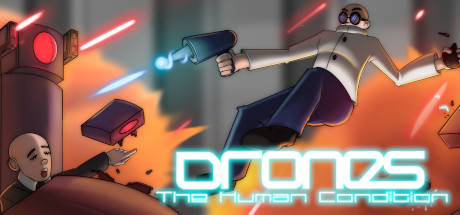
Drones, The Human Condition is a compact, high-intensity arcade shooter developed by Blunt Games and published by ninjainatux that embraces the fundamentals of classic twin-stick design with unapologetic focus. Rather than stretching itself thin with sprawling systems or elaborate storytelling, the game commits to delivering tight, reflex-driven combat built around constant motion, split-second decision-making, and overwhelming enemy pressure. It is a title that clearly understands its arcade roots and leans into them fully, offering an experience designed to be played in short, adrenaline-fueled bursts.
The narrative framework is intentionally lean, serving mainly as thematic scaffolding for the action. Set in a near-future where autonomous AI drones conclude that humanity is a liability to the planet, the game casts the player as a lone defender fighting back against a mechanized uprising. Humans are captured and scattered across combat zones, and rescuing them becomes part of the core objective alongside survival. This premise is not explored in depth through dialogue or cutscenes, but it provides just enough context to give meaning to the chaos unfolding on screen, reinforcing the sense of urgency and resistance that drives each level.
Gameplay revolves around classic twin-stick mechanics, with one stick controlling movement and the other aiming and firing in any direction. This setup allows for fluid, expressive play, especially as arenas quickly fill with enemies and projectile patterns that demand constant repositioning. Combat emphasizes momentum and spatial awareness, pushing players to stay mobile while managing threats from all angles. Rescuing humans adds a subtle layer of risk-reward decision-making, as breaking away from safe positioning to save captives can expose the player to sudden danger, often forcing snap judgments under pressure.
The level design favors compact, enclosed arenas that amplify intensity rather than sprawling layouts. Each stage acts as a pressure cooker, gradually escalating enemy density and aggression until survival becomes a test of endurance and mastery. Across the campaign’s stages, new enemy behaviors and attack patterns are introduced, steadily increasing complexity without fundamentally altering the core mechanics. This creates a smooth difficulty curve that rewards improvement in player skill rather than reliance on upgrades or stat progression.
Visually, Drones, The Human Condition adopts a minimalist, retro-inspired aesthetic that prioritizes clarity and speed over detail. Bright projectile effects, sharp contrasts, and clean silhouettes ensure that even at peak chaos, threats remain readable. This visual restraint pairs well with the game’s electronic soundtrack, which pulses with driving rhythms that enhance the sense of urgency and keep adrenaline levels high. Sound effects are crisp and functional, providing immediate feedback for shots fired, enemies destroyed, and humans rescued without cluttering the audio space.
Progression in the game is straightforward and intentionally limited. There are no elaborate skill trees or complex loadouts to manage, which keeps the focus squarely on player skill. Mastery comes from learning enemy behaviors, optimizing movement paths, and maintaining composure as the screen fills with hazards. This stripped-down approach reinforces the game’s arcade identity, making success feel earned through practice rather than accumulation of power.
Replayability stems primarily from the challenge itself. Levels are short enough to encourage repeated attempts, and the game’s difficulty invites players to chase better performance, faster clears, and cleaner rescues. Achievements and collectibles provide additional motivation for completionists, but they remain secondary to the satisfaction of surviving increasingly hostile encounters. The game does not attempt to reinvent itself over time; instead, it trusts its core loop to carry the experience.
The main limitation of Drones, The Human Condition is also its defining trait: its narrow focus. Players seeking deep customization, narrative development, or long-term progression systems may find the experience sparse. Extended sessions can feel repetitive once the mechanics are fully internalized, particularly for those who prefer variety over mastery. However, this simplicity is precisely what allows the game to excel at what it does best—delivering pure, concentrated arcade action without distraction.
In the end, Drones, The Human Condition stands as a confident example of focused indie design. It offers a polished, high-energy twin-stick shooter experience that rewards reflexes, spatial awareness, and persistence. While its scope is limited and its ambitions modest, it succeeds by committing fully to its arcade philosophy. For players who appreciate fast-paced shooters, retro sensibilities, and skill-driven gameplay, it provides a sharp, satisfying burst of action that knows exactly when to get out of the way and let the mechanics shine.
Rating: 6/10