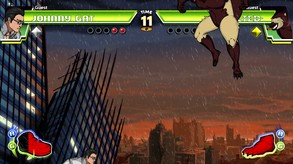
Divekick is the world’s first two-button fighting game. It distills the essence of the fighting game genre into just two buttons with no d-pad directional movement. Includes two extra playable characters: Fencer from Nidhogg and Johnny Gat from Saints Row!
Modeled estimate, not a reported figure. How we estimate →
About
Genres
Stats
All-time low is the lowest price we've recorded for this game since we started tracking it.
Languages: English**languages with full audio support
Engagement
Hours played at review time, across 42 reviews with recorded playtime.
Reviews
Themes across 42 recent reviews and how positive each mention is. A keyword signal, not full sentiment analysis.
positive critical· bar length = how often the theme comes up
Reviews
I play a lot of fighting games, and there are certainly a lot of them that I have a brief stint with and then never play again. Divekick isn't one of those, and I can't, for the life of me, figure out why. I do not know why, even 12 years later, I still get the urge to challenge someone to Divekick, and I do not know why it is almost always fun. It simply is. Embrace the foot, because it's coming for your head either way.
Странный внешний вид и нелепый игровой процесс. Про такие игры не делают репортажи, о них не говорят ни в одних группах или пабликах. Они просто есть где-то там на задворках. Видимо поэтому я получил эту игру в каком-то (очередном) Humble Bundle за какие-то жалкие деньги. В игре нужно использовать две кнопки - это дайв и кик.
It's certainly clever, but don't expect to get much time out of it; the novelty effect wears off very quickly.
ボタン2つとソレの同時押しでシンプルに楽しめるネタ格ゲ スト4のユンヤン事件を皮肉って作った作品とのことだけど、意外としっかりはしてる じゃぁなんで低評価なのかって? 2000回、ランクマッチプレイしろって実績あったからだよ!! 60時間近くかかった。
Divekick is one of the most memorable and unconventional fighting games of its era, not because it overwhelms players with deep mechanics or encyclopedic move lists, but because it strips the genre down to its barest, most essential elements. Developed and published by Iron Galaxy Studios, it transforms what is typically a complex system of combos, cancels, and directional inputs into something governed by only two buttons: one to jump (Dive), and one to attack (Kick). What may sound like a joke concept becomes, in practice, a remarkably sharp competitive experience that reveals how much tension, strategy, and mind-games can emerge from minimalism. Instead of trimming features for accessibility, Divekick uses reduction as a design philosophy, distilling the heart of fighting games into timing, spacing, and psychological prediction. Every match in Divekick is built around sudden-death momentum. A single successful kick wins a round, and even one misstep sends you crashing into defeat. Matches are played as best-of-nine, but rounds often end in seconds, creating a rhythm closer to rapid-fire duels than long-form battles. Because movement is limited—you cannot walk, only dive or kick—your airborne arcs and landing angles become your primary tools. This transforms the battlefield into a dance of geometry and anticipation: reading your opponent’s trajectory, controlling space with feints, and punishing poorly timed dives become the pillars of play. Rather than worrying about long combo execution or technical inputs, the challenge shifts toward outsmarting your rival in micro-decisions that carry immediate consequences. Character design adds surprising depth. While the control scheme is universal, each fighter has unique attributes: altered jump heights, unusual kick angles, special traits, and post-round ability boosts. Some characters glide farther before kicking, others drop like meteors, and a few have gimmicks that dramatically warp the flow of a match. These distinctions ensure that—despite the minimal input system—matchups remain strategically varied. Part of the game’s humor comes from its exaggerated roster, which is filled with parodies of well-known fighting-game tropes, community memes, and competitive personalities. This tongue-in-cheek presentation gives the game a playful energy, reinforcing that while Divekick is competitive at its core, it never takes itself too seriously. The presentation mirrors the simplicity of its mechanics. The art style is intentionally straightforward, with bold outlines and comedic expressions, and the interfaces are designed for clarity above all else. By eliminating visual noise, Divekick ensures you always understand how you lost or won a round—an element many traditional fighters struggle with. The minimalist visuals fade into the background during intense matches, allowing players to focus entirely on positioning and timing. This clarity is a major part of the game’s appeal: even players with no fighting-game experience can immediately see the cause-and-effect relationships that define each duel. Where Divekick shines brightest is in local multiplayer. Sitting next to a friend, trading lightning-fast victories and humiliating defeats, gives the game the feel of a couch-competitive classic. Matches can swing on tiny errors or brilliant predictions, and the quick resets keep both players emotionally invested. As a party game or a competitive warm-up among friends, it excels, and its stripped-down controls make it accessible to nearly anyone. However, this same simplicity limits its appeal as a long-term single-player experience. While there is a story mode, the narrative is light, repetitive, and mostly played for laughs. Without a robust online community or substantial solo content, the game’s longevity depends heavily on whether you have others to play with. As with any highly focused design, Divekick’s strengths can become limitations. Players who thrive on the complexity of traditional fighters may find the lack of combos, varied movesets, or nuanced mechanics too sparse. Once you internalize fundamental spacing and character quirks, the game’s depth plateaus, especially if you’re mostly playing offline. Some characters also feel more balanced than others, and a few gimmicks can tilt matchups in ways that feel unfair. Yet even with these shortcomings, the game’s tight design and commitment to its core idea remain admirable. Ultimately, Divekick is an experiment that succeeds far beyond its comedic origins. It proves that fighting games don’t need dozens of buttons or high execution demands to create intense, tactical showdowns. By focusing on timing, mind games, and spatial control, it captures the psychological heart of the genre in a way that is both refreshingly simple and deceptively deep. It won’t replace mainstream fighters with massive systems, nor is it meant to—but as a unique competitive experience, an accessible entry point for newcomers, and an endlessly entertaining local multiplayer title, Divekick stands proudly on its own. It is a reminder that sometimes, less truly is more. Rating: 8/10
Fun little concept for a fighting game. Jump kicks and mind games can lead to some surprisingly tense moments.
Divekick is the purest form of fighting games. Add to that some excellent humor, and you get a very easy title to recommend!
INGREDIENTS 3/4 lb. lasagna noodles 1 tsp. extra-virgin olive oil, plus more for drizzling 1 lb. ground beef 2 cloves garlic, minced 1 tsp. dried oregano Kosher salt Freshly ground black pepper 1 (32-0z.) jar marinara 16 oz. whole milk ricotta 1/2 c. freshly grated Parmesan, divided 1/4 c. chopped parsley, plus more for garnish 1 1/2 lb. sliced mozzarella DIRECTIONS Preheat oven to 375º. In a large pot of salted boiling water, cook pasta according to package directions until al dente, less 2 minutes. Drain and drizzle a bit of olive oil to prevent noodles from sticking together. Meanwhile, in a large pot over medium-high heat, heat oil. Cook ground beef until no longer pink, breaking up with a wooden spoon, then drain fat. Return beef to skillet and add garlic and oregano and stir for 1 minute. Season with salt and pepper, then add marinara and stir until warmed through. Combine ricotta, 1/4 cup Parmesan, and parsley in a large mixing bowl and season with salt and pepper. Set aside. In a large casserole dish, spread a thin layer of meat sauce, a single layer of lasagna noodles, a layer of ricotta mixture, and a single layer of mozzarella, then repeat layers. Top last layer of noodles with meat sauce, Parmesan, and mozzarella. Cover with foil and bake for 15 minutes, then increase temperature to 400º and bake uncovered for 18 to 20 minutes. Garnish with parsley and serve.
My friends and family love this game, even my very small family members can grasp the basic gameplay and take some rounds.
a meme game, a relic of the time. Good for a party - like once
Related
Related
Trends
Modeled estimate over time, reconstructed from Steam's monthly review histogram.
Audience
Estimated from the language of this game's reviews — a proxy for where players are, not official Steam demographics.
Related
| Backstage Pass | $230.8K | 216 | 88% | $29.99 |
| Pinball FX Classic VR | $231.3K | 407 | 84% | $14.99 |
| BREAK ARTS II | $231.4K | 731 | 74% | $14.99 |
| Pax Nova | $231.4K | 451 | 56% | $24.99 |
| Scarlet Tower | $231.4K | 2.4K | 81% | $4.99 |
| Real Boxing™ | $231.4K | 1.4K | 64% | $4.99 |