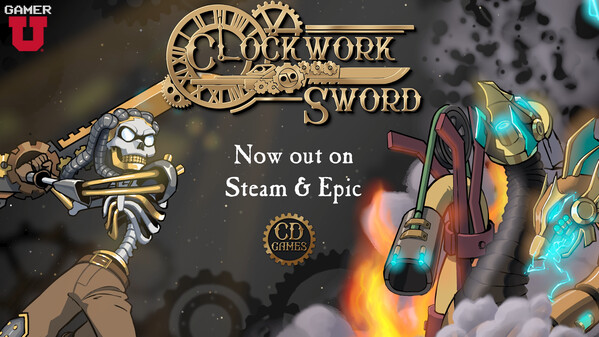
Clockwork Sword is an isometric hack-and-slash action game that distinguishes itself through an unusually flexible weapon-building system. Developed and published by Clockdrive Games, it takes place within a multi-level museum filled with corrupted mechanical enemies. The setting embraces a mixture of steampunk machinery, fantasy elements, and stylized action, but the real centerpiece is the protagonist’s customizable weapon. Rather than constantly discarding equipment for something with slightly better statistics, players are encouraged to modify how their weapon functions and create combinations suited to their preferred approach to combat.
The customization system revolves around Forms, Charges, and Gears. Forms have the most immediate influence because they determine the fundamental behavior of a weapon, including its attack pattern and effective range. This makes it possible to construct configurations suited to direct melee encounters or attacks from a safer distance. Charges add elemental characteristics that can change how attacks affect enemies, while Gears provide further enhancements that help refine a particular build. These systems complement one another well because customization is not limited to increasing damage numbers. Instead, modifications can meaningfully alter the way the player approaches encounters.
An important feature is the ability to configure two sides of the weapon separately. Each can have its own Form, Charges, and Gears, essentially allowing players to prepare two distinct combat styles and move between them during battle. A close-range setup can be used to tear through enemies that are easy to approach, while the second configuration might provide ranged capabilities against more troublesome targets. Players who prefer specialization can instead design both sides around complementary versions of the same general strategy. This system provides considerable freedom without forcing the player to carry a large inventory of completely unrelated weapons.
Switching configurations also has a direct relationship with the pressure mechanic. Successful attacks build pressure, and changing modes after filling the relevant gauge can activate a powerful special attack associated with the chosen Form. This prevents weapon switching from becoming a purely passive equipment feature. Players have an incentive to consider the timing of transformations, balancing the immediate advantage of changing attack styles against the possibility of waiting until a stronger special move becomes available. It gives combat a satisfying cycle of attacking, building momentum, transforming the weapon, and unleashing more powerful abilities.
The museum provides an appropriate environment for this style of game. Its different tiers create a straightforward sense of advancement as the protagonist fights through increasingly dangerous groups of corrupted automata. Mechanical enemies also fit naturally with the game's emphasis on gears, modular weapon components, and pressure-powered abilities. The isometric viewpoint helps players observe nearby threats and position themselves according to the range of their current weapon configuration. Visually, the stylized presentation favors readability and personality over realism, which suits the fast and experimental nature of the combat.
Defeated enemies provide scraps that contribute to the broader progression and customization loop. This creates a useful connection between fighting and equipment development: combat produces resources, resources improve or alter the weapon, and those modifications encourage players to return to combat with new strategies. The strongest appeal consequently comes from experimentation. Discovering an effective combination is satisfying, but trying an unconventional mixture of Forms, elemental Charges, and supporting Gears can be equally entertaining. Players who enjoy testing builds are likely to find substantially more longevity here than those who simply want to select one weapon and use it unchanged.
The focused structure does mean that Clockwork Sword should not be approached as an enormous action RPG. Its identity is primarily built around combat, weapon construction, mechanical opponents, and progression through the museum. Players expecting an expansive world or an abundance of unrelated activities may find the scope comparatively compact. However, concentrating on a smaller collection of interconnected systems benefits the game. The customization mechanics have a clear purpose, and nearly everything feeds back into the central pleasure of constructing a weapon and discovering how effectively it performs.
The game also provides achievement objectives for players interested in additional completion goals. Its free-to-play format makes the experience particularly approachable, since curious players can explore its core systems without the commitment normally associated with purchasing an unfamiliar indie action title. Despite that accessibility, the underlying weapon mechanics offer enough complexity to reward players willing to understand the relationships between Forms, Charges, Gears, pressure, and mode switching.
Steam Deck compatibility is less definitive. Clockwork Sword does not have an official Valve Steam Deck Verified or Playable rating indicated for the game, so it should be treated as officially unverified rather than guaranteed compatible. The Windows-focused release means that Steam Deck users may need Proton and could encounter issues that are absent on a conventional Windows PC. Its action-oriented structure and controller-friendly style appear naturally suited to handheld play, but without an official compatibility classification, Steam Deck performance, controls, interface readability, and overall stability should not be assumed to be fully validated.
Overall, Clockwork Sword is an inventive action game whose strongest accomplishment is turning a single weapon into an entire customization platform. The ability to combine melee or ranged Forms, elemental properties, specialized Gears, dual configurations, and pressure-based special attacks creates considerably more tactical variety than its straightforward hack-and-slash premise initially suggests. The relatively concentrated scope may not satisfy players looking for a massive adventure, but those interested in responsive isometric combat and creative build experimentation have plenty to explore. Its mechanical theme also works particularly well because the weapon customization, enemies, progression, and setting all reinforce the same identity rather than feeling like disconnected ideas.
Rating: 7/10