ClickCorp: The HR Tycoon by Rafe Fredericks and Normal Guy Games is a management roguelike that takes the familiar structure of corporate simulation and twists it into something more cynical and self-aware. Instead of building a thriving company through smart expansion and optimization, the game casts you as an HR manager trying to keep a failing startup afloat, often through questionable or ethically uncomfortable decisions. This framing immediately sets it apart, turning what could have been a straightforward tycoon experience into something that leans heavily on satire and commentary about workplace culture.
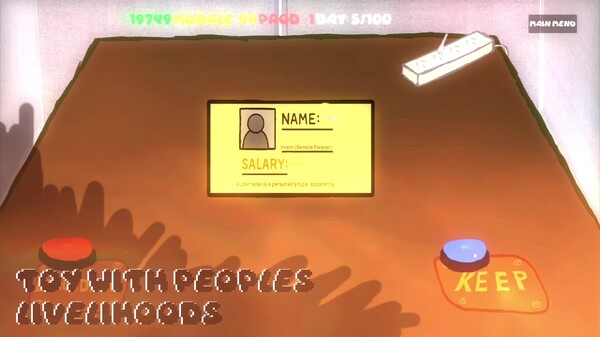
The core gameplay revolves around a loop of decision-making where each choice affects the company’s stability, finances, and employee morale. Rather than managing a physical space or constructing infrastructure, the focus is on people and policies. Hiring new employees, cutting costs, reorganizing teams, and responding to unexpected events form the backbone of the experience. These decisions are often presented in a card-like or event-driven format, which gives the game a structured rhythm while still allowing for unpredictability. Each run feels like a balancing act, with players trying to delay collapse while maintaining just enough control over the situation.
What makes the game stand out is how it frames these decisions. The player is rarely encouraged to act in a purely positive or idealistic way. Instead, many choices push toward maximizing profit or satisfying investors at the expense of employee well-being. This creates a consistent tension between doing what is efficient and what feels morally acceptable. The game does not explicitly judge the player, but it presents scenarios that highlight the consequences of those decisions, reinforcing its satirical tone. It is less about winning in a traditional sense and more about how far you are willing to go to keep the system running.
Mechanically, the systems are relatively easy to grasp. The game does not overwhelm the player with complexity, and most of the challenge comes from how different elements interact rather than from managing intricate systems. Financial resources, staff dynamics, and random events all influence each other, requiring players to think ahead while also reacting to immediate problems. The roguelike structure adds another layer, as each run introduces variations that prevent the experience from feeling entirely predictable. However, this reliance on randomness can sometimes make outcomes feel inconsistent, with certain runs being more forgiving than others.
Progression is tied to individual sessions rather than long-term development. Each attempt starts from a similar baseline, and success depends on how well the player navigates that specific run. This keeps the experience focused and avoids grinding, but it also limits the sense of ongoing growth. Without strong persistent upgrades or evolving systems, the motivation to continue playing comes primarily from improving decision-making rather than unlocking new content.
The pacing of the game is steady, with each run gradually increasing in pressure as more complex situations arise. Early stages allow players to establish a basic structure, but as time goes on, problems begin to stack, and the margin for error shrinks. This escalation creates tension, especially when multiple issues need to be addressed at once. However, because the core mechanics remain consistent, the experience can start to feel repetitive after several runs, particularly once players become familiar with the types of events and choices that appear.
Visually, the game adopts a simple and stylized approach that supports its theme without drawing too much attention to itself. The interface is clear and functional, making it easy to track information and make decisions quickly. The overall aesthetic leans into a slightly exaggerated depiction of corporate life, which fits the satirical tone, but it does not offer much variety or visual depth. It serves its purpose effectively, but it does not elevate the experience in a significant way.
Sound design is similarly understated. Basic audio cues accompany actions and events, but there is little variation in tone or intensity. The lack of a dynamic soundscape means that most of the game’s impact comes from its writing and decision-making rather than from audiovisual elements. While this keeps the focus on the core mechanics, it also makes the presentation feel somewhat flat over time.
Overall, ClickCorp: The HR Tycoon is a concept-driven game that succeeds in offering a different perspective on management gameplay. Its emphasis on ethical tension and corporate satire gives it a unique identity, and its accessible mechanics make it easy to engage with. At the same time, its limited depth, repetitive structure, and lack of long-term progression prevent it from fully reaching its potential. It feels like a strong idea that could be expanded further with more variety and refinement.
For players interested in management games with a thematic twist and a focus on decision-making, it provides a distinct and occasionally thought-provoking experience. For those looking for deeper systems or a more traditional sense of progression, it may feel somewhat limited. It stands as an interesting and creative take on the genre, even if it does not sustain its impact over extended play.
Rating: 6/10