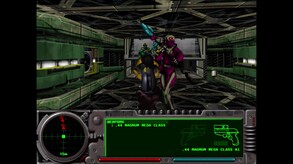
Classic Marathon Infinity, developed and published by Aleph One Developers, is the most daring and unconventional entry in the Marathon trilogy, arriving on modern platforms as both a preservation effort and a continuation of one of the most intellectually ambitious first-person shooter series ever created. Rather than simply concluding the story established in earlier entries, Infinity dismantles and reshapes it, presenting a fragmented narrative that feels less like a traditional sequel and more like a reinterpretation of everything that came before. Through the Aleph One engine, this version ensures the experience remains accessible today while preserving the strange, experimental identity that defines it.
From the outset, the game establishes a tone that is markedly different from its predecessors. While earlier Marathon titles balanced action with structured storytelling, Infinity leans heavily into abstraction and ambiguity. The narrative unfolds through terminals once again, but the information presented is often contradictory, nonlinear, and intentionally disorienting. Time loops, alternate realities, and cosmic forces become central themes, creating a story that resists easy understanding. Rather than guiding the player toward clear answers, the game invites interpretation, encouraging players to piece together fragments of meaning from scattered clues. This approach makes the experience deeply engaging for those willing to invest the effort, though it can feel impenetrable for anyone expecting a straightforward narrative.
Gameplay builds upon the foundation established in Marathon 2, maintaining its deliberate pacing and emphasis on tactical combat. Weapons feel consistent with the series’ identity, offering a satisfying sense of impact, while enemy encounters demand awareness and positioning rather than pure reflex. However, Infinity distinguishes itself most clearly through its level design. The environments are larger, more intricate, and often intentionally surreal, with layouts that challenge spatial logic and player expectations. Levels may shift abruptly in tone or structure, reinforcing the game’s themes of instability and uncertainty. This design can be both captivating and frustrating, as moments of discovery are often balanced by periods of confusion or disorientation.
One of the defining strengths of Classic Marathon Infinity is its embrace of player creativity. The original release introduced powerful editing tools that allowed players to create their own maps, scenarios, and modifications, effectively turning the game into a platform for experimentation. This legacy continues in the Aleph One version, which supports custom content and benefits from years of community contributions. As a result, the game extends beyond its campaign, offering a wealth of user-generated experiences that add significant replay value and variety.
The technical improvements provided by the Aleph One engine play a crucial role in making Infinity approachable for modern audiences. Enhanced resolution, smoother performance, customizable controls, and cross-platform compatibility all contribute to a more comfortable experience without compromising the original aesthetic. Multiplayer functionality is also present, allowing players to engage in cooperative or competitive modes that echo the early days of networked shooters, now adapted for online play.
Despite these enhancements, the game’s age remains visible. Visuals are firmly rooted in mid-1990s design, with sprite-based enemies and relatively simple environments that lack the detail expected of modern titles. Navigation can be difficult, particularly given the complex and sometimes illogical level layouts. The reliance on text-heavy storytelling, combined with the game’s abstract narrative structure, may also deter players who prefer more immediate or visually driven forms of storytelling.
What ultimately makes Classic Marathon Infinity stand out is its willingness to challenge both the player and the conventions of its genre. It is not content to simply deliver action; instead, it explores ideas about time, identity, and the nature of reality in a way that few shooters attempt even today. This ambition gives the game a unique identity, transforming it from a standard FPS into something closer to an interactive philosophical exercise.
Classic Marathon Infinity is not an easy game to appreciate, but for those willing to engage with its complexity, it offers a deeply rewarding and memorable experience. It stands as a bold conclusion to the trilogy, pushing boundaries in ways that remain impressive decades later. While it may not appeal to everyone, particularly those seeking clarity or accessibility, it remains an essential experience for players interested in the more experimental side of game design.
Rating: 8/10