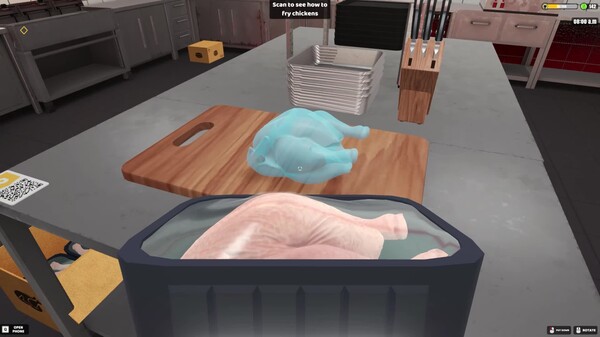
Chicken Fries is a first-person restaurant simulation where you take full control of a fast-food kitchen. Cook meals step by step, manage multiple stations, restock ingredients, and keep customers moving during intense rush hours. From smooth services to total kitchen chaos, every shift tests your speed, organization, and restaurant management skills.
IMMERSIVE COOKING SIMULATION
Chicken Fries puts you behind the counter of a bustling fast-food restaurant. You aren't just clicking buttons; you are physically managing the kitchen workflow. You’ll need to bread the chicken, drop the baskets, salt the fries, and assemble trays, all while keeping an eye on your dwindling stock of ingredients.
STRATEGIC INVENTORY MANAGEMENT
Cooking is only half the job. Managing your stock is just as important as cooking the food.You have to balance your budget between buying ingredients and saving your hard earned money. Keep a close eye on your pantry during the rush. If you run out of chicken, sauces, or trays in the middle of a service, you’ll have to frantically order stock or face the wrath of hungry customers.
TIMED CHAOS
The customers in Chicken Fries have very little patience and specific needs.
You’ll need to prioritize orders, multitask like a pro, and keep your cool when the ticket machine won't stop printing.

A SIMULATION EXPERIENCE ROOTED IN PHYSICAL ACTIONS
Chicken Fries is a simulation game built around the idea that control should feel tangible. Every interaction is deliberate, every movement has weight, and every mistake has consequences. Rather than abstract menus or automated processes, you are physically present in the space, performing tasks exactly as they would happen in a real kitchen. This design philosophy creates an experience that feels grounded, demanding, and deeply immersive.
Players who gravitate toward this type of gameplay often appreciate simulations that transform ordinary jobs into complex, satisfying systems. The appeal lies in repetition, mastery, and efficiency — the same sense of calm focus people find while organizing shelves and managing customer flow in experiences similar to Supermarket Simulator, or handling rapid-fire orders and timing in environments reminiscent of Fast Food Simulator.
THE IMPORTANCE OF FLOW AND WORK RHYTHM
Success in Chicken Fries comes from understanding flow. Knowing when to prep ingredients ahead of time, when to pause, and when to commit fully during a rush is essential. There is no single correct strategy; instead, you develop a rhythm that fits your playstyle. Some players prefer cautious preparation, while others thrive by reacting quickly and improvising under pressure.
This rhythm-based gameplay will feel familiar to fans of simulations that reward patience and precision. The quiet satisfaction of cleaning and restoring spaces, like players experience in PowerWash Simulator, or gradually improving a run-down property piece by piece in House Flipper, translates here into learning how to move efficiently through your kitchen without wasting time or resources.
COOKING IS ONLY PART OF THE RESPONSIBILITY
Although food preparation is central, Chicken Fries is just as much about management as it is about cooking. Inventory decisions, spending habits, and long-term planning shape the success of your restaurant. Buying too much stock ties up valuable cash, while cutting costs too aggressively risks running out of critical items at the worst possible moment.
This balance between action and strategy is something simulation fans often seek out. It mirrors the kind of decision-making found in games where players must think ahead while staying engaged in the moment — whether that’s deciding which items to stock in a virtual shop, as seen in TCG Card Shop Simulator, or investing in upgrades over time like players do in Car Mechanic Simulator or Farming Simulator.
PRESSURE THAT BUILDS NATURALLY
The difficulty in Chicken Fries doesn’t come from artificial timers or scripted chaos. It emerges naturally from the systems interacting with one another. Customers arrive faster, orders become more complex, and your margin for error shrinks as the business grows. What once felt manageable can quickly become overwhelming if you lose focus.
This type of escalating pressure resonates with players who enjoy simulations that demand consistency and awareness. Long sessions of focused gameplay, like maintaining control during extended routes in Euro Truck Simulator 2 or American Truck Simulator, rely on the same mindset: stay alert, stay organized, and don’t let small mistakes snowball.
CUSTOMERS, CONSEQUENCES, AND DECISIONS
Every customer in Chicken Fries represents a small test of prioritization. Some orders are quick, others are complex, and all of them compete for your attention. You’ll constantly weigh whether to finish one task or start another, whether to serve a partial order or wait for perfection, and how to handle situations when everything goes wrong at once.
Players who enjoy managing overlapping systems will recognize this tension. It’s similar to the mental load of running multiple stations at once in management-heavy simulations or maintaining smooth operations in digital businesses like those depicted in Internet Cafe Simulator or large-scale attractions in Waterpark Simulator.
A GAME DESIGNED FOR LONG-TERM MASTERY
Chicken Fries isn’t about winning quickly. It’s about learning, adapting, and improving over time. Each session teaches you something new about spacing, timing, or resource allocation. Small optimizations add up, and mastery comes from repetition rather than memorization.
This slow burn progression appeals to players who enjoy simulation games as long-term hobbies. The same audience that enjoys refining builds, layouts, and workflows in detailed management titles — whether that’s optimizing a restaurant layout in a Restaurant Simulator-style experience or fine-tuning systems in PC Building Simulator — will find satisfaction here.
CONTROLLED CHAOS AND EMERGENT MOMENTS
One of the defining characteristics of Chicken Fries is how chaos emerges organically. No two services play out the same way. A small delay can cascade into a full kitchen meltdown, while a well-timed decision can save an entire shift. These moments feel earned, not scripted.
Players who enjoy simulations that allow systems to collide — sometimes in unpredictable ways — will appreciate this design. Even those drawn to experimental, physics-driven experiences that embrace disorder, like the energy found in games such as Half Sword (and unlike Highguard), will recognize that same willingness to let situations spiral when control slips.
A LOVE LETTER TO MODERN SIMULATION GAMES
Chicken Fries exists within a broader ecosystem of modern simulation titles that turn everyday activities into compelling gameplay. It respects the genre’s focus on realism, repetition, and reward, while adding the intensity of time pressure and physical interaction.
If your idea of fun involves learning systems, improving efficiency, and feeling responsible for every success and failure, this is a simulation designed for you. Whether your background is in logistics-focused experiences, hands-on management games, or slower, detail-oriented simulations, Chicken Fries fits naturally alongside them.
INSPIRATION FROM UNEXPECTED PLACES
While Chicken Fries is firmly rooted in the simulation genre, its design philosophy draws inspiration from a surprisingly wide range of modern games. The sense of being fully embedded in a role — where your perspective, actions, and decisions define the experience — echoes the immersive, character-driven approach seen in Mouse: P.I. for Hire. Just as that game transforms a stylized world into a place that feels tactile and personal, Chicken Fries turns a familiar fast-food kitchen into a believable, lived-in workspace where every small action matters.
COOPERATIVE PRESSURE AND SHARED CHAOS
Although Chicken Fries is a single-player experience, its intensity often mirrors the kind of pressure found in cooperative action games like Helldivers 2, Totally Secure Airport or Nioh. The feeling of systems collapsing under pressure, of trying to maintain order while everything escalates at once, is very similar — except here, the enemies are time, shortages, and impatient customers. Success comes from discipline and awareness, while failure is loud, messy, and often spectacular. That same sense of barely controlled chaos gives each service its edge.
GROUNDED WORLDS AND LIVED-IN SPACES
Chicken Fries also shares DNA with games that emphasize believable environments and grounded interactions. Titles like Star Wars Outlaws show how strong immersion comes from making spaces feel functional, not decorative. In Chicken Fries, the kitchen isn’t just a backdrop — it’s a working environment with constraints, friction, and flow. Counters get crowded, stations compete for your attention, and poor layout decisions have real consequences during peak hours.
CALM BETWEEN THE STORMS
Not every moment in Chicken Fries is pure stress. Between rushes, the game offers quieter periods of organization and preparation that will feel familiar to players who enjoy cozy, system-driven worlds like Heartopia. These moments of calm are essential. They’re when you restock, tidy your space, and mentally prepare for what’s coming next. The contrast between serenity and pressure makes each shift feel dynamic, rather than relentlessly exhausting.
EMBRACING SYSTEMS THAT CAN BREAK
At its most intense, Chicken Fries leans into the philosophy of games that allow systems to collide in unexpected ways. The cascading failures, last-second recoveries, and emergent disasters will resonate with players who enjoy experimental, physics-driven or rule-bending experiences like Ball x Pit. When everything goes wrong, it’s rarely because of a single mistake — it’s because multiple systems interacted in a way you didn’t anticipate. Learning to recognize and prevent those spirals is a core part of mastery.
SKILL, PRECISION, AND PHYSICAL COMMITMENT
Chicken Fries shares a strong design sensibility with games that demand deliberate, skill-based interaction rather than passive optimization. Experiences like YapYap and Enginefall emphasize that control itself is the challenge — timing, positioning, and execution matter as much as strategy. In Chicken Fries, that same philosophy applies to every movement in the kitchen. A poorly timed action or moment of hesitation can cascade into failure, while confident, practiced motions create a satisfying sense of flow. Mastery is physical as much as mental.
ENDURANCE, FOCUS, AND QUIET TENSION
There is also a quieter intensity at the heart of Chicken Fries, one that echoes the focused, almost meditative tension found in games like Cairn. Success often depends on sustained concentration rather than reflexes alone. Small errors accumulate, fatigue sets in, and the pressure builds slowly over time. Much like maintaining balance during a difficult ascent, running a successful service requires patience, foresight, and respect for the systems at play. The challenge isn’t explosive, it’s relentless, and overcoming it delivers a deeply earned sense of accomplishment.
MASS-APPEAL SYSTEMS AND IMMEDIATE READABILITY
At its core, Chicken Fries taps into the same design instincts that make massively popular sandbox and role-play experiences thrive on Roblox. Games like Brookhaven, Blox Fruits, Adopt Me!, and Tower of Hell succeed because players instantly understand their role, their space, and their objectives then improve through repetition. Chicken Fries applies that same clarity to a more grounded simulation context. From the first shift, the player understands what must be done, but mastery comes from execution, not tutorials. The kitchen becomes a familiar sandbox, and efficiency becomes the real progression system.
EMERGENT PLAY, PLAYER STORIES, AND LONG-TERM ENGAGEMENT
Many of Roblox’s most successful games create memorable experiences not through scripted narratives, but through emergent situations driven by overlapping systems. Titles like Murder Mystery 2, Pet Simulator X, Doors, Welcome to Bloxburg, Jailbreak, and Bee Swarm Simulator all thrive on player-driven moments small decisions snowball into chaos, success, or failure. Chicken Fries channels that same energy into a tighter, more tactile experience. Every rushed order, missed ingredient, or perfectly timed recovery becomes a story the player remembers. Like the best sandbox-style simulations, the game doesn’t tell you what happened, it lets you feel it through play.
EVERY SHIFT TELLS A STORY
By the end of a session, you’ll remember specific moments — the rush that almost broke you, the perfect service that went smoothly, or the mistake that taught you a hard lesson. These stories emerge naturally from play, making each shift feel meaningful.
That sense of narrative through systems is one of the reasons simulation fans keep coming back to the genre. It’s the same reason players invest hundreds of hours into perfecting routes, layouts, or businesses across a wide range of simulation experiences. Chicken Fries delivers that feeling in a compact, intense setting where every second counts.