Carrier Command, developed by Realtime Games and MicroProse Software and published by MicroProse Software, is a strategic warfare experience that blends real-time tactics, vehicle command, and logistical management into a single, demanding package. Rooted in the legacy of the influential late-1980s original, this modern incarnation preserves the core idea of placing the player in full control of a massive mobile carrier while updating the concept for contemporary systems and expectations. Rather than focusing on isolated missions or scripted scenarios, the game presents a broad, open-ended campaign where success depends on foresight, resource control, and the ability to coordinate multiple combat systems simultaneously.
At the heart of the experience is the carrier itself, which functions as both your most valuable asset and your central hub of operations. From its command interface, you oversee the deployment of aircraft, amphibious tanks, and support vehicles, directing them toward objectives spread across an island-filled theater of war. Every action is tied to the carrier’s capabilities, from launching air strikes to ferrying ground units ashore. This creates a constant sense of responsibility, as losing vehicles or mismanaging supplies can severely limit your options later in the campaign. The game rarely allows reckless play, instead encouraging careful planning and deliberate execution.
The strategic layer revolves around conquering islands, each of which serves as a source of vital resources. Once captured, islands can produce fuel, ammunition, and replacement units, forming the backbone of your logistical network. Choosing which islands to attack, when to consolidate territory, and how far to push into enemy-controlled waters becomes a delicate balancing act. Expanding too aggressively risks stretching supply lines thin, while playing too defensively may allow the enemy to regroup and strengthen their position. This dynamic gives the campaign a strong sense of momentum, where every victory or loss echoes across subsequent engagements.
Combat itself unfolds in real time and can be experienced from multiple perspectives. Players can issue high-level commands from tactical maps or take a more hands-on role by directly controlling vehicles during engagements. This dual approach allows for flexibility in playstyle, catering to those who prefer strategic oversight as well as those who enjoy moment-to-moment action. Aerial units provide reconnaissance and precision strikes, while ground vehicles are essential for capturing and holding territory. Each unit type has distinct strengths and limitations, reinforcing the need for combined-arms tactics rather than reliance on a single dominant strategy.
Customization and progression further deepen the experience. Weapons systems, sensors, and equipment can be configured to suit different tactical approaches, allowing players to tailor their forces based on mission requirements or personal preference. These choices are not merely cosmetic; selecting the right loadout can determine whether an assault succeeds or collapses under enemy fire. As the campaign progresses, understanding how different systems interact becomes increasingly important, transforming Carrier Command into a game of mastery rather than improvisation.
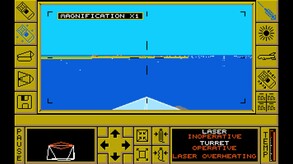
Visually, the game adopts a grounded military aesthetic that prioritizes clarity and functionality over spectacle. The interface is dense but purposeful, presenting a wealth of information that supports informed decision-making. While it may appear intimidating at first, this design reinforces the sense that the player is operating a complex war machine rather than a simplified arcade abstraction. Sound design complements this approach, with mechanical hums, weapon effects, and environmental audio contributing to an atmosphere of constant operational tension.
Carrier Command is not a game that reveals all its depth immediately. The learning curve can be steep, especially for players unfamiliar with logistics-heavy strategy titles. Understanding supply chains, unit roles, and the timing of assaults requires patience and experimentation. However, this complexity is also one of the game’s greatest strengths. Success feels earned, and overcoming difficult scenarios through careful planning delivers a strong sense of accomplishment rarely found in more streamlined strategy games.
Overall, Carrier Command stands as a thoughtful and demanding blend of strategy, simulation, and real-time combat. It respects its heritage while offering a modernized experience that challenges players to think like commanders rather than simple combatants. For those willing to invest the time to understand its systems, it provides a richly layered sandbox where strategic insight and tactical discipline are rewarded. While its deliberate pace and complexity may not appeal to everyone, fans of deep military strategy and simulation-driven gameplay will find Carrier Command to be a compelling and intellectually satisfying experience.
Rating: 6/10