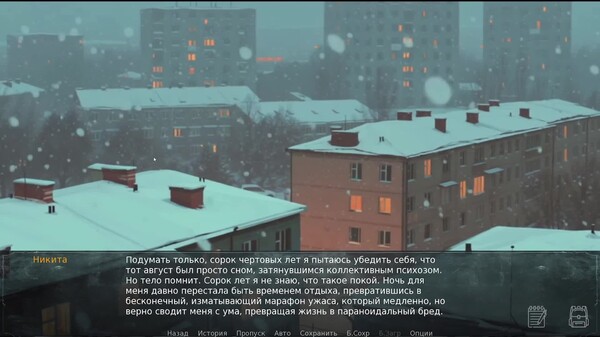
For Nikita, time stood still long ago. His life has become an endless, exhausting marathon of anxiety, where night brings no rest. Trying to find some peace and escape the haunting nightmares, he suddenly discovers that reality has cracked.
Modeled estimate, not a reported figure. How we estimate →
Media

About
Forty years of insomnia. Forty years of trying to forget that August. But memory is a trap you can't escape by simply closing your eyes.
For Nikita, time stood still long ago. His life has become an endless, exhausting marathon of anxiety, where night brings no rest. Trying to find some peace and escape the haunting nightmares, he suddenly discovers that reality has cracked. Instead of oblivion, he falls into the past.
It's August 1982. Hot, dusty, real. He's thirteen again, and he's shaking on an old bus carrying a group of late Pioneers to the Burevestnik camp.
Your shift begins strangely. The camp greets you not with a ceremonial assembly and songs around the campfire, but with an eerie silence and the creaking of empty swings. The counselors are gone, the director has left, and the only remaining master of the camp is the mysterious caretaker, Yegor Danilych—a man with a heavy gaze who seems to know more about you than you do.
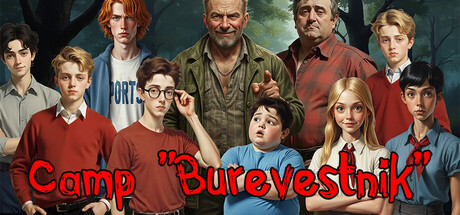
This shift is filled with outcasts: a local bully, a perpetually hungry greedy man, an arrogant beauty, inseparable twins with opposite personalities, and a quiet intellectual. But in the strange, distorted world of "Burevestnik," their childhood vices and fears begin to take on a terrifying physical form.
You will be immersed in a surreal story where familiar Soviet life intertwines with a nightmare. Why did the beauty turn into a soulless mannequin? Why was the greedy man punished with bestial form? And where do those who didn't manage to hide before lights out disappear to?
To break the time loop and return home, Nikita will have to play a dangerous game with the camp's owner. Solve Danilych's riddles, search for items that can restore your comrades' humanity, and try to understand what really happened that distant August.
Every mistake throws you back to the beginning of your shift. But remember: sometimes saving others is the only way to save yourself. Welcome to Burevestnik. Your final shift begins now.
Stats
All-time low is the lowest price we've recorded for this game since we started tracking it.
Languages: English, Russian, Simplified Chinese, Japanese
Engagement
Hours played at review time, across 22 reviews with recorded playtime.
Reviews
A surreal game where a seemingly ordinary summer camp session turns into a nightmare filled with mysteries. Our hero, Nikita, must figure out what brought him to this strange place and how to escape.
This game absolutely nailed its atmosphere. From the very first minutes, it pulls you into a strange mix of nostalgia and dread — that uneasy feeling when something feels familiar, but deeply wrong. The Soviet summer camp setting is used brilliantly, not just as decoration, but as a core part of the story and its psychological horror. The narrative is the real star here. It’s slow, unsettling, and emotional in a way that sticks with you long after you stop playing. The characters feel symbolic yet human, and watching their flaws literally turn into monsters is both disturbing and oddly tragic. The time-loop mechanic fits the story perfectly, making every mistake feel meaningful rather than frustrating. There’s no cheap jump-scare horror here — it’s all about mood, mystery, and creeping tension. If you enjoy story-driven games, psychological horror, and surreal worlds that blur memory and nightmare, this is absolutely worth your time. Quiet, eerie, and surprisingly powerful.
Стильный психологический хоррор, который мастерски играет на чувствах тех, кто помнит атмосферу старых летних лагерей. Разработчикам удалось создать по-настоящему неуютное пространство, где привычные бетонные корпуса и заброшенные аллеи превращаются в источник первобытного страха. Что выделяет игру: - Уникальный сеттинг: Эстетика советского лагеря передана очень точно - от архитектуры до мелких деталей интерьера. Это создает мощный эффект "знакомого, но неправильного" места. - Густая атмосфера: Игра делает ставку на саспенс и звуковой дизайн. Тишина здесь пугает сильнее, чем любой резкий звук. - Визуальный стиль: Качественная работа с освещением и фильтрами создает ощущение просмотра старой кинопленки или затертого воспоминания. Итог: Если Вы любите игры в духе "лиминальных пространств" или просто ищете качественный инди-хоррор с необычным колоритом, этот лагерь определенно стоит посетить. Только не забудьте фонарик. Оценка: Рекомендую!
прикольная ии новела. Хороший сюжет - видно что каждую генерацию корректировали. Сюжет тоже не плохой. Вобщем советую. Крууууууууто
Мило, только больше похоже на превью к полноценной игре. Хорошая демонстрация возможности и способностей сделать что-то интересное. Тема не раскрыта.
Camp "Burevestnik" is a compact, narrative-heavy indie title that leans into psychological storytelling, blending elements of visual novel structure with light puzzle interaction to create an experience that feels more introspective than traditionally game-driven. Developed by Reanim Games and published by STuNT, it frames its story around memory, anxiety, and the lingering weight of childhood, using a surreal version of a Soviet-era summer camp as both its setting and its central metaphor. The story follows a protagonist who finds himself drawn back into a distorted version of his past, where familiar places and figures take on unsettling new forms. What initially feels like a nostalgic return quickly shifts into something more ambiguous and uneasy, as the camp reveals itself to be abandoned, fragmented, and strangely disconnected from reality. The narrative unfolds in a nonlinear, often symbolic way, encouraging players to interpret events rather than simply follow a clearly defined plot. This approach gives the game a reflective tone, though it can also make the story feel obscure at times. Gameplay is intentionally minimal, with most of the experience centered around exploration, dialogue, and solving small puzzles that gate progression. These puzzles often take the form of riddles or decision-based challenges, requiring players to pay attention to details in the environment or narrative. While this adds a layer of interaction, the mechanics themselves remain simple and do not evolve significantly throughout the game. One notable aspect is how failure is handled—incorrect choices can send players back to earlier points, introducing a sense of consequence but also interrupting the flow. This system creates tension, but it can also lead to frustration, particularly when repetition becomes necessary. The atmosphere is where the game leaves its strongest impression. The empty camp setting is used effectively to evoke a sense of isolation and unease, with quiet spaces and subtle environmental cues reinforcing the feeling that something is wrong. Characters encountered along the way are less grounded individuals and more exaggerated representations of emotions or memories, contributing to the surreal tone. This blending of psychological themes with environmental storytelling gives the game a distinctive identity, even if not every element is fully developed. Visually, the game adopts a stylized approach that emphasizes mood over detail. The environments are simple but purposeful, using lighting and composition to convey a sense of decay and disconnection. While the presentation lacks polish in certain areas, it remains consistent with the game’s tone. The audio design plays an important supporting role, with ambient sounds and understated music helping to build tension and reinforce the emotional undercurrent of the experience. The writing reflects the game’s thematic ambitions, focusing on internal conflict and fragmented memory rather than straightforward storytelling. There are moments where this approach works well, creating a sense of intrigue and encouraging players to piece together meaning. At other times, the lack of clarity can make it difficult to fully engage with the narrative, as certain elements feel underexplored or loosely connected. In terms of length and structure, Camp "Burevestnik" is a brief experience that can be completed in a single sitting. It offers multiple endings, providing some incentive for replay, but the core journey remains largely the same across playthroughs. This reinforces its identity as a focused, one-time narrative experience rather than a game designed for extended engagement. Ultimately, Camp "Burevestnik" succeeds in creating a distinct atmosphere and exploring themes that are not often addressed directly in games. It prioritizes mood and interpretation over mechanical depth, resulting in an experience that is memorable for its tone rather than its gameplay. While its puzzle design and pacing issues prevent it from reaching its full potential, it remains an intriguing and thoughtful project for players who appreciate experimental storytelling. Rating: 7/10
забавная игра
В "игре" 6 загадок с 3 вариантами ответов на каждую. Итого 18 вариантов "прохождения" и выбор в конце. То есть, даже если вообще не пытаться читать текст загадок, а отвечать наобум, то на тупой перебор, приводящий к "правильному" результату уйдёт чуть больше 2 недель. Ну допустим, ГГ в первый раз выбрал "неправильный" вариант (не взял часы), и его снова вернули в лагерь. Да ещё и забыл при этом правильную комбинацию ответов, и перебор пришлось повторить. Даже в этом случае на достижение полного счастья нужно чуть больше месяца. Внимание, вопрос. Что ГГ делал 40 лет? ЗЫ. Да, вы не ослышались - "игра" про 6 загадок для дошколят. Никаких обещанных тайн, расследований и разоблачений. ЗЗЫ. Картинки и тексты - нейрослоп. Но картинки хотя бы нормальные, без явных косяков типа 6 пальцев.
«Буревестник» — атмосферная визуальная новелла с сильным сеттингом и хорошим нагнетанием тревоги. Советский лагерь и психологический хоррор реально цепляют, но от сюжета и вариативности можно ожидать большего — игра довольно линейная и не слишком длинная. В итоге это крепкий инди-проект на пару вечеров: кому зайдёт атмосфера и неспешный темп — тем понравится, но, конечно, не трипл-эй.
有中文 没成就 暴风鸟营地 四十年的辗转难眠,四十年的竭力忘却,只为那个八月。可记忆本就是无法靠闭眼逃离的牢笼。 于尼基塔而言,时间早已静止。他的人生成了一场无尽又疲惫的焦虑马拉松,黑夜从无安宁可言。他试图寻得一丝平静,摆脱纠缠不休的噩梦,却骤然发现现实已然碎裂。未曾迎来遗忘,反倒坠入了过往。 那是 1982 年的八月,燥热难耐,尘土飞扬,一切都真实得触手可及。他重回十三岁,正坐在一辆老旧巴士上瑟瑟发抖,车上载着一群迟到的少先队员,驶向暴风鸟营地。 这场营地值守,从一开始便透着诡异。迎接你的不是仪式般的集合,也没有篝火旁的欢歌,唯有令人心悸的死寂,以及空秋千晃动的吱呀声。辅导员不知所踪,营地主任早已离去,整座营地仅剩一位神秘的管理员 —— 叶戈尔・达尼利奇。他目光沉重,眼中似乎藏着比你自己更了解你的秘密。 同你一同值守的,皆是些被排挤的孩子:当地的小霸王、永远饥肠辘辘的贪心鬼、高傲的漂亮女孩、性格截然相反却形影不离的双胞胎,还有沉默寡言的小才子。可在暴风鸟营地这个扭曲的诡异世界里,他们童年的顽劣与恐惧,竟开始化作狰狞可怖的实体。 你将沉浸在一个超现实的故事之中,熟悉的苏联日常与梦魇交织缠绕。为何那个漂亮女孩变成了没有灵魂的人偶?为何贪心鬼被化作野兽模样受罚?而那些没能在熄灯前藏好的人,又都消失在了何处? 想要打破时间循环,重返现实,尼基塔必须与营地的掌控者展开一场凶险的博弈。解开达尼利奇的谜题,找寻能恢复同伴人性的物品,试着弄清遥远的那个八月,究竟发生了什么。 每一次失误,都会让你重新回到值守的起点。但请记住:有时,拯救他人,才是拯救自己的唯一途径。欢迎来到暴风鸟营地,你最后的值守,此刻开启。
Related
Related
Trends
Modeled estimate over time, reconstructed from Steam's monthly review histogram.
Audience
Estimated from the language of this game's reviews — a proxy for where players are, not official Steam demographics.
Related
| Glasses and Girls | $315.6 | 51 | 82% | $0.99 |
| Food and Girls | $315.6 | 51 | 86% | $0.99 |
| Bongo Quest | $315.6 | 51 | 45% | $0.49 |
| Dances and Girls | $322 | 52 | 83% | $0.99 |
| Carnival and Girls | $334.4 | 53 | 85% | $0.99 |
| Anime Sunset Ride | $334.4 | 54 | 67% | $0.49 |