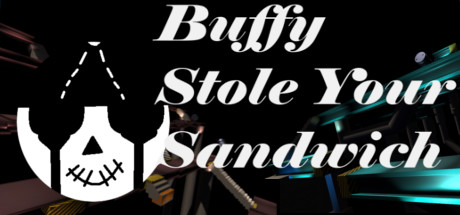
Buffy Stole your Sandwich is an arcade rage game with non-physics based barrels. If you die, you are sent all the way back to level one.
Modeled estimate, not a reported figure. How we estimate →
Media

About
Genres
Stats
All-time low is the lowest price we've recorded for this game since we started tracking it.
Languages: English**languages with full audio support
Reviews
Buffy Stole Your Sandwich is a 3D arcade platformer and utter unabashed ripoff of Donkey Kong (copyright Nintendo, 1981). While presented in 3D first person view, gameplay consists of the same process of climbing (stairs instead of ladders) while a giant (bug instead of ape) throws barrels at you. That's all there is to it. The game presentation is deplorably bad. From a technical perspective, the game doesn't meet basic minimum requirements that most PC gamers expect as standard. The game features lazy untextured low-polygon "retro" assets, making this look like a barely functional 3D game from the 1990s. It's unclear why the developers weren't able to arrange high quality, high polygon count contemporary assets for the game, and also irrelevant... what matters is that this looks bad as a result of their decisions, a compromise PC gamers shouldn't have to put up with. Bewilderingly, the game doesn't include proper audio controls, so you can't turn off the annoying background music, you'll need to alt+tab out and stop the music using the Windows sound mixer. This is obviously not okay and it's unclear why the developers chose not to include this basic feature. The controls can't be customised, which will be an annoyance for many, but it can also render the game unplayable for differently-abled gamers. These technical defects push this game below acceptable standards for any modern PC game. The poor quality of this game is reflected by how many people spent time with it. At the time of this review, SteamDB shows the game all-time peak player count was only ONE player. That's right, only one person ever played this at a time. When I played this for the purposes of reviewing it, I equalled the peak player count for the game. OUCH. The only player activity occurs once or twice a month, presumably someone loading it up to see what it is then quickly uninstalling it. Considering there's over 120 million gamers on Steam and well over 50,000 games for gamers to choose from (over 9,000 completely free titles), the overwhelming lack of interest in this low quality game is to be expected. Buffy Stole Your Sandwich is relatively cheap at $1 USD, but it's not worth it. Given the defects and quality issues with the game, coupled with the unrealistic price, this is impossible to recommend.
予想はつくと思いますが一人称視点のドン◯ーコ◯グです。 いや、ド◯キーコン◯ではありませんが◯ンキー◯ングみたいなもんですね。 ゲーム説明文にも書いてありますが、死ぬとステージ1からやり直しになるので慎重にプレイしましょう。 「死ぬ→イライラする→操作が雑になる→死ぬ→イライラする→」という負のスパイラルに突入します。 操作は意外とスムーズで動かしやすいです。ただしドラム缶の挙動が若干ガバガバ。 「死んだらステージ1からやり直し」って設定が無ければ割りと良ゲーになったのではないかと感じました。
This game has been a fun and challenging ride so far! The controls/motions could be smoother, like when getting up stairs, but that just comes with the territory of playing a new indie game. The music in the game is also really cool. I look forward to making it through all the levels. I just posted my first episode of gameplay if devs/gamers are interested in seeing it in action. https://www.youtube.com/watch?v=20sCvsw24nQ This is definitely worth $1 to play. But.... Keep your head on a swivel......cause those barrels are coming!!!!
Nice game m8
Buffy Stole Your Sandwich, developed and published by Xivek’s Toybox, is a deliberately punishing indie experience that embraces the “rage game” design philosophy with little compromise. Built around a bizarre and humorous premise—a puppet-like protagonist chasing down a stolen sandwich from an absurdly aggressive squirrel named Buffy—the game immediately signals that it values challenge and persistence over comfort or accessibility. It’s a title that doesn’t try to ease players in or gradually build complexity; instead, it throws them into a harsh, repetitive loop where progress is earned through trial, error, and sheer determination. The gameplay is built on a very simple foundation: navigate a short sequence of obstacle-filled stages while avoiding hazards and reaching the end. Movement is straightforward and easy to grasp, which makes the difficulty feel intentional rather than a result of complicated controls. The real challenge comes from the design of the obstacles, particularly the barrels that act as the primary threat. These hazards move in unpredictable ways, often forcing players to react quickly and commit to decisions without complete information. The lack of consistent physics adds to the tension, as players can’t always rely on pattern recognition alone to succeed. What truly defines the experience is its unforgiving structure. Failure at any point sends the player all the way back to the beginning, effectively resetting all progress. This single design choice transforms what would otherwise be a very short game into a test of endurance. Each run becomes a learning process, where players slowly internalize the layout and behavior of obstacles. The sense of progression doesn’t come from unlocking new abilities or reaching checkpoints, but from improving one’s own performance and reducing mistakes over time. For players who enjoy this kind of challenge, it can create a strong sense of accomplishment. For others, it can quickly become exhausting. The game’s level design is minimal but purposeful, with only a handful of stages that are meant to be replayed repeatedly until mastered. There is little variation in mechanics or objectives, and the experience remains consistent from start to finish. This simplicity is both a strength and a limitation. On one hand, it keeps the focus tight and ensures that the challenge is clear. On the other, it means there is very little to discover beyond the core loop, which can make the experience feel repetitive once the initial novelty wears off. Visually, Buffy Stole Your Sandwich adopts a rough, low-budget aesthetic that reflects its indie origins. The character models and environments are basic, with a cartoonish style that complements the game’s absurd tone. While the visuals lack polish and detail, they are functional and do not distract from the gameplay. The same can be said for the audio, which is minimal and serves primarily to support the action rather than enhance it in any meaningful way. The overall presentation feels intentionally simple, reinforcing the idea that the game’s primary focus is on its challenge rather than its production value. One of the most divisive aspects of the game is how little it offers beyond its central idea. There are no additional modes, meaningful progression systems, or incentives to return once the game has been completed. Its replayability is tied entirely to the player’s willingness to revisit the challenge and improve their performance. This makes it a very specific kind of experience—one that appeals strongly to a niche audience but may not hold the attention of players looking for variety or long-term engagement. Despite its limitations, the game succeeds in delivering a clear and focused experience. It knows exactly what it wants to be and does not attempt to dilute that vision. The combination of simple controls, punishing mechanics, and a humorous premise creates a unique identity, even if that identity is not universally appealing. For players who enjoy overcoming difficult, repetitive challenges and don’t mind starting over again and again, it can provide a satisfying sense of achievement. In the end, Buffy Stole Your Sandwich is less about content and more about mindset. It’s a game that demands patience, persistence, and a willingness to embrace failure as part of the process. While its lack of depth and variety may limit its broader appeal, it delivers a consistent and intense experience for those who are willing to engage with its design on its own terms. Rating: 6/10
Related
Related
Trends
Modeled estimate over time, reconstructed from Steam's monthly review histogram.
Momentum
Pace estimated from the game's recent review growth (our daily snapshots) at its own sales-per-review ratio — a momentum signal, not booked sales.
Related
| Food and Girls | $315.6 | 51 | 86% | $0.99 |
| Bongo Quest | $315.6 | 51 | 45% | $0.49 |
| Glasses and Girls | $315.6 | 51 | 82% | $0.99 |
| Dances and Girls | $322 | 52 | 83% | $0.99 |
| Carnival and Girls | $334.4 | 53 | 85% | $0.99 |
| Anime Sunset Ride | $334.4 | 54 | 67% | $0.49 |