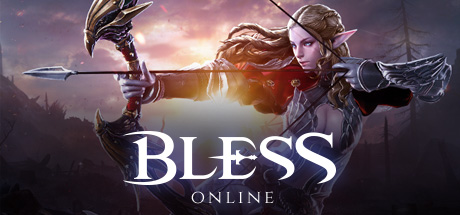
Live your own adventure in the breathtaking world of Bless Online! Fight for your faction in RvR battles and field PvP, explore treacherous dungeons with your friends, tame fantastic monsters, and become a legend.
Modeled estimate, not a reported figure. How we estimate →
Media

About


Genres
Stats
Languages: English*, German, Korean*languages with full audio support
Engagement
Reviews
Themes across 40 recent reviews and how positive each mention is. A keyword signal, not full sentiment analysis.
Reviews
I will leave the cat here, so that everybody who passes by can pet it and give it a thumbs up and awards /> フ | _ _ l /` ミ_xノ / | / ヽ ノ │ | | | / ̄| | | | | ( ̄ヽ__ヽ_)__) \二つ
Bless Online was once hailed as the next big thing in MMORPGs—a sprawling fantasy epic with AAA visuals, dynamic combat, and a world brimming with lore. Developed by Neowiz Games, the title generated significant buzz prior to its Western release, thanks to its impressive trailers and a promise to offer a modern, premium alternative to the aging MMO landscape. But despite its potential, Bless Online is a cautionary tale in how big dreams can falter under the weight of poor execution and mismanagement. Let’s start with the positives: Bless Online is visually striking. Its environments range from lush forests to towering citadels, all rendered in a high-fidelity Unreal Engine 3 aesthetic that—while now a bit dated—was impressive at launch. The art direction leans heavily into high fantasy, with towering armor sets, imposing monsters, and elaborately designed cities that feel truly massive. The world itself, Lumios, is clearly built with lore in mind. There’s a sense of scale and ambition in the layout of its factions, kingdoms, and conflicts. You can tell that the developers tried to build a living, breathing universe. Bless offers a decent selection of races and classes, from traditional archetypes like mages and warriors to more exotic additions like the mystical Mascu race. The customization options are surprisingly robust, with sliders for nearly every facial and body feature, allowing for a deeply personalized character. Unfortunately, class balance has always been a sore spot. Some classes were drastically over- or under-powered, leading to frustration in both PvE and PvP contexts. Frequent rebalancing sometimes made things worse instead of better. Combat was marketed as “action-oriented,” but in practice, it landed somewhere between traditional tab-targeting and sluggish combo systems. Animations often felt stiff, input delays were common, and the rhythm of combat lacked the fluidity that defines modern action MMORPGs like Black Desert Online or Final Fantasy XIV. Dungeons and raids, while visually interesting, suffered from lackluster mechanics. AI behavior was predictable, and group coordination was rarely necessary beyond basic tank-healer-DPS setups. PvP, both open-world and structured, was meant to be a core feature. Unfortunately, lag, balance issues, and lack of meaningful rewards made it feel more like a chore than a thrilling challenge. One of Bless Online's most controversial aspects was its progression system. Grinding was severe, and character advancement often felt artificially slowed down to encourage monetization. Although Neowiz attempted to clarify that the game wasn’t pay-to-win, many systems (gear upgrades, convenience items, cash-shop bonuses) painted a different picture. This was exacerbated during the Steam Early Access period, where players who paid for Founder’s Packs quickly felt shortchanged by rapid changes to the game’s monetization and progression models. From the start, Bless Online was plagued with technical issues: server instability, crashing clients, memory leaks, and optimization problems across all hardware tiers. Despite patches and a steady stream of developer updates, the core infrastructure seemed fundamentally flawed. The community, initially hopeful and passionate, became disillusioned over time. Promised features were delayed or quietly removed. Communication from the developers, while frequent, often felt reactive rather than proactive. The player base rapidly declined within months of launch, and eventually, the game was sunset in 2019. Bless Online was a game with enormous potential—ambitious world-building, beautiful visuals, and a rich fantasy setting. But its lifeless combat, grind-heavy systems, technical instability, and inconsistent development roadmap doomed it from the start. It stands now as a poignant example of how even the most beautiful MMOs can fall apart without solid execution and player-focused design. It wasn’t unplayable, but it never lived up to its promise. A blessing in name, but a burden in practice. Rating: 5/10
Related
Related
Trends
Modeled estimate over time.
Hours played at review time, across 40 reviews with recorded playtime.
positive critical· bar length = how often the theme comes up
Bless Online Посредственная корейская ММОшка была, прожила всего-то несколько лет, сервера сдохли давно, что в Стиме, что в ру регионе, что везде. Как итог: такие дела братцы и сестрицы.
Still mad.
0/10. Can't even refund my 35$
Should've stuck with one game and polish it, as all the other games in the 'franchise' are just the same ♥♥♥♥.
Uma dica pra quem faz cocô em shopping: Qualquer shopping que tenha 3 andares, o melhor banheiro é o do segundo andar. Por que o primeiro andar, sempre chega quem está desesperado, mija fora do vaso e etc… No terceiro, geralmente está a praça de alimentação, aonde o uso é frequente. Já no segundo andar, é onde está aquelas lojas que você não consegue pagar os valores dos produtos. Ninguém vai nas lojas caras e pensa: ♥♥♥♥♥ preciso CAGAR agora!” Portanto, o segundo andar é o canal. Outra coisa, ou melhor… dica extra: Se o shopping não tiver 3 andares e tiver banheiros perto das lojas caras, o efeito é o mesmo.
Gra nie istnieje, po zainstalowaniu okazuje się, ze serwery są wyłaczone. po co to nadal jest na steam??
ММО РПГ что тут сказать.Средняя графика боёвка на уровне!
Still mad I couldn't refund my money, damn snakes!
Momentum
Pace estimated from the game's recent review growth (our daily snapshots) at its own sales-per-review ratio — a momentum signal, not booked sales.
Audience
Estimated from the language of this game's reviews — a proxy for where players are, not official Steam demographics.