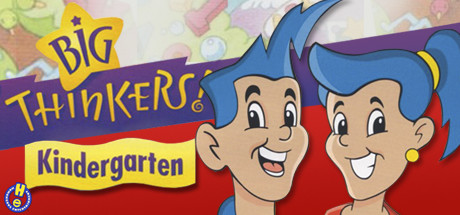
Big Thinkers! Kindergarten is the perfect learning supplement to your child's classroom experience. Ben and Becky Brightly's contagious wonder and ability to transform themselves into a variety of shapes and forms engage kids in a fun world of learning and discovery!
Modeled estimate, not a reported figure. How we estimate →
Media

About
Genres
Stats
All-time low is the lowest price we've recorded for this game since we started tracking it.
Languages: English**languages with full audio support
Engagement
Hours played at review time, across 40 reviews with recorded playtime.
Reviews
Themes across 40 recent reviews and how positive each mention is. A keyword signal, not full sentiment analysis.
positive critical· bar length = how often the theme comes up
Reviews
get this for yo kindergardener no brain rot today my kid loves this game
|Drunk SeriesSeries Review| Big Thinkers Kindergarten was fun bunch of mini-games teaches colors, letters, music, telling time.. some of this was advanced back when I was in Kindergarten. Of course, they bribe you to continue playing through Star rewards, and you need a bunch of them in different colors play the final mini-game and get your certificate of being as smart as a kindergartner. The Brightlys gives off Thing1 & Thing2 vibs. The Hide & Seek Game was kind of bullpoop, some of the hints are not helpful, and the locations need to be more defined, having a cave and a canyon right next to and connecting is very misleading. Drunk me had a time. Drunk Video Posts 9/7/24 https://youtu.be/T9SeZtU4O7w
A, B, C, D, E, F, G H, I, J, K, L, M, N, O, P Q, R, S, T, U, V W, X, Y, and Z Now I know my ABC Next time won't you sing with me? A, B, C, D, E, F, G H, I, J, K, L, M, N, O, P Q, R, S, T, U, V W, X, Y, and Z Now I know my ABC Next time won't you sing with me? A, B, C, D, E, F, G H, I, J, K, L, M, N, O, P Q, R, S, T, U, V W, X, Y, and Z Now I know my ABC Next time won't you sing with me? Now we know the ABC We can read from A to Z
fun game for small children. 3/10 as i´m not one but 7/10 if you are
Okay so let's be real here. It's a pretty great kids game! It's nicely animated too! Though it's also weirdly scary in a way that makes it super entertaining to show to adults. The way the siblings transform and follow you everywhere gets a little horrifying when you think about it too much. There's a lot of ironic fun potential here.
Big Thinkers Kindergarten, developed by Humongous Entertainment and re-released by Nightdive Studios, stands as a nostalgic relic from the golden age of 1990s edutainment software. It features the enthusiastic duo Ben and Becky Brightly, sibling mascots who guide young learners through a series of interactive activities designed to teach essential kindergarten-level skills. Like many of Humongous Entertainment’s titles, the game emphasizes engagement and discovery through humor, animation, and accessible gameplay. However, unlike the studio’s more narrative-driven series such as Pajama Sam or Freddi Fish, Big Thinkers takes a more instructional approach, packaging its lessons into discrete educational minigames rather than unfolding them through story or adventure. At its core, Big Thinkers Kindergarten is a collection of sixteen learning activities, each focusing on a specific early childhood skill. Players explore the Brightly home, where different rooms contain lessons on literacy, math, science, spatial reasoning, and problem-solving. In the kitchen, children might learn measurement or counting; in the study, they may explore letters and vocabulary. The game introduces early math through pattern recognition, sequencing, and simple addition, while reading and phonics activities reinforce sound association and word recognition. What makes these minigames effective is their simplicity and colorful presentation—each one feels like a self-contained puzzle or toy, with clear feedback and encouragement from the main characters. The use of “SmartStars” as a reward system helps maintain a sense of progression and achievement, allowing children to track their growth in a way that feels playful rather than evaluative. The educational design of Big Thinkers Kindergarten reflects Humongous Entertainment’s philosophy of “learning through play.” The activities are built to be intuitive, requiring minimal instruction, and rely on interaction rather than passive observation. The animations are lively and full of personality, and Ben and Becky serve as constant companions, offering praise, hints, and commentary that encourage experimentation. The inclusion of subjects beyond reading and math—such as geography, environmental awareness, and spatial relationships—gives the game a broad educational scope. This variety keeps the experience dynamic, as players can freely choose which skills to practice in any order. The open-ended structure makes it ideal for short, repeatable sessions that fit the attention span of its target audience. However, the game’s age shows in both its presentation and interface design. Originally released in the late 1990s, Big Thinkers Kindergarten retains the look and feel of that era’s CD-ROM educational software. While Nightdive Studios’ Steam version runs smoothly through ScummVM and preserves the charm of the original artwork, the low-resolution visuals and dated sound design may seem crude by modern standards. The interface can be cluttered, with multiple clickable objects and text labels that may be confusing for children who are not yet confident readers. Navigation between rooms is sometimes unintuitive, and the lack of prominent visual cues can leave players unsure of where to go next. These design quirks make adult guidance almost necessary for younger children, reducing its potential as an independent learning tool. The voice acting and audio design, while characteristic of Humongous Entertainment’s high-energy style, can also be hit or miss. Ben’s exaggerated enthusiasm and Becky’s cheerful commentary were intended to engage children, but the constant repetition of voice lines can become grating over time. Sound effects and background music are cheerful but repetitive, looping in ways that may test a parent’s patience after extended play. Still, the overall tone remains friendly and encouraging, fostering a positive emotional environment that helps mitigate the occasional frustration caused by interface limitations. In terms of content longevity, Big Thinkers Kindergarten offers enough variety to keep a young learner entertained for several sessions, but it lacks adaptive difficulty or dynamic feedback systems found in modern educational software. Once a child masters the activities, there is little reason to return beyond the novelty of replaying favorite minigames. The educational depth, while age-appropriate, is fairly shallow—each task teaches a single concept in isolation rather than reinforcing skills through cumulative progression. This makes the game most effective as a supplementary tool rather than a standalone learning program. Yet despite its limitations, Big Thinkers Kindergarten retains a certain charm that transcends its dated design. The personality of its hosts, the lively animation, and the whimsical presentation make it far more engaging than the dry, worksheet-style learning tools that dominated much of 1990s educational media. It captures the spirit of curiosity and play that defines early childhood learning, rewarding exploration and experimentation rather than rote memorization. For parents and educators, it remains a gentle, low-pressure way to introduce academic concepts within a colorful, entertaining framework. Viewed through a modern lens, Big Thinkers Kindergarten is a snapshot of a particular era in educational gaming—one where creativity, character, and imagination were considered as important as pedagogy. It lacks the sophistication and adaptive intelligence of today’s digital learning apps, but it compensates with warmth, humor, and personality. Its value now lies less in its teaching effectiveness and more in its nostalgic appeal and historical significance. For those who grew up with Humongous Entertainment’s catalog, revisiting Big Thinkers Kindergarten is like opening a time capsule of childhood wonder—proof that learning and laughter once shared the same floppy disk. Rating: 7/10
Super smart stars and now I can count them
I used to play a demo as a kid and it feels great to play it as a whole today. With today's issues schools have with kids using tablets, leading to lack of attention and education. I wish the series kept going, I would encourage this for parents so that kids can be educated.
I remember as a kid, I had a demo disc of this game, only a few minigames were playable but I remember playing the hide and seek and maze games a lot. There's no real reason to play it now that I'm an adult aside from nostalgia but if I ever have kids I can see myself showing them this.
I thought this game would be easy, because you know, but it's honestly a complex puzzle that blew my mind. I spent countless hours analyzing each area and picture and after just a few hours, I gave up because it was too hard. I appreciate developers that aren't afraid to push the boundaries of difficulty in point-to-click games such as this. I would buy this 10x if I could. Thank you.
Related
Related
Trends
Concurrent players on Steam, sampled daily since tracking started.
Audience
Estimated from the language of this game's reviews — a proxy for where players are, not official Steam demographics.
Related
| Let's Explore the Airport (Junior Field Trips) | $11.2K | 90 | 92% | $6.99 |
| Train and Tame | $11.2K | 206 | 67% | $1.59 |
| Amazing Adventures Around the World | $11.2K | 126 | 83% | $4.99 |
| Default Dan | $11.2K | 74 | 88% | $5.99 |
| Mad Nords: Probably an Epic Quest | $11.2K | 74 | 92% | $5.99 |
| Bonelords | $11.2K | 107 | 93% | $4.19 |