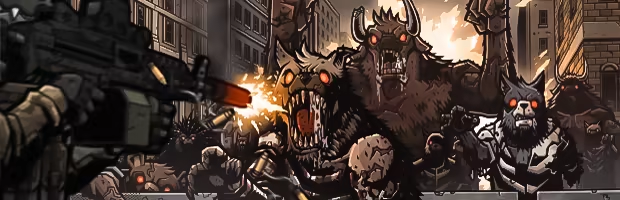
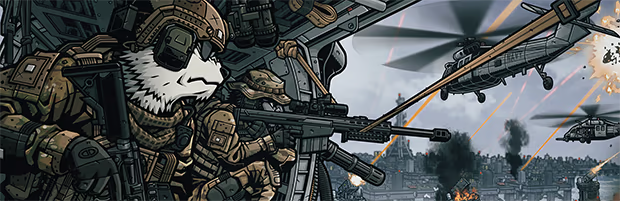
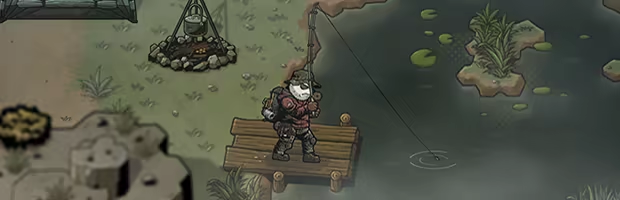
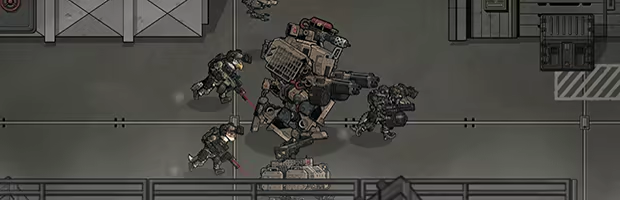
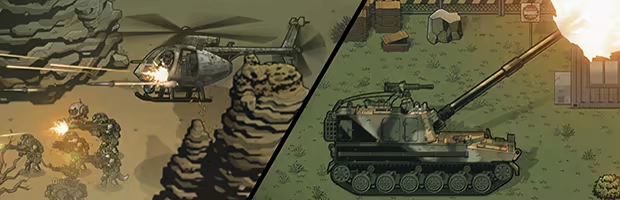
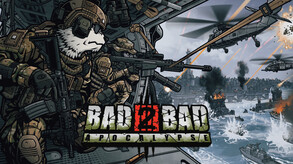
The open-world survival role-playing game "Bad 2 Bad: Apocalypse" tells the story of Delta Team and his comrades as they work to rebuild a world devastated by humans and their race turned into zombies.
Modeled estimate, not a reported figure. How we estimate →
Media

About


Stats
All-time low is the lowest price we've recorded for this game since we started tracking it.
Languages: English, French, Italian, German, Spanish - Spain, Russian, Vietnamese, Indonesian, Japanese, Simplified Chinese, Traditional Chinese, Thai +3 more
Engagement
Hours played at review time, across 41 reviews with recorded playtime.
Reviews
Themes across 41 recent reviews and how positive each mention is. A keyword signal, not full sentiment analysis.
positive critical· bar length = how often the theme comes up
Reviews
[h1]Sum-Up[/h1] [h3]In-depth analysis further down.[/h3] [table] [tr] [th]🟩 [b]Pros[/b][/th] [th]🟥 [b]Cons[/b][/th] [/tr] [tr] [td] • You can choose to buy a bottle of decent vodka with the money. It will surely hurt your brain less, and make you happier, than playing this game. [/td] [td] • Extremely repetitive gameplay loop that, despite some additions as you progress, never really evolves or becomes more interesting at any point. • Horrendous story, with butchered English translation and generic sci-fi / post-apo themes. It reads out, and evolves, like an AI-generated script more than anything else. • Very low enemy archetypes roster: even if there are multiple factions, most foes behave too similarly to each other, resulting in limited mechanical variety. • Shallow combat mechanics that never evolve in depth at any point. Most fights, excluding a few bosses, are simple trades of blows / DPS checks without any quirks to them whatsoever. • Immense content bloat, due to the heavy recycling of assets, animations, enemies and pretty much anything else. It feels like grinding the same map 50 times over, just with different color palettes. [/td] [/tr] [/table] [table] [tr] [th]🟨 [b]Bugs & Issues[/b][/th] [th]🔧 [b]Specs[/b][/th] [/tr] [tr] [td] • Rarely, your character may get stuck inside some props. [/td] [td] • i9 13980HX • 64GB RAM DDR5 • RTX 4090 • SSD • 3840x2160 [/td] [/tr] [/table] [table] [tr] [td][b]Content & Replay Value:[/b][/td] [td]It took me 52 incredibly boring hours to clear about 70% of the map, including unlockable dungeons and extra levels; to fully 100% everything, I estimate no less than 75 hours are needed. The entire content is linear, there’s no reason to replay.[/td] [/tr] [tr] [td][b]Is it worth buying?[/b][/td] [td]God, no. It’s a low-effort, incredibly shallow and repetitive conversion of a previously F2P mobile game. It has no place in a PC gaming library, and isn’t worth anyone’s time or money.[/td] [/tr] [tr] [td][h3]Verdict: Terrible[/h3] [url=https://steamcommunity.com/sharedfiles/filedetails/?id=2548409603]Rating Chart Here[/url][/td] [td]One of the most boring, generic titles I had the displeasure of playing in 25 years of gaming. An affront to anything that could be even remotely considered ‘fun’.[/td] [/tr] [/table] [h1]In-Depth[/h1] [h3]Writing & Worldbuilding[/h3] After something along the lines of WW3 went down, Nations decided to use bioweapons as a last resort, consequently transforming a good chunk of the population into anthropomorphic furries; which could be a dream come true for some, but a nightmare for most. Also, the majority of them went feral or insane, while an evil PMC known As APEX is speedrunning world domination amidst the chaos. This might sound like a fairly exciting and ‘weird in a good way’ premise, however its narrative execution is terribly lackluster, even for the low expectations you’d have from an ARPG hybrid subgenre such as this one. None of the events, characters or locations you’ll encounter during the main or side quests feel remotely memorable. They’re all generic elements to justify gameplay, nothing more. What little elaboration upon lore is written so awfully, that half of it is atrocious to read, or at times, incomprehensible. Even if it was readable grammatically, it would still bore most people to death after half an hour. The post-apocalyptic, warzone-themed (no, not that warzone) worldbuilding could be decent, if the art style couldn’t be resumed in a shovel of repetitive, generic assets scattered throughout all-too-similar maps. Every single location feels generic, boring, and just not interesting to explore or look at in any way. [h3]Exploration & Secrets[/h3] The world map is divided into self-contained, interconnected areas that you can freely explore with your squad, and fast travel to and from once you find and repair each zone’s helipad. Initially, each zone will be covered by fog of war, progressively dispelled as you move around and detect POIs, loot caches and sometimes unique encounters like merchants and bosses. There aren’t any secrets or hidden loot: everything you can find is clearly highlighted and evident, while intelligence files can be bought at your base to know exactly where to find specific components to upgrade facilities, which are about the only thing worth looting for, aside from basic materials you’ll always have an excess of. The exploration pacing is rather slow, because not only it takes some time to traverse maps, but also the looting and exploration are hindered by a multitude of unnecessary animations, loading screens and transitions that bloat the gameplay time to hell. [h3]Combat System & Bosses[/h3] In B2B:A you’ll command a squad of operatives, deciding their combat formations, each giving different set bonuses, their equipment and skills as they level up. Fights play out in real-time, against enemies that range from crazed mutants to highly-skilled hostile operatives and AI-powered robots. During each fight, you’ll be able to use each operative’s unique abilities and equipment, other than consumables and support call-ins like artillery barrages or helicopter support, once unlocked. Even if it all seems deep and varied enough, it’s really not, in practical terms. Beyond the basic decision of what formation suits your needs the most at the current time, and assigning the best weapons to each operative for their skill trees, there isn’t really any further depth to combat mechanics. Most fights play out as a reciprocating trade of blows, with no skill-based way to dodge attacks or make combat more dynamic. All you’ll see during fights are bullets flying between two sides, the one with the best DPS and HP coming out as the victor. Since you’ll have to fight thousands of enemies across dozens of large maps, this becomes an extremely repetitive ordeal, also because most foes feel too same-y, while the skill evolution of each operative isn’t deep enough to add more nuance to combat. Boss fights are just marginally better, with a few diverse attack patterns that will keep your attention up, and that could actually pose a threat if you don’t get the right positioning to avoid large AoE attacks. However, these are few and far in-between, surely not enough to make you escape the endless boredom that standard combat represents. [h3]Progression & Crafting[/h3] While not fighting or exploring, you’ll have to manage your base and operatives. Change equipment, craft better ones with the materials you find on the field, and enhance base facilities to gain better passive bonuses, or access higher crafting tiers for weapons and armor. Generally, you’ll always have a surplus of crafting materials for basic consumables such as ammo, bandages, foodstuffs that grants passives, while crafting new weapons or upgrading existing ones requires considerably more grinding to acquire enough parts. Also in this aspect, B2B:A doesn’t deliver enough, as far as the sense of meaningful progression and its pacing are concerned. Most of the time, it feels like an endless slog for minimal improvements, over an overly-long, repetitive, bloated period of time that isn’t justified by any kind of complexity or variety. The crafting system is basic, using resources found during exploration to craft consumables, special ammunition types, foods that give long-lasting buffs. Generally, the progression is about equipping your operatives with better gear, while also assigning skill points as they level up. The issue is that the sense of progression is barely tangible, due to how bloated and diluted it is when compared to the total extent of the game’s content.
地图又臭又长,跑了四五个小地图景色完全一样,所有建筑物内部也完全一样,所有怪物也几乎一模一样,模型复用非常非常严重,玩一会就犯困了。 第一次玩到这么无聊的游戏。
太肝了,内容重复,UI操作繁琐。整体反馈很差,2h都坚持不下去。
什么时候把材料堆叠改了什么时候改评价。你知道我仓库存了14111个布料的痛苦吗?草泥马的。
스팀에 출시된 게임의 형태를 갖춘 흥미로운 모바일 '애플리케이션'입니다. P.S. 모바일 게임은 절대로 게임이라고 할 수 없다..
엄청 추천할 정돈 아니지만 취향만 맞으면 충분히 즐길만한 게임입니다 게임초기엔 심각한 노가다, 편의성 부족 등으로 많은 비판을 받았지만 차후 패치를 통해서 이러한 부분을 일정부분 해소 시켰고 적당한 노가다만 있어도 엔딩을 보는데 문제가 없는 수준이었습니다 장점으로는 여러 캐릭터와 총기류가 준비가 되있다는 점이지만 단점으로는 효율을 따지면 특정 캐릭터와 총기류만 사용한다는 점입니다 맵마다 텅텅빈 느낌도 많이 아쉽게 느껴졌고 건물 업그레이드 하는 부분도 너무 빨리 max 치를 찍어서 성장을 체감하는 부분이 빨리 끝난것도 아쉽게 느껴졌습니다 그럼에도 이러한 게임이 취향에 맞으시는 분은 재미를 느끼실거라 생각합니다
아니 존나 빡세게 열심히 하고 나니 세이브파일 한번 깨지고 처음부터 하라네 개같은거 장난하냐?
Have played 55hours on taptap Game goes Repeat and Repeat. Contents are just variety of textures and Gameplay is pale. The game actually only takes about one hour to finish.
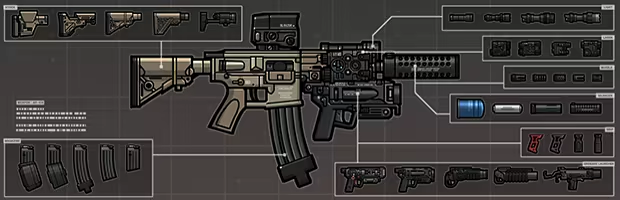
Bad 2 Bad: Apocalypse is a system-heavy hybrid that blends open-world exploration, squad-based shooting, and survival progression into a single loop that’s easy to get absorbed in, even if it rarely feels refined. Developed by DAWINSTONE, it continues the series’ distinctive identity—anthropomorphic animal soldiers navigating a ruined world—while expanding the scale of its systems and the scope of its progression. What emerges is less a tightly curated experience and more a layered sandbox of mechanics that constantly feed into each other, sometimes elegantly, sometimes awkwardly. You take command of Delta Team, a group of survivors operating in a world fractured by infection and conflict. The narrative serves primarily as a framework rather than a focal point, pushing you from mission to mission while hinting at broader efforts to rebuild society. It’s not especially deep or character-driven, but it doesn’t need to be; the real focus lies in what you do rather than what you’re told. The story provides direction, but the sense of purpose comes more from progression—expanding your base, strengthening your squad, and gradually gaining control over increasingly dangerous territories. The gameplay loop is built around exploration and accumulation. You move through different regions, scavenging materials, fighting enemies, and completing objectives that contribute to both immediate rewards and long-term growth. Each outing feeds back into your base, where resources are used to unlock new systems, upgrade facilities, and improve efficiency. This creates a strong sense of continuity, where no action feels entirely wasted. Even small gains contribute to a broader trajectory of development, making the game particularly satisfying for players who enjoy incremental progress. Combat is handled through a top-down perspective, with a focus on managing a small squad rather than a single character. Each member has their own equipment, abilities, and role within the team, and success often comes down to positioning and preparation rather than reflexes. The shooting mechanics are straightforward but effective, with enough responsiveness to make encounters engaging without becoming overly demanding. As you acquire better weapons and upgrades, combat becomes more flexible, allowing for different approaches depending on your loadout. However, while the system grows in options, it doesn’t necessarily grow in depth, and encounters can start to feel repetitive once you settle into an effective strategy. Customization plays a major role in maintaining engagement. Weapons can be modified, characters can be outfitted with different gear, and skill systems allow for gradual specialization. This creates a strong sense of ownership over your squad, as each decision shapes how they perform in the field. Experimentation is encouraged, and finding combinations that work well together can be rewarding. At the same time, the interface used to manage these systems can feel clunky, making it harder than it should be to fully enjoy the depth that’s available. Base management adds another layer to the experience, tying everything together into a cohesive progression loop. As you gather resources, you expand and upgrade your headquarters, unlocking new features that improve both efficiency and capability. This system is not as deep as dedicated simulation games, but it provides enough structure to make long-term planning feel meaningful. The connection between exploration and development is clear and consistent, reinforcing the idea that every action contributes to rebuilding something larger. The game’s biggest challenge is repetition. The core loop—explore, fight, gather, upgrade—remains largely unchanged throughout the experience, and while it is satisfying, it can also become predictable over time. Mission objectives often follow similar patterns, and enemy encounters lack the variety needed to keep things consistently fresh. This leads to a gradual shift from discovery to routine, where the focus becomes less about what you’re doing and more about how efficiently you can do it. Pacing reflects this structure. Early progression feels rewarding, with frequent upgrades and new systems being introduced at a steady rate. As the game continues, however, the pace slows, and advancement begins to rely more heavily on repetition and resource accumulation. This can create a sense of grind, particularly for players who are less interested in long-term optimization. The game does not hide its reliance on repetition; instead, it leans into it, which will appeal to some players while pushing others away. Visually, the game embraces a stylized approach that emphasizes clarity over detail. The use of anthropomorphic characters gives it a distinct personality, helping it stand out from more conventional post-apocalyptic settings. Environments are functional and varied enough to support exploration, though they lack the detail or polish seen in more technically advanced titles. The overall presentation feels consistent with its design philosophy—focused on systems and readability rather than spectacle. Ultimately, Bad 2 Bad: Apocalypse is a game defined by its scope and its systems. It offers a dense, interconnected experience where exploration, combat, and progression are tightly linked, creating a loop that can be both engaging and addictive. At the same time, its rough edges—particularly in interface design, repetition, and pacing—prevent it from reaching a higher level of refinement. It is a game that rewards patience and persistence, offering a steady sense of growth for those willing to invest the time. Rating: 7/10
총, 털, 철
Related
Related
Trends
Modeled estimate over time, reconstructed from Steam's monthly review histogram.
Audience
Estimated from the language of this game's reviews — a proxy for where players are, not official Steam demographics.
Related
| WHAT THE CAR? | $386.2K | 892 | 85% | $19.99 |
| Verho - Curse of Faces | $386.2K | 1.2K | 92% | $12.99 |
| The friends of Ringo Ishikawa | $386K | 3.1K | 89% | $14.99 |
| Axon TD: Uprising - Tower Defense | $386.4K | 767 | 86% | $19.99 |
| MEGATON MUSASHI W: WIRED | $386.4K | 717 | 80% | $24.99 |
| Sonicomi | $385.9K | 619 | 90% | $34.99 |