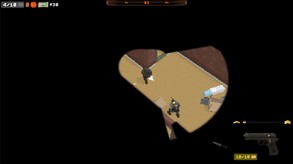
B67, developed and published by Steel Peak Games, is an independent roguelite shooter that strives to merge minimalist design with tense, atmospheric gameplay. Set in a claustrophobic, industrial environment, the game challenges players to survive and descend through sixty-seven procedurally generated levels, each filled with hostile enemies and shifting hazards. It is a game of endurance and precision, where every encounter feels like a test of reflexes and resource management. The premise is simple—fight, descend, survive—but beneath this simplicity lies a rhythm that rewards adaptability and tactical thinking. Every failed run teaches you something new about the dangers lurking below, and every success tempts you to descend just one floor deeper.
The structure of B67 revolves around risk and reward. Each descent demands a balance between aggression and caution, as ammunition and health are both finite commodities. Players navigate confined rooms that can quickly turn from manageable firefights to chaotic deathtraps, with enemies swarming from multiple angles or appearing in unpredictable patterns. Combat feels weighty and deliberate, with each shot carrying real consequence; a wasted bullet can mean death in the next encounter. Weapons vary in power, accuracy, and firing speed, forcing players to adapt their strategies to whatever tools they manage to scavenge along the way. The roguelite progression ensures that while every death sends you back to the top, certain upgrades and enhancements persist, granting small but crucial advantages in subsequent runs. This cyclical structure creates an addictive loop of failure, improvement, and discovery that defines the genre at its best.
Visually, the game adopts a stripped-down style that complements its tense atmosphere. The top-down perspective, combined with sharp contrast lighting and stark textures, evokes a sense of descent into darkness and uncertainty. The environments are rendered with minimal color but strong visual clarity, allowing players to read enemy movement and environmental hazards at a glance. The limited palette—mostly greys, reds, and muted tones—creates a feeling of mechanical decay and isolation. It’s a world that feels oppressive by design, and the visual austerity serves as an effective extension of the game’s tone. Sound design plays an equally important role; the hum of machinery, echoing footsteps, and bursts of gunfire create an industrial rhythm that heightens the sense of dread. The music, sparse and ambient, reinforces the mood of unease, making every encounter feel like a descent into something deeper and more hostile.
B67’s gameplay thrives on its procedural generation and unpredictable pacing. No two runs feel exactly alike, and this randomness keeps the experience tense and dynamic. Some levels feel manageable, even methodical, while others throw players into frantic battles that demand split-second reactions. The deeper one goes, the more brutal and complex the enemies become, with faster movement patterns and deadlier attacks. The difficulty curve escalates steeply after the midpoint, and success often hinges on learning how to conserve ammunition, exploit environmental cover, and prioritize targets efficiently. The challenge can sometimes border on punishing, particularly when the randomization delivers poor weapon drops or overwhelming enemy placement. Yet the frustration is tempered by the satisfaction of mastery; with each failed attempt, players learn to anticipate threats, optimize routes, and execute faster, cleaner runs.
Where B67 excels most is in its atmosphere of tension. The combination of confined spaces, sparse lighting, and unpredictable enemy encounters creates a near-constant sense of vulnerability. Each level feels like a fight for survival rather than a mere test of skill. The minimal narrative—conveyed through visual cues and the stark descent motif—adds to this tension. There is no exposition or dialogue, only the quiet implication that you are plunging deeper into an unknown abyss. The game’s design philosophy prioritizes immersion through action rather than storytelling, and the result is an experience that feels raw and instinctual. It relies on the player’s imagination to fill in the blanks, much like classic roguelike titles that favored tone and atmosphere over lore-heavy narratives.
However, B67’s ambition also exposes its limitations. The game’s reliance on repetition and procedural structure means that, over time, its patterns can become familiar. Players who crave more variety in objectives or environmental design may find the experience too narrow in scope. The absence of a developed story or meaningful progression outside of stat upgrades may also alienate those seeking a deeper narrative hook. Some users have noted issues with balance, particularly in how certain weapon combinations can trivialize sections while others feel underpowered. Additionally, while the minimalist presentation strengthens the mood, it can occasionally make spatial navigation confusing, especially when combat fills the screen with overlapping effects and enemies.
Despite these drawbacks, B67 manages to capture the core appeal of the roguelite genre—a blend of tension, challenge, and incremental progress that keeps players coming back. Its straightforward design and atmospheric execution make it a compelling experience for fans of procedural shooters who value gameplay precision and risk management. The sense of accomplishment that comes from surviving one more floor, discovering a rare weapon, or narrowly escaping death reinforces the addictive nature of the descent. Though modest in scope, the game succeeds in crafting a cohesive and engaging experience built on a simple but effective foundation. It is a testament to how strong mechanics and focused design can elevate even the smallest of indie projects into something memorable. For players who appreciate stripped-down, high-stakes action with an emphasis on atmosphere and skill, B67 remains a hidden gem—an unassuming but potent descent into tension, survival, and relentless perseverance.
Rating: 7/10