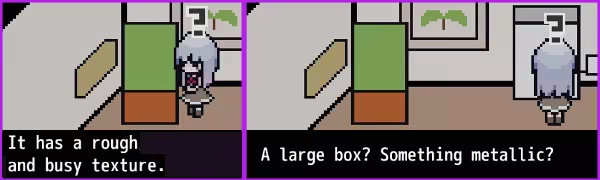
You find yourself in a room you know nothing of. As you examine the objects around you, your awareness rises and the room slowly comes into focus. Can you find your way out?
Modeled estimate, not a reported figure. How we estimate →
Media
About


Stats
All-time low is the lowest price we've recorded for this game since we started tracking it.
Languages: English, Japanese
Engagement
Hours played at review time, across 40 reviews with recorded playtime.
Reviews
Themes across 40 recent reviews and how positive each mention is. A keyword signal, not full sentiment analysis.
positive critical· bar length = how often the theme comes up
Reviews
titolo corto e carino basato sulle escape rooms. Personalmente non gioco tanto a videogiochi del genere però per averlo pagato un'euro è stato un bel acquisto anche se non sono tanto portato nel risolvere i puzzle quindi lo consiglio vivamente
I Recommend
окей
Si
good
不建议使用控制器。
Um jogo que não me prometeu nada e me ENTREGOU TUDO! Um jogo de Puzzle com um sistema de descobrimento visual da sala onde o personagem está, onde cada vez que você interage e descobre mais da sala, a pixel art melhora e você entende cada vez mais o que deve ser feito no enigma, com um plot final que linka toda essa mecanica com a lore do jogo. Recomendo demais, esse é o ouro na simplicidade!
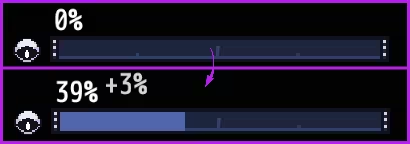
Awareness Rooms, developed by GAME NA KIBUN and published by PLAYISM, is a rare kind of puzzle experience that deliberately strips away the player’s sense of familiarity and replaces it with uncertainty. From the moment the game begins, it places you in an unfamiliar environment where even the most basic objects are difficult to interpret, forcing you to confront a world that feels simultaneously ordinary and alien. Instead of guiding you with tutorials or clear objectives, the game leans into disorientation as a design philosophy, asking you not just to solve puzzles but to first understand what you are even looking at. This approach immediately sets it apart from traditional escape room-style titles, as the challenge is rooted as much in perception as it is in logic. The defining mechanic revolves around the concept of “awareness,” a system that governs how clearly you perceive the environment. At the start, objects are vague, poorly described, and often misleading, with items appearing as abstract shapes or being labeled in simplistic, almost naive terms. Through interaction—examining, using, and experimenting with these objects—your awareness gradually increases, and the world begins to reveal itself with greater clarity. What initially seemed like meaningless clutter transforms into recognizable tools, and previously incomprehensible spaces start to make sense. This progression is deeply satisfying because it creates a layered form of discovery; you are not just unlocking solutions, but unlocking your ability to interpret the world itself. As you move through the game’s compact set of rooms, the puzzles evolve in tandem with your growing awareness. Early challenges are straightforward, often requiring basic interaction and observation, but later segments introduce more intricate problem-solving that combines item usage, environmental manipulation, and subtle logical connections. The clever twist is that many puzzles cannot even be approached properly until your awareness has reached a certain level, effectively tying progression to comprehension rather than arbitrary barriers. This creates a looping structure where revisiting earlier spaces with improved perception reveals new possibilities, reinforcing the idea that knowledge itself is the key to advancement. When the design clicks, it produces moments of genuine insight that feel earned rather than handed to the player. The visual presentation plays a crucial role in supporting this concept. The game adopts a minimalist aesthetic that shifts dynamically based on your awareness level, with objects transitioning from indistinct forms into detailed, recognizable items. This visual transformation is more than just cosmetic—it serves as a tangible representation of your progress, making the act of understanding feel physically reflected in the environment. The overall tone is quiet and introspective, with subdued lighting and sparse environments that emphasize isolation. Audio design follows a similarly restrained approach, relying on subtle effects rather than a prominent soundtrack, which helps maintain focus but can also make the experience feel somewhat empty during extended play. Despite its originality, the game’s central idea does not expand as much as it could over time. The awareness mechanic remains largely consistent throughout, and while it is initially compelling, it begins to lose some of its novelty as the experience continues. Interacting with objects to increase awareness can eventually feel routine, especially when the process becomes predictable. Additionally, the game’s short length means that just as you fully grasp its systems, it is already approaching its conclusion. While this brevity prevents the concept from overstaying its welcome, it also leaves a sense that the idea could have been explored in more depth with additional rooms, mechanics, or variations. Another point of friction lies in the game’s intentional lack of guidance. While this design choice reinforces the theme of discovery, it can occasionally lead to moments of confusion where progress stalls not because of complex puzzles, but because of unclear interaction points or obscure requirements. Players who enjoy being left to figure things out on their own will likely appreciate this hands-off approach, but others may find it frustrating, particularly when the game’s abstract presentation makes it difficult to identify what actions are even possible. Even with these limitations, Awareness Rooms remains a memorable and distinctive entry in the indie puzzle space. It succeeds in delivering an experience that feels genuinely different, using its mechanics to explore the idea of perception in a way that few games attempt. Rather than overwhelming players with content or complexity, it focuses on a single concept and executes it with clarity and purpose. The result is a game that feels more like an interactive thought experiment than a conventional puzzle adventure, leaving a lasting impression despite its modest scope. In the end, Awareness Rooms is best approached with the expectation of a short, concept-driven experience rather than a fully expansive game. It may not offer extensive replay value or mechanical variety, but what it does achieve is a thoughtful and engaging exploration of how understanding shapes interaction. For players interested in unconventional design and introspective gameplay, it provides a unique journey that is both intriguing and quietly satisfying. Rating: 7/10
A simple puzzle -- too simple, perhaps. I was expecting twists, truth of in-game objects or ending. But really, it is all just a dream... Rather anti-climatic. Are the incomprehensible things in life also just a dream...?
Recommended only if you want some short puzzle game (1hr+ at most) Don't bother if you're hoping for any kind of story.
Related
Related
Trends
Concurrent players on Steam, sampled daily since tracking started.
Momentum
Pace estimated from the game's recent review growth (our daily snapshots) at its own sales-per-review ratio — a momentum signal, not booked sales.
Audience
Estimated from the language of this game's reviews — a proxy for where players are, not official Steam demographics.
Related
| With My Past | $48.4K | 272 | 94% | $8.99 |
| Duck Life 7: Battle | $48.4K | 360 | 76% | $5.99 |
| Dream Cage | $48.4K | 319 | 66% | $7.99 |
| Street Power Football | $48.4K | 90 | 40% | $29.99 |
| Master of Orion 3 | $48.5K | 175 | 56% | $9.99 |
| Northwind | $48.5K | 82 | 85% | $19.99 |
Related
| 7 Days to Die | $425.3M | 403.6K | 87% | $44.99 |
| Euro Truck Simulator 2 | $421.6M | 932.3K | 97% | $19.99 |
| Mount & Blade II: Bannerlord | $309.8M | 294K | 88% | $49.99 |
| Palworld | $279.6M | 447.5K | 94% | $20.99 |
| The Forest | $254.8M | 678.6K | 96% | $19.99 |
| Project Zomboid | $239.1M | 461K | 94% | $19.99 |