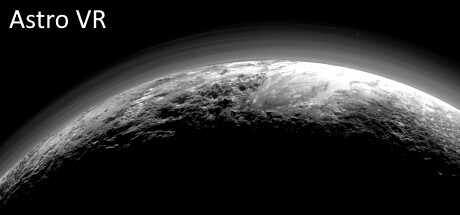
Freely travel among the stars and planets in this made for VR astronomy simulation. Experience space from some of the smallest solar system bodies to our largest planets. Or leave the solar system to explore strange new worlds orbiting stars so distant it takes light thousands of years to get here.
Modeled estimate, not a reported figure. How we estimate →
Media

About
Travel among the stars and planets In this made for VR astronomy simulation. Within the solar system you can visit all the planets and moons as well as many asteroids, trans-Neptunian objects, and other small solar system bodies. Outside the solar system, go to thousands of stars and their exoplanets. Also works on flat screen with keyboard and mouse.
All the solar system objects sizes and locations are based on accurate and up to date information. Where actual images are available you will see the correct texture or, if detailed information is available, a reasonable extrapolation is used. The orientation of the planets is correct relative to the solar system and the solar system itself is oriented correctly to the background stars.
Star color, brightness, size and position are taken directly from available data or are calculated. There are thousands of stars and exoplanets to explore. The habitability zone of each star is calculated and the exoplanets within it are textured appropriately for size, age, and rotation. As you explore you will see text for stars that are known to have planets as well as planets that are within the habitability zone.
Black holes have mass from the latest sources, size and event horizon assume a rotating black hole. Accretion disk rotation speed and doppler beaming effect are simulated along with the gravitation distortion of the background stars.
Objects move with time. Set a time scale and observe planets, moons, asteroids, etc. move in orbits determined by ephemeris data from JPL. See the motion of moons around Jupiter or the Earth around the moon, or the entire system around the sun. Time can move forward or backward and positions are extrapolated for time before or after the dataset.
Every object is labeled with an option to turn off the text. In addition, detailed information on each object can be displayed. When available, we collect data on position and orbits, size, mass, temperature, magnitude, luminosity, inclination, and more. You can do side by side comparisons with the sun, Jupiter, Earth, and the moon.
Currently there are:
6100 Star Systems
6720 Individual Stars, 16 black holes, 7 neutron stars
8 Planets
222 Moons
91 Minor Planets
5404 Exoplanets
9 Spacecraft
There will be more.
You may freely move among all the stellar objects with only two controls. Left controller thumbpad/stick for movement, right to zoom. Separate scales for object size and distance allow you to see the entire solar system within arms length or you may zoom in to where size and distance scales are the same.
Terrible. It is possible to set a webcam (including from some headsets) as the background. Typically this is fuzzy and laggy. Your results may vary, but probably not.
Currently:
Min Scale Distance: 1 meter = 2 light years.
Max Scale (both): 1 meter = 1 meter
Genres
Stats
All-time low is the lowest price we've recorded for this game since we started tracking it.
Languages: English
Engagement
Hours played at review time, across 21 reviews with recorded playtime.
Reviews
Initially I could not launch it on Linux, but Developer came forward and made sure that I can. Fellow Linux Users, If you are reading this review consider supporting developer for not forgetting about us. For everyone esle: consider supporting educational projects such as this, to prove that humans can use VR for something other than degradation. For Developer: Consider enabling rotation by default and maybe ability to select what kind of locomotion to use. I feel like head orientated locomotion can be a good addition.
[h1]Experienced on the Meta Quest 2[/h1] You can view my initial impressions review & gameplay here: https://youtu.be/1dbS9zTnmMo I do recommend this app. It's a simple, but very effective space exploration app. You can quickly travel & zoom in to almost any celestial object known to man. You can also manipulate time and watch the orbiting planets or moons, either sped up or slowed down. I would say the UI is a little rough, but it's worth it given the sheer amount of celestial objects you can explore and zoom in on. I also wish there was information available on each celestial object identified. It's only $2.99 USD though so I can't really complain for the price. It's quick & easy exploration of the vastness of the known universe. I wish we could listen to our own music though or watch YT videos while we're exploring. Maybe we could look up info via YT on the celestial object we're looking at. [b]Rate ?/10.[/b] [quote]If you enjoyed my review, please consider joining my Steam Curator Group. You can join here: https://steamcommunity.com/groups/Oculus_WMR [/quote]
Astro VR von Light-Year Simulatons ist eine Astronomieapp, die es uns ermöglicht 6096 Sternensysteme, 6720 einzelne Sterne, 16 Schwarze Löcher, 7 Neutronensterne, 8 Planeten, 222 Monde, 91 Zwergplaneten, 5404 Exoplaneten und ganze 9 Raumvehiekel etwas näher zu betrachten. Die ganze Show lässt sich geführt in einer Tour durchleben. Das kann je nach Einstellungsparametern im Menü ganz schön lange dauern. Der Jupiter z.B. hat ganz schön viel Monde. Wem das aber zu lange dauert, kann sich auch individuell in unserem Universum umsehen. https://steamcommunity.com/sharedfiles/filedetails/?id=3273879166 Wir fliegen und beamen quer durch die Galaxis und werden am Zielort immer mit einer kleinen Texttafel mit kurzen Infos über das Ziel belohnt. Die Steuerung ist nicht ganz einfach, wird aber in einem Tutorial erklärt und geht mit etwas Übung gut von der Hand. Wir können die einzelnen Objekte, die wir uns ansehen möchten, jeweils rein und rauszoomen. Lediglich der Exitknopf lässt sich zu schnell versehentlich aktivieren und schwubs! ist man wieder auf der guten alten Erde. Eine Nachfrage, ob man wirklich raus möchte, wäre nett. Das Programm lässt sich wohl auch in flat steuern, aber wenn man schon ein HMD hat, ist das eigentlich keine Option. https://steamcommunity.com/sharedfiles/filedetails/?id=3273879037 Die Grafik ist, soweit bekannt, realistisch, das betrifft aber vor allem nur unser Sonnensystem. Alle anderen Himmelskörper sind berechnete Darstellungen mit aktuellen Daten der einschlägigen Weltraumagenturen. Wir können die einzelnen Objekte rein und rauszoomen. https://steamcommunity.com/sharedfiles/filedetails/?id=3273879520 Die Musik ist okay, aber vor allem beim Start des Programms sehr LAUT! Also bitte die Lautstärke runterdrehen, wenn ihr das Programm ausprobieren wollt. Astro VR ist eine sehr umfangreiche astronomische Tour durch unsere Galaxis. Die Informationen sind interessant, für Kenner und Entdecker. 👀[url=https://store.steampowered.com/curator/32170554/]Besser Astro VR als Astro TV[/url]🎊 All das auf meiner Kurator Seite. 👑 Powered by HoI 4 Deu Curators group in German / English 👑⠀⠀⠀[list] [*][url=https://store.steampowered.com/curator/30388691/] Follow Main group [/url] [*][url=https://store.steampowered.com/curator/40282064/] Follow Second group [/url] [*][url=https://store.steampowered.com/curator/44688798/] Follow Third group [/url][/list] [u]English:[/u] Astro VR by Light-Year Simulatons is an astronomy app that allows us to take a closer look at 6096 star systems, 6720 individual stars, 16 black holes, 7 neutron stars, 8 planets, 222 moons, 91 dwarf planets, 5404 exoplanets and a whole 9 space vehicles. The whole show can be experienced in a guided tour. Depending on the setting parameters in the menu, this can take quite a long time. Jupiter, for example, has quite a lot of moons. But if that takes too long, you can also look around our universe individually. We fly and beam across the galaxy and are always rewarded at our destination with a small text panel with brief information about the destination. The controls are not easy, but they are explained in a tutorial and are easy to master with a little practice. We can zoom in and out on the individual objects we want to see. Only the exit button can be activated too quickly by mistake and then you're back on good old earth. It would be nice to be asked if you really want to exit. The program can probably also be controlled in flat, but if you already have an HMD, this is not really an option. As far as we know, the graphics are realistic, but this only applies to our solar system. All other celestial bodies are calculated representations with current data from the relevant space agencies. We can zoom in and out on the individual objects. The music is okay, but very LOUD, especially at the start of the program! So please turn down the volume if you want to try out the program. Astro VR is a very comprehensive astronomical tour through our galaxy. The information is interesting for connoisseurs and explorers. 👀[url=https://store.steampowered.com/curator/32170554/]Better Astro VR than Astro TV[/url]🎊 All this on my curator page. 👑 Powered by HoI 4 Deu Curators group in German / English 👑⠀⠀⠀[list] [*][url=https://store.steampowered.com/curator/30388691/] Follow Main group [/url] [*][url=https://store.steampowered.com/curator/40282064/] Follow Second group [/url] [*][url=https://store.steampowered.com/curator/44688798/] Follow Third group [/url][/list]
Shut up and take my money. 10/10
Good app. I use it when I am watching "How the Universe Works".
The attention to scientific detail in the environment and the seamless VR integration make for a great experience. There are an enormous number of exoplanets and objects in our own solar system to explore. Once you get used to the zoom-move controls you can smoothly navigate through the cosmos. The AR works but has a lot of latency, though this could be because I don’t have an AR headset (Vive Pro). Highly recommended for anyone looking to explore the vastness of space in virtual reality.
For the price this is well worth it. Nothing like feeling insignificant in the vastness of space.
Fun game for exploring and getting lost in the solar systems. Like that it works both in VR and in a screen mode. Interestingly enough I had my embedded graphics card turned off on my laptop to favor using the installed NVidia card and that seemed to cause a performance issue. Re-enabled the default card and the game still used the NVidia card, but all worked well then... I expect that's more of a driver issue with my laptop than anything else.
its cool and all but i wish there was a way to find planets faster like a tab to go there or a way it shows you them instead of digging all around the universe and also you get lost every easy the zoom if you zoom into a star its like you cant go back its a fun game but those are my ideas i recommend if your into astromy and just better movement hard to move you look
It's great in VR for wandering around space looking at planets, moons, galaxies, etc.. Played both VR (HTC Vive) and PC. Easier to navigate in VR and more of a wow factor than just PC, but still good for PC only users. Highly recommend for anyone that enjoys and is interested in astronomy.
Related
Related
Trends
Modeled estimate over time, reconstructed from Steam's monthly review histogram.
Audience
Estimated from the language of this game's reviews — a proxy for where players are, not official Steam demographics.
Related
| KAIKAN | $5.1K | 66 | 97% | $4.08 |
| Puzzle Chambers | $5.1K | 504 | 79% | $0.71 |
| Exit: A Biodelic Adventure | $5.1K | 70 | 89% | $4.99 |
| Demon's Crystals | $5.1K | 75 | 76% | $2.99 |
| Beat Shapes | $5.1K | 80 | 81% | $2.39 |
| The Puppy | $5.1K | 75 | 72% | $1.99 |