Virtual 8-bit computer with 256 bytes of memory. A powerful learning tool for mastering Assembler, with lessons available in English. Try your hand at low-level programming!
Modeled estimate, not a reported figure. How we estimate →
About
Step into the era of early computing and feel like a real engineer from the past. ASTRA-256 isn’t just a computer — it’s a complete educational environment where you write real Assembler code for a virtual von Neumann architecture machine.
ASTRA-256 is:
An interactive simulator for learning Assembler from scratch.
A logic puzzle for those who love “real” programming.
A nostalgic time machine for veterans of the LPG-30, Altair 8800, and PDP-11.
This is the kind of machine pioneers of computing once used to solve real problems — under tight resource constraints, just like in the 1970s.
Assembler is the language the machine truly understands. It’s not obsolete — it’s foundational.
Still used in microcontrollers and embedded systems: from home appliances and automotive electronics to medical devices and IoT.
Gives you full control over the hardware — drivers, firmware, DSP, memory, and registers.
Essential for cybersecurity: reverse engineering, malware analysis, hacking, and low-level defense.
Helps you understand how high-level languages like Java, C++, and Python work under the hood.
Reveals the essence of computation — how bits become intelligence, how stacks, memory, and ALUs operate.
Understand Assembler, and you’ll understand how everything else works.
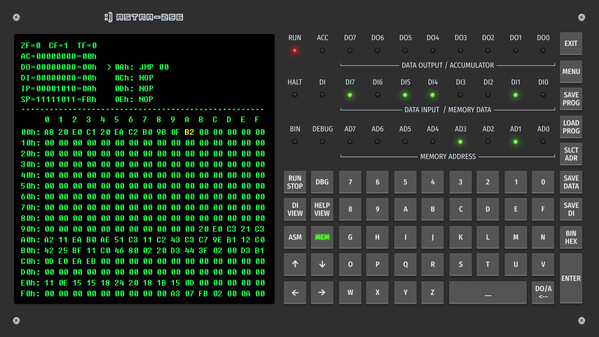
8-bit processor with accumulator and visible registers: IP, IN, OUT, SP, FLAGS.
256 bytes of memory — just like the original Altair 8800 released in 1975 with the Intel 8080.
75 instructions grouped by purpose: control flow, data movement, arithmetic, stack, I/O, and more.
Lessons and documentation in five languages — printable, just like in the good old days.
Start with simple programs and progress to complex algorithms: square roots, trigonometry, even mini-games.
ASTRA-256 runs on a custom Assembler designed specifically for this environment. We intentionally offer an extended instruction set — similar to what you’ll find in modern microcontrollers and processors.
It’s a hands-on way to gain foundational experience with low-level hardware logic — the kind that prepares you to work with any modern microcontroller. The principles haven’t changed.
Everything you need is built in: editor, debugger, help system.
Everything is real: memory, registers, instructions.
Everything is here to help you understand how computers truly work — not at the interface level, but at the bit level.
Who knows — maybe you’ll be the one to write the program that sends Elon Musk to Mars.
Genres
Stats
All-time low is the lowest price we've recorded for this game since we started tracking it.
Languages: English, Ukrainian, French, German, Spanish - Spain, Spanish - Latin America
Engagement
Reviews
First of all, thanks for the native Linux support. Ok, so what do we have here... https://www.youtube.com/watch?v=7WaYYNUCWMY That's not the Assembly most people expect with all these MOVs and MULs. It's inspired by Altair 8800, LGP-30, and PDP-11, machines from somewhere in the 1978-1990 era. It can be interesting for people who like to tamper with such museum stuff. It kinda reminds me of Zach games such as TES-100 and Shenzhen I/O. But there are no missions (yet?), so you just explore the device using the manual (ENG/RUS/UA, by the way) both PDF and in-game text, without "anyone holding your hand", as some people like to say. This is quite an interesting process by itself. I'll definitely recommend this for anyone interested in programming games. This is one of these sadly few "niche" products which require some thinking to be interesting, instead of just feeding you with "content". I do miss some code examples though. https://steamcommunity.com/sharedfiles/filedetails/?id=2077855996
[i]Disclaimer: I have had previous assembler language programming experience (hobby) when I owned a TRS-80 Model I computer in the 1980s. This review will be based on that experience.[/i] TL;DR This is a toy for those who have experience writing assembler language programs, and a very well done design of one too. Having said this, if you've never programmed before, or even if you have but use high-level programming languages, the toy can be frustrating. [hr][/hr] This software is basically a programming sandbox. It's a virtual machine based on the Altair 8800 microcomputer of the 1970s. This was a primitive ancestor to the modern laptops and desktops we take for granted where information was presented in blinking coloured lights and sounds. It also used assembler language, which is hexadecimal op code and the native language microcomputers understand (as opposed to C, BASIC, and Python). In it, you write assembler language programs within a 256 byte (not gigabyte, not megabyte, not kilobyte) memory slice. Program flow and execution, arithmetic and conditional operations, data transfer and storage are done through single-byte storage counters called registers. Visual display comes in the form of flashing coloured lights representing the binary notation of a value, which is a representation of values different from decimal notation (in decimal notation, 251 is 2 groups of 10 to the power of 2, 5 groups of 10 to the power of 1, and 1 group of 10 to the power of zero or simply 1). Data entry of both programming and any useful data to read and manipulate is done through an interface not far removed from a calculator keypad. You can enter the program either through the assembler interface which uses the mnemonic representation of the codes (MOVLA instead of 10h) or through the memory address where you enter in hexadecimal values. You can run the program in a step-by-step debug mode or a full execution until an end-of-program instruction is read. Because there's no "screen" to display information, the indicator lights are all you are going to get for output and you'll have to use your imagination on how to present that. Even for those like myself who grew up with a non-pixel 24 row by 80 column monochrome character screen might balk at that. You can save programs you write, and also run programs from other Astra-256 owners through the workshop interface. You're probably asking yourself if you should you get this. If you have previous assembler language experience like myself, this is a revisit back to those days. It's a faithful recreation of a programming environment that both optimised program runtime and memory space while at the same time makes you feel like you are a few seconds away from having a cranial stroke from the challenge. I personally enjoyed it. If you are willing to learn the language computers "speak", and what interpreters and compilers do to your pretty high-level Python code, this will be a great way to learn it. Having said this... If you never learned assembler code programming, or even know how to code a program of any kind, there's no tutorial, just the manual. It's not a bad source but it's not great one either. If you're not a learn-from-the-owner's manual type, this might not be for you, though perhaps someone in the community wrote a guide to help with that. If you like your information readout and display to be in English, there is none. The lights are your guide and there are a lot of them. It's basically a sandbox where you experiment in. The assembler language is fairly robust. b̶u̶t̶ ̶n̶o̶t̶ ̶w̶h̶o̶l̶l̶y̶ ̶p̶e̶r̶f̶e̶c̶t̶.̶ ̶T̶h̶e̶ ̶C̶A̶L̶L̶ ̶m̶n̶e̶m̶o̶n̶i̶c̶,̶ ̶a̶ ̶s̶u̶b̶r̶o̶u̶t̶i̶n̶e̶ ̶c̶a̶l̶l̶,̶ ̶f̶o̶r̶ ̶e̶x̶a̶m̶p̶l̶e̶ ̶d̶o̶e̶s̶ ̶n̶o̶t̶ ̶w̶o̶r̶k̶.̶ ̶ Because it's software for a small niche of very sick programmers who enjoy this (like me), your inquiries in discussion might go unanswered for a few days. I recommended ASTRA-256 because of my past experience and it engages me to use something I've learned a long time ago, but stopped using in favour of the high level languages I use now in my past I.T. career and my hobby. To me, it's fun but what is fun for me might not be fun for you. Get it on sale, and try it for 2 hours. If you do not like it, return it. Steam is awesome at handling that up to now.
Media

Related
Related
Price dynamics, follower growth, revenue and sales trajectories with interactive tooltips
This and every other Pro feature is free until October 20, 2026. A free account is all it takes.
Hours played at review time, across 31 reviews with recorded playtime.
People who like Zachlike games and/or assembly programming will find this pretty cool. Can't wait to see where the dev takes it in terms of tutorials and puzzles, but for now we have an awesome 8-bit computer to mess around with and get a taste of what it was like to program in the old days of computing. The world needs more games/emulators like this.
This program is very confusing. And the instruction manual for this program is extremely useless. What is curious is that, on the website it says: "We hope that for schoolchildren and students our calculator will be interesting." And "And the" children "of older age, this toy is just a pleasure." I am an adult and, I understand assembly language and, I think this program is confusing so, how would it be interesting for a child? How would a child think this "toy" is a pleasure? I looked for some contact from the creators of this program and, I didn't find it. I wrote on the forum and no one answered. So, I will ask for my money back.
Хотел бы еще иметь возможность выводить звук. Хочу написать музыку.
Забавная штука для изучения программирования на ассемблере =) Жду задачек!
Architecture is confusing for x86 users but still a solid game.
Хотите понять как работает "железо" и получить представление о том, что такое Ассемблер? Тогда берите. Но приготовьтесь во всем разбираться самостоятельно читая мануалы.
I'd say this is a terribly designed game, but it's hard for me to tell what the developer's goal was. Maybe they were trying to make a confusing and seemingly pointless game with terrible instructions. If so, mission accomplished. There is no tutorial. There are pages like "MANUAL" and "INSTRUCTION SET" which bring you to pages that contain words that are, as far as I'm aware, in English. However, speaking the language that is conveyed on those pages serves little value because they aren't in any order or context from which I can infer useful information. I wanted to like this game because I like supporting small developers, and because those aforesaid developers seem to indicate that this game has educational value. However the only educational value I derived from this game was knowing how the inside of my skull looks due to rolling my eyes back so far. Make a tutorial that explains how to play and what the goal is and I'll gladly consider repurchasing this game (even at full price). And for those who will inevitably say, "mAyBe YoUr JuSt A dUmMy HeAd" (that's the commenter's misspelling of "you're", not mine) I have worked in IT for 3 years and I dabble in coding and electronics, so while I'm not an expert on... to whatever subject this game is trying relate... I'm smart enough to know they should have done a better job.
At the moment the learning curve is quite high and there isn't a lot to do. The best thing to do right now is go to the workshop and subscribe to a few example programs so you can run them and see what happens. It's all still a bit buggy right now but you can't blame the developer for that. It's called early access for a reason. All in all, I'm really looking forward to seeing the progress as time goes on. It shows potential and it's kind of neat to be able to interact with a very old-school virtual computer.
Players by region
Where this game's players are, estimated from review languages.
Related
| Game | Estimated lifetime revenue | Reviews | Review score | Price |
|---|---|---|---|---|
| $23.9K | 31 | 100% | $19.99 | |
| $329.2K | 532 | 90% | $19.99 | |
| $113.4K | 188 | 76% | $14.99 | |
| $1.6K | 4 | 50% | $9.99 | |
| — | 0 | — | — | |
| $3.2M | 5.7K | 96% | $19.99 |
Related
| Game | Estimated lifetime revenue | Reviews | Review score | Price |
|---|---|---|---|---|
| $7.1K | 68 | 82% | $3.99 | |
| $7.1K | 103 | 74% | $4.99 | |
| $7.1K | 377 | 75% | $0.99 | |
| $7.1K | 59 | 61% | $4.99 | |
| $7.1K | 71 | 92% | $6.15 | |
| $7.1K | 73 | 89% | $3.99 |