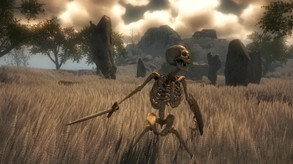
The creators of Shadowgate present Argonus and the Gods of Stone, an epic first-person adventure set in ancient Greece. Stranded on an uncharted isle, you must use your wits to unlock legendary mysteries, barter with gods and overcome an evil that threatens to bring the world to ruin...
Modeled estimate, not a reported figure. How we estimate →
Media

About
Genres
Stats
All-time low is the lowest price we've recorded for this game since we started tracking it.
Languages: English*, French, Italian, German, Russian, Simplified Chinese, Spanish - Latin America, Portuguese - Brazil*languages with full audio support
Engagement
Hours played at review time, across 46 reviews with recorded playtime.
Reviews
Themes across 46 recent reviews and how positive each mention is. A keyword signal, not full sentiment analysis.
positive critical· bar length = how often the theme comes up
Reviews
Argonus and the Gods of Stone, developed and published by Zojoi, is a mythological first-person adventure that blends the grandeur of ancient Greek legend with the structure of a classic point-and-click experience. It opens with a striking image: you are Argonus, a historian and cartographer aboard the fabled ship Argo, shipwrecked upon an unknown island. Your crewmates, once living heroes, have been turned to stone by an unseen force. With the help of a mysterious goddess who serves as both narrator and guide, you must uncover the cause of the curse, appease the gods, and navigate a land steeped in divine wrath and forgotten secrets. From its first moments, the game makes clear that it aims to be less about combat or spectacle and more about atmosphere, discovery, and mythic storytelling. The tone and pacing of the game immediately recall classic adventure titles of the 1990s, but presented through a modern visual and narrative lens. Argonus is not a hero in the traditional sense—he is an observer, a man of intellect rather than violence—and this choice defines the game’s entire design philosophy. There are no battles to fight or enemies to slay; instead, your progress depends on exploration, puzzle-solving, and paying attention to the world around you. You traverse the island’s cliffs, forests, and temples in first-person, collecting artifacts, interpreting runes, and listening to the ethereal voice of the goddess Calliope, who narrates your discoveries and offers cryptic hints. This slower, more contemplative approach allows the mythological setting to breathe, encouraging immersion rather than adrenaline. It’s a game for those who prefer to linger in a world, to absorb its mood and details rather than conquer it. The island itself is the centerpiece of the experience. Zojoi has crafted an environment that feels ancient and otherworldly, at once beautiful and desolate. Marble ruins and fallen columns litter the landscape, statues of once-living men stand as haunting reminders of divine punishment, and sunlight filters through broken archways as waves crash in the distance. The developers use this visual language effectively to convey the theme of decay—civilization eroded by time and divine neglect. The level of environmental storytelling is impressive; each location hints at its own history, often without words. The attention to light, shadow, and scale transforms the island into more than just a backdrop—it becomes a living, breathing myth in itself. Though not every texture or model is pristine, the art direction compensates with atmosphere and color. It feels like a world painted in the hues of a myth retold by torchlight. The gameplay follows a methodical rhythm. You explore areas, gather items, and solve puzzles that range from logical to obscure. Some puzzles involve deciphering inscriptions or manipulating ancient mechanisms, while others require combining items in ways that reveal hidden truths. The lack of hand-holding gives the experience an old-school sensibility that will appeal to veterans of classic adventure games, though it can frustrate those accustomed to modern conveniences. At times, progress can stall simply because an essential object blends too well with its surroundings or because a trigger event requires revisiting a previous area. This ambiguity adds to the sense of realism and mystery, but it can also test patience. The game rewards observation and memory rather than mechanical skill, making every solution feel earned but occasionally slow to uncover. Narration plays a vital role in maintaining immersion. The goddess’s voice accompanies you throughout, providing exposition, guidance, and emotional context. Her delivery is theatrical, almost poetic, which suits the mythological tone but can occasionally verge on excessive, describing actions or observations that the visuals already convey. Still, her presence serves as an effective narrative anchor, lending the story a sense of continuity and divine oversight. The writing captures the cadence of Greek mythology, with its blend of grandeur, fatalism, and moral consequence. The gods in this world are not benevolent—they are distant, temperamental, and driven by pride. Through your interactions with them, the story explores themes of hubris, mortality, and the fragile boundary between human reason and divine power. The technical presentation is uneven but serviceable. The game’s lighting and environmental composition do much of the heavy lifting, while character animation and facial detail remain limited. The soundtrack, composed of ambient tones and melancholic melodies, complements the visuals perfectly, evoking both wonder and melancholy. Sound effects are subtle but effective—waves lapping against the shore, footsteps echoing in ruined halls, and the distant calls of unseen creatures—all of which enhance the sense of isolation. Performance is mostly stable, though occasional stuttering and clipping can break immersion. The interface is minimal and clean, with contextual icons indicating interactive objects, though sometimes these icons fail to appear consistently, leading to unintentional confusion. What makes Argonus and the Gods of Stone stand out is its devotion to mythic storytelling rather than action. It does not seek to modernize Greek mythology through spectacle, as many games do; instead, it treats it with reverence and restraint. The game’s world feels ancient not just in setting, but in structure—it moves at the pace of an epic poem, deliberate and grand, but unhurried. For players willing to engage on those terms, the journey becomes quietly profound. Each discovery, each puzzle solved, and each whispered revelation adds to a growing sense of awe and melancholy. Yet the same qualities that make it atmospheric also limit its accessibility. Those seeking fast-paced gameplay or constant stimulation will likely find it too slow, too opaque, or too contemplative. Ultimately, Argonus and the Gods of Stone is a work of artistry and mood rather than mechanical precision. It evokes the timeless beauty of Greek myth through its haunting landscapes, its lyrical narration, and its emphasis on reflection over action. It asks players to embrace patience, curiosity, and imagination—to walk among ruins, listen to the echoes of gods, and uncover a story as old as tragedy itself. Though its execution can falter in pacing and technical finesse, it succeeds in what it sets out to do: to create an experience that feels like wandering through a living myth. It may not satisfy everyone, but for those attuned to its wavelength, it offers a memorable and meditative journey into the divine and the forgotten. Rating: 8/10
FANTASTIC EXPERIENCE!WORTH THE PRICE
Drecksspiel, Drecksgrafik, Drecksperformance, Stottern ohne Ende, Unity Engine sei Dank. Da hätte ich das Geld auch gleich verbrennen können. Crappy game, crappy graphics, crappy performance, endless stuttering, thanks to the Unity Engine. I could have burned the money for this crap right away.
If you like Greek mythology and this type of game, then this is for you. I enjoyed the story, and it makes good use of the Greek mythology in pleasing and surprising ways to tell it's tale. I really wish they had more of a budget to do a lot of cut scenes as that would have really improved immersion and elevated the game overall but it is what it is and it's still pretty good. Aside from that, there's nothing particularly special, or particularly bad, about this game. Typical of a lower budget game of this genre some of the puzzles can be obtuse and require a lot of annoying backtracking (if you're not using a walkthrough - which I am as my time is precious and I'm not wasting hours on trying to figure out some barely logical a+b=something your couldn't possibly expect) but for the most part, most of the puzzles are logical and straight forward. But to save frustration have a walkthrough handy for when you've done every obvious thing and can't figure out what to do next because you miss some item way back when....
As a longtime fan of the Shadowgate series and similar games, I was naturally drawn to this game. Overall, I enjoyed it. The main quest was fairly straightforward. A couple of the achievements were a little tricky to accomplish, but they can all be done without a guide. I do have a few gripes, though. First, the graphics constantly went through these stuttering moments. At 2560x1440p, I could typically get 80-110fps at the highest settings. However, at certain times and areas, the game would suddenly get choppy, and the fps would drop to around 40. I could not figure out the problem initially. I tried disabling depth of field and overwriting anti-aliasing with my graphics drive (as suggested in general discussion). It still didn't solve the stuttering. I always had to play with the texture setting to stop the stuttering during the first 2-3 books. Finally, I noticed that the stuttering would often happen when looking at the clouds. I started wondering if it had to do with my HDR settings on my monitor. So, I turned it off, and the stuttering magically stopped! The game was fine the rest of the way. Secondly, the sound. The music was alright (I could do without Athena's theme). The selections for the voices were generally okay. However, the volume setting for the voices was awful. This game really needs to normalize the volume for the voices (it's not hard!). Sometimes the narrator's voice was too low; at other times, too loud. Too much inconsistency.
慢热游戏,静下心来沉浸在古希腊史诗中
interfaccia caotica , idea e buona ma i comandi nel gioco son fatti male coe tutto il resto.
Увлекательное приключение с прекрасным мифологическим сюжетом.
not a bad little adventure game. took 5.8 hours. worth the play through. but those suckers force you to watch the credits before the final end of the game can be played. tricky programmers.
Bit of an undiscovered gem if you're into adventure style games.
Related
Related
Trends
Modeled estimate over time, reconstructed from Steam's monthly review histogram.
Momentum
Pace estimated from the game's recent review growth (our daily snapshots) at its own sales-per-review ratio — a momentum signal, not booked sales.
Audience
Estimated from the language of this game's reviews — a proxy for where players are, not official Steam demographics.
Related
| Roblox | $2.5B | 50.1M | 84% | Free |
| Pokémon GO | $839.2M | 15.4M | 73% | Free |
| Black Myth: Wukong | $794.9M | 1.2M | 97% | $59.99 |
| PK XD: Fun, friends & games | $538.5M | 6.4M | 94% | Free |
Related
| Electro Bop Boxing League | $33.1K | 87 | 79% | $14.99 |
| Sweet Dreams Alex | $33.1K | 97 | 97% | $14.99 |
| Sloppy Fields | $33.1K | 191 | 95% | $9.79 |
| 10 Second Ninja | $33.1K | 777 | 85% | $1.99 |
| First Class Escape 2: Head in the Clouds | $33.1K | 283 | 81% | $7.99 |
| Claire | $33.1K | 130 | 92% | $14.99 |