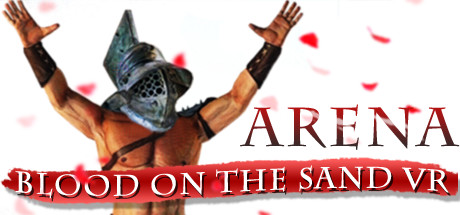
Arena: Blood on the Sand VR is a virtual reality action game developed by Random Bird Studio and published by Conglomerate 5. Released in 2017, it takes a simple but fitting approach to VR by placing the player inside a hostile gladiatorial arena where survival depends on physically attacking, defending, and avoiding incoming threats. Instead of attempting to deliver an enormous adventure filled with exploration and elaborate storytelling, the game focuses almost entirely on close-range combat. Its narrow scope makes it easy to understand and immediately accessible, although that same simplicity eventually becomes one of its most significant limitations.
The setting revolves around a cursed ancient empire and the warriors trained to fight within its arena. The player assumes the role of a gladiator who must confront dangerous creatures while working toward freeing the souls of people who have fallen under the empire's curse. An evil emperor provides the larger threat behind the fighting. This background gives the battles a dark fantasy context rather than presenting them as completely disconnected survival encounters. However, the story remains secondary to the action. There is not enough narrative development to make the world feel especially deep, and the premise mainly serves as motivation for moving from one confrontation to another.
Combat is built around one of the most natural ideas for motion-controlled virtual reality: putting a sword in one hand and a shield in the other. Players physically swing their weapon to attack enemies while positioning the shield to protect themselves. This creates an immediate style of interaction that conventional controls cannot reproduce in quite the same manner. The need to react to enemy movements also prevents combat from being completely passive. Attacking recklessly can leave the player vulnerable, while defensive positioning and timely movement become increasingly important when several dangers are present.
Dodging adds another physical element to the experience. Ranged attacks can force players to move rather than simply remain stationary behind their shield, helping the battles feel more active. This combination of swinging, blocking, and avoiding projectiles provides the foundation of the entire game. The controls are straightforward enough that players can quickly understand what is expected of them, making Arena: Blood on the Sand VR approachable even without complicated combat systems or extensive tutorials.
Large monsters are among the more memorable parts of the concept because virtual reality can communicate scale particularly well. A creature that might look ordinary on a flat display can appear considerably more intimidating when it seems to be standing directly in front of the player. The game makes use of this advantage by emphasizing encounters with substantial enemies alongside its regular hordes. These moments provide some spectacle and help sell the fantasy of being a gladiator facing threats far more dangerous than ordinary human opponents.
The weakness is that the fundamental gameplay does not develop enough beyond its basic formula. Sword fighting, blocking, dodging, and defeating waves of creatures can initially be entertaining, but repetition becomes increasingly noticeable. The arena-focused structure naturally restricts environmental diversity, while the relatively uncomplicated combat lacks the sophisticated physics, extensive weapon selection, or detailed progression found in more ambitious VR melee games. Players who enjoy chasing increasingly difficult encounters may tolerate this better than those expecting a lengthy campaign with constant mechanical evolution.
Visually, the game prioritizes establishing an ancient fantasy arena rather than delivering exceptional realism. The environment, weapons, and monsters perform their intended roles, and being surrounded by them in VR gives the presentation additional presence. The atmosphere benefits substantially from the headset because the player is not merely observing the arena from a distance. The sensation of occupying the same physical space as approaching creatures helps compensate for some of the game's graphical simplicity.
The physical nature of the gameplay is important to consider. Arena: Blood on the Sand VR was designed around tracked motion controllers and room-scale interaction, originally supporting hardware such as HTC Vive and Oculus Touch. Players need enough clear space to swing their arms and respond to attacks comfortably. This requirement reinforces that the experience was conceived specifically around virtual reality rather than being a conventional action game with VR added as an optional viewing mode.
Its technical requirements are modest by modern gaming standards, which reflects both its age and relatively compact design. The Steam listing specifies a 64-bit Windows operating system, an Intel Core i5-level processor, 6 GB of memory, graphics around the NVIDIA GTX 950M class or equivalent, and roughly 400 MB of available storage. SteamVR support is part of the intended setup. Because this is an older VR release, owners of newer headsets should keep its original hardware era in mind when considering compatibility.
Additional Steam features include five achievements, Trading Cards, and Family Sharing. The experience is single-player and requires VR hardware, so players looking for multiplayer gladiator battles or a traditional monitor-based mode will not find them here. These supplementary features provide small incentives beyond simply completing battles, but they do little to extend the fundamental gameplay. Arena combat remains the overwhelming focus.
Arena: Blood on the Sand VR ultimately works best as a compact example of early consumer VR action design. Its strongest qualities come from ideas that translate naturally into virtual reality: physically swinging a sword, raising a shield, dodging attacks, and confronting creatures that appear imposing at life-sized scale. Random Bird Studio created something easy to grasp and physically engaging in short sessions, while Conglomerate 5 published an experience that clearly prioritizes immediate action over complexity.
The game becomes less convincing when judged as a substantial long-term action experience. Limited variety, repetitive encounters, basic progression, and a thin narrative prevent its promising gladiatorial premise from reaching greater potential. Still, players interested in straightforward fantasy sword fighting or curious about an earlier generation of room-scale VR games can find some entertainment here. It is most enjoyable when treated as a focused arena diversion rather than a deep gladiator simulation, offering uncomplicated physical combat without enough variety to sustain the excitement indefinitely.
Rating: 6/10