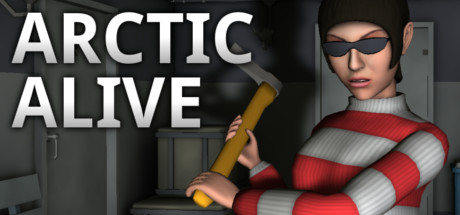
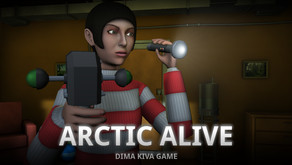
Arctic Alive, developed by Tort and published by Conglomerate 5, is a first-person survival horror experience that attempts to immerse players in the unrelenting cold and isolation of the Arctic. It places you in the role of an unnamed survivor trapped inside a remote scientific facility where a mysterious catastrophe has left the station in ruin and its inhabitants gone. With no clear explanation of what happened, you must navigate the abandoned complex, gather supplies, manage your body’s temperature and hunger, and uncover the truth behind the eerie silence that pervades every corridor. It is a concept that carries great promise—a psychological and environmental horror story built on survival mechanics—but one that struggles to maintain consistency due to its technical limitations and uneven design.
The game immediately establishes a chilling atmosphere. From the opening moments, Arctic Alive surrounds you with the howling wind, creaking metal, and a sense of absolute solitude that defines the frozen wasteland outside. Inside the Arctic station, flickering lights, foggy breath, and the dim beam of a flashlight evoke a constant feeling of unease. The player is not only battling the elements but also the oppressive sense that something unseen is watching. The setting itself becomes the primary antagonist. Each room feels like a small pocket of temporary safety within an otherwise inhospitable world. This environmental storytelling is where the game shines brightest—the abandoned laboratories, half-buried storage rooms, and snow-covered hallways all tell fragments of a larger mystery. You can almost piece together the lives of the scientists who once worked there through scattered notes and cryptic clues, giving the setting a hauntingly believable weight.
The survival aspect is central to the experience. Players must monitor key stats such as temperature, hunger, thirst, and stamina, all of which degrade rapidly in the freezing conditions. Resources are scarce, forcing you to carefully ration food and fuel. Simple tasks like lighting a fire or finding batteries for your flashlight become vital acts of self-preservation. The constant need to maintain warmth creates a layer of tension that persists even when no visible threat is present. While this system adds realism, it also highlights the game’s pacing issues. The mechanics can feel unforgiving, and without clear direction or balance, it is easy to get trapped in loops of starvation or hypothermia before making meaningful progress. The lack of an intuitive tutorial means much of the early game is spent in confusion, experimenting with controls and figuring out what each mechanic demands. This can be frustrating for new players, especially when paired with the clunky interface and dated design elements.
In addition to survival mechanics, Arctic Alive introduces a stealth and horror component that deepens the tension. At certain points, an unseen enemy begins to stalk the station. The only way to survive is to remain perfectly still or find cover, relying on sound cues and patience to stay hidden. These encounters, while rare, are genuinely unnerving thanks to the minimal sound design and unpredictable behavior of the entity. However, the stealth mechanics themselves are inconsistent. Movement is stiff, camera control can feel disorienting in tight spaces, and enemy detection doesn’t always behave logically. At times, you may be caught despite being concealed, while in other moments, the enemy may overlook you completely. The unpredictability can heighten the fear but also leads to frustration, especially given the sparse save points and the potential to lose significant progress after dying.
Arctic Alive’s ambition often exceeds its technical capabilities. Built using the Blender Game Engine, the game shows its limitations almost immediately. The textures are simplistic, animations are stiff, and the lighting can be overly harsh or inconsistent depending on the environment. While these flaws would normally detract from immersion, they sometimes work in the game’s favor, enhancing the sense of discomfort and unreality. The cold, low-poly visuals give the station a sterile and dreamlike quality, amplifying the isolation. However, performance problems—ranging from crashes and rendering glitches to occasional white-screen bugs—are common, and the lack of configuration options makes optimization difficult. Even small issues, such as delayed input or poorly placed objects, can break immersion. It is clear that the developers aimed high with limited resources, resulting in a game that feels both ambitious and incomplete.
Sound design plays a crucial role in shaping the experience. The constant wind outside, the creak of metal under pressure, and the echo of distant footsteps create a palpable sense of dread. There is minimal music, and when it does appear, it is often subtle—more of an ambient hum than a melody. The lack of dialogue or overt narrative direction means players must rely heavily on environmental cues and audio feedback to guide them. This choice contributes to the feeling of isolation but also leaves the story vague and open to interpretation. The narrative unfolds through fragmented notes and documents scattered around the facility, providing small insights into the events that led to the disaster. However, the writing is sparse and sometimes awkwardly translated, which limits emotional impact. The mystery of what truly happened at the Arctic base remains compelling, but its resolution feels underdeveloped, leaving players with more questions than answers.
Arctic Alive’s pacing is its most divisive element. The open-ended design encourages exploration, but its slow movement speed, repetitive environments, and frequent backtracking can make progression feel tedious. The map is expansive but confusing, with little guidance beyond trial and error. Without a clear objective marker or cohesive structure, it’s easy to wander aimlessly. For players who enjoy methodical exploration and discovery, this can create a strong sense of immersion; for others, it may simply feel aimless and disjointed. The atmosphere often carries the experience when the mechanics fail to engage. Those moments of quiet dread—listening to the distant groan of wind through the walls or spotting movement in the dark—can be genuinely chilling and remind you why Arctic Alive’s concept is so intriguing despite its flaws.
The game’s overall reception reflects its polarizing nature. Many players appreciate its ambition and the haunting atmosphere it achieves on a small budget. Its deliberate pacing, environmental realism, and focus on psychological horror have earned it a modest cult following among fans of obscure indie survival games. However, others find its technical shortcomings, lack of polish, and obtuse systems too frustrating to overlook. Its “Mixed” reception on Steam is fitting—it is neither a disaster nor a hidden gem but a rough experiment that manages to evoke genuine tension despite its flaws.
Ultimately, Arctic Alive is a flawed but fascinating survival horror experience that captures the loneliness and desperation of being stranded in the frozen wilderness. It thrives on atmosphere and restraint, building unease through silence, slow movement, and environmental storytelling. Yet its technical execution, outdated engine, and inconsistent mechanics prevent it from fully realizing its potential. For those willing to forgive its rough edges, it offers moments of haunting beauty and real fear—the kind that comes not from jump scares, but from the simple dread of freezing to death alone in an empty, forgotten world. It stands as an example of indie ambition reaching beyond its means, a frozen experiment in horror that is as fragile and fascinating as the ice it takes place on.
Rating: 5/10