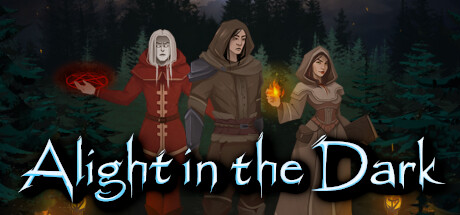
Alight in the Dark is a reverse bullet hell rogue-lite with a strategic ability and equipment system where player choice is not only crucial, but a core part of developing your build, allowing you to either survive or dominate based on the choices you make.
Modeled estimate, not a reported figure. How we estimate →
Media

About
Alight in the Dark is a reverse bullet hell survival game with a strategic ability and equipment system.

Players have limited inventory space and must choose items wisely. The game features side levels for a change of pace and rewards for completing challenges.

This game offers a fresh start each playthrough, but with permanent unlocks (characters, upgraded stats) for an advantage. It also has a permanent progression system where players earn souls for unlocking base stats.

Players use abilities and equipment to survive against relentless attacks and make strategic decisions using the elements of fire, earth, water, air, light, and shadow. Player choice is crucial and decision making is paused per choice. The game is set in a world where humanity underwent a "revolution of faith," resulting in the split of light into these elements.


Updates for this game have been postponed indefinitely, the roadmap below is where we would take the game next if it gains traction/popularity
Rewards from gaining Global profile levels (levels that persist between games) these can be used in a powerful skill tree like interface where choices matter depending on which Element path you want to focus on.
Tiers 1 through 4, levels 1 through 100 (Global levels)
- As of 29th July 2023, Tier 1 (levels 1 through 15) is now available.
Experience gains from release will persist for this future system, all experience gained in-game is added to a global total experience, which in turn is used for the Ascension System
Using equipment and certain ability combinations will result in the option to evolve them into stronger versions
These evolutions will aim to have their own sequence of upgrades
Tier 1 evolution: 2 maxed abilities = 1 evolved ability
Tier 2 evolution: 1 evolved ability + synergizing equipment = Tier 2 evolution of ability
We will be adding more maps, more abilities and more bosses, but in moderation. We will try not to make the game unnecessarily complex
We are currently leaning towards an approach to this were we raise the base game price per "big expansion", rather than doing a DLC approach
This will also introduce unique mobs per map, cutscenes for map and hero unlocks and more to come
Fight several or single bosses that have unique mechanics in a single challenge map for unique rewards
The Void boss encounters would be a perfect candidate for this where each element has its own unique boss
We intend to add a wide range of options for tweaking the game to your liking
Custom crosshairs/cursors
UI element positioning/layout
All configurable through XML files local to the executable, and stored using steam cloud
Once we're comfortable with our anti-cheat detection/implementations we will add leaderboards/hiscores
Potential for entire game Replays to be stored for anti cheat purposes and/or for a subscription fee to cover server costs/networking for this
Replay system will most likely be free for local use/"unranked"
General idea is to have some official game modes like "limit break" where you lock in one ability and its upgrades go on forever
We might also add sped up gameplay to this (faster wave timers) as well as more max mob spawns per wave
There is a good chance that we even take this to the next level and allow users to make their own shareable game-modes with their own rules/settings
Stats
All-time low is the lowest price we've recorded for this game since we started tracking it.
Languages: English**languages with full audio support
Reviews
This has the bones of a good horde survival game, but I'm confused as to why it's not marked as Early Access. It's clearly incomplete and under active development, with a major progression mechanic labeled "coming soon". The maps all appear to have the exact same enemies and waves, with the only difference being which character gets unlocked when you enter a little room. There are also a number of weird design choices (why would i want to go back to a character unlock location again?) and the balance is all over the place. For whatever reason, the menus use a very low contrast color for the selection, so it's easy to make incorrect choices if you happen to be colorblind. If this was early access and priced in line with the many, [b]many[/b] other, more polished, horde survival games, I'd give it a positive recommendation. But right now it's an incomplete game with about 4 hours of content, which is not something I'd recommend for $10.
Great game, oddly addicting
Edit: Thank you for the response Devs, I didn't realize the game was still in development. That being considered, this game has a great foundation currently, I will be looking forward to updates. Definitely a fun game, but there are a a few mechanics that I feel are poorly explained. I have unlocked all characters and maps, but can't use the Halls of Ascension. The game doesn't really tell me what that is or how to use it. I also hope there are more gear pieces than I think there are. My gear encyclopedia is full, with around 30 pieces, which sounds like a ton, but considering there are 14 slots that's 2-3 options per slot. I also don't understand the store page's Ability Synergies & Evolutions section (maybe that's ascension related?) I haven't seen any evolved abilities that I know of. Maybe I'm missing some option in the game explaining this, but I can't find it. Overall a good game, I just think there needs to be something in game to explain some of this.
Alight in the Dark, developed and published by Furious AS, is a roguelite action game that takes the familiar bullet hell formula and subtly inverts it, shifting the emphasis away from tightly choreographed projectile patterns toward a more fluid, survival-driven chaos. Instead of memorizing attack sequences, players are placed in situations where threats emerge dynamically, forcing constant movement and adaptation. The result is a game that feels less like a test of memorization and more like an ongoing struggle to maintain control in an increasingly hostile environment. Each run begins with a basic setup and quickly evolves as enemies close in from all directions. The core loop revolves around staying alive while gradually building a character through a series of decisions that appear at regular intervals. These choices define the direction of a run, shaping how abilities interact and how the player approaches combat. The game frequently pauses the action to present upgrades, encouraging players to think carefully about their selections rather than reacting purely on instinct. This design creates a balance between fast-paced movement and deliberate planning, giving the experience a rhythm that alternates between tension and reflection. One of the most engaging aspects of the game is its build system. Players can combine abilities tied to different elemental themes, creating a wide range of potential playstyles. Some combinations focus on dealing consistent damage across large areas, while others emphasize defensive strategies or crowd control. Equipment further modifies these abilities, allowing for additional layers of customization. The interplay between these elements gives each run a distinct identity, and discovering effective synergies becomes a key part of the experience. At the same time, the game limits how much players can carry, forcing them to make meaningful decisions about what to keep and what to discard. Progression follows a familiar roguelite structure, where individual runs reset temporary power but contribute to long-term growth. Over time, players unlock new characters and improvements that make subsequent attempts more manageable. This gradual sense of advancement helps maintain engagement, even when individual runs end in failure. The learning curve is tied not only to mechanical skill but also to understanding how different systems interact, which adds depth without making the game overly complex. The pacing is relentless, with enemy density increasing rapidly as each run progresses. The screen can quickly fill with threats, requiring players to constantly reposition and manage space effectively. This creates a sense of pressure that rarely lets up, making each successful run feel earned. However, the intensity can also become overwhelming, particularly in later stages where the sheer number of enemies can make it difficult to maintain control. The challenge is less about executing precise movements and more about staying aware of the overall situation, which gives the game a distinct feel compared to more traditional bullet hell titles. Visually, the game adopts a dark and somewhat minimalistic style that supports clarity during chaotic moments. Effects tied to abilities and enemy attacks are easy to read, which is essential for maintaining control when the screen becomes crowded. While the presentation is consistent, it does not push beyond functional design, focusing on readability rather than visual impact. The atmosphere is effective but understated, serving the gameplay without drawing attention away from it. Despite its strengths, the game’s scope is relatively limited. While the build system offers variety, the overall structure of runs does not change significantly over time. Once players become familiar with the available abilities and enemy behaviors, the experience can begin to feel repetitive. The lack of additional modes or significant content expansions further reinforces this limitation, making the game feel like a solid foundation that is not fully developed. Even so, Alight in the Dark succeeds in delivering a focused and engaging experience within its chosen framework. Its emphasis on decision-making and build experimentation adds a layer of depth that complements its fast-paced action, making it appealing to players who enjoy refining strategies as much as reacting in the moment. It may not offer the breadth or longevity of larger roguelites, but it provides a satisfying loop that can be enjoyed in shorter sessions. In the end, Alight in the Dark is a well-crafted but modest entry in the roguelite genre, offering a unique twist on bullet hell mechanics through its emphasis on adaptability and build diversity. It stands out through its ideas, even if it does not fully expand on them, and remains an enjoyable experience for players willing to engage with its systems. Rating: 6/10
Liker veldig godt at jeg har spilt i 10+ timer å enda har masse og utforske og åpne.
Ждал игру в зелёном магазине, а её всё нет и нет, решился купить и понял, почему её там нет. Игра очень сырая, русского языка нет (хотя там текста минимум, могли бы хоть через автоперевод запихнуть), тёмная до усёра, глаза напрягаешь постоянно, чтобы хоть что-то разглядеть, плюс анимации эффектов прям не оч выполнены. В общем - не советую к покупке, запросил рефанд
Related
Related
Trends
Modeled estimate over time, reconstructed from Steam's monthly review histogram.
Momentum
Pace estimated from the game's recent review growth (our daily snapshots) at its own sales-per-review ratio — a momentum signal, not booked sales.
Related
| Glasses and Girls | $315.6 | 51 | 82% | $0.99 |
| Bongo Quest | $322 | 52 | 46% | $0.99 |
| Dances and Girls | $322 | 52 | 83% | $0.99 |
| Anime Sunset Ride | $334.4 | 54 | 67% | $0.49 |
| Cosmic Journey PC Live Wallpaper | $336.3 | 52 | 71% | $0.99 |
| Girls and Dragons | $340.5 | 55 | 76% | $0.99 |