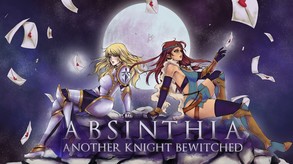
Absinthia is a turn-based RPG featuring the story of scorned Knight Freya, her young apprentice Sera, and their individual struggles with loss, betrayal and acceptance as they fight to protect their home.
Modeled estimate, not a reported figure. How we estimate →
Media

About


Stats
All-time low is the lowest price we've recorded for this game since we started tracking it.
Languages: English
Engagement
Hours played at review time, across 40 reviews with recorded playtime.
Reviews
Themes across 40 recent reviews and how positive each mention is. A keyword signal, not full sentiment analysis.
positive critical· bar length = how often the theme comes up
Reviews
GAY PEOPLE
I liked the game. Combat was pretty fun/a little different from the standard RPG Maker. Story started to heat up after a few hours, with some good twists and turns. Has really cute pixel art, interesting characters, definitely worth the price.
Knight Bewitched is still my favourite in this series - because the central romance was so charming - but I'm liking this one so far.
I've been a fan of keith's game. and this one hits hard.
Absinthia, developed by Joshua Keith in collaboration with Team Bewitched and published by Team Bewitched, is a character-driven indie JRPG that embraces retro inspiration while focusing heavily on emotional storytelling and inclusive representation. Set in the Ambrose Isles, the narrative follows Freya, a disciplined knight, and her apprentice Sera, whose quiet life is shattered by forces that threaten not only their homeland but their personal convictions. What begins as a localized conflict soon expands into a journey marked by betrayal, grief, identity struggles, and the difficult process of growth through hardship. Though modest in scale, the story carries an earnest tone that distinguishes it from many nostalgia-driven RPG projects. Combat in Absinthia adheres to traditional turn-based mechanics while incorporating modern pacing adjustments. Battles are initiated through visible overworld encounters rather than random interruptions, allowing players to engage on their own terms. The regenerating MP system encourages frequent use of abilities instead of conservative resource hoarding, which keeps combat flowing and strategic rather than grind-heavy. Party members can coordinate through combination skills and synergistic techniques, adding layers of tactical decision-making. While the mechanics do not radically innovate within the genre, they are polished and balanced enough to support varied playstyles. Adjustable difficulty settings further allow players to tailor the experience toward either strategic challenge or narrative immersion. Exploration unfolds across towns, dungeons, and natural landscapes rendered in colorful pixel art reminiscent of 16-bit era RPGs. The visual presentation strikes a balance between simplicity and expressiveness, with detailed character portraits enhancing emotional dialogue scenes. Environments are compact but thoughtfully designed, offering hidden treasures and optional interactions that reward curiosity. Dungeons focus more on combat and progression than on elaborate puzzle-solving, maintaining steady pacing. Though not sprawling in scale, the world feels cohesive and carefully constructed. A defining strength of Absinthia lies in its character writing and representation. The cast includes LGBTQ+ protagonists and supporting characters whose identities are integrated naturally into the story. Themes of acceptance, vulnerability, and resilience are woven into character arcs without feeling tokenistic. Sera’s personal journey from insecurity to self-assurance, Freya’s mentorship and internal conflicts, and the evolving relationships within the party give the narrative emotional weight. These interpersonal dynamics elevate the experience beyond homage, offering a sense of authenticity that resonates strongly with players seeking representation within the JRPG framework. The soundtrack complements the retro aesthetic with compositions inspired by classic console RPGs while maintaining its own melodic identity. Music shifts fluidly between contemplative town themes and energetic battle tracks, reinforcing emotional beats without overwhelming dialogue or exploration. Sound design remains understated but effective, supporting the atmosphere rather than drawing attention to itself. As an indie production, Absinthia inevitably reflects its scope. The campaign runs roughly a dozen hours, making it shorter than many genre counterparts. Certain dialogue exchanges may feel uneven, and dungeon segments occasionally emphasize combat repetition over environmental variety. However, these limitations are offset by the sincerity of its storytelling and the consistency of its design philosophy. Rather than attempting to replicate large-scale RPG epics, it delivers a focused narrative experience centered on character growth. Ultimately, Absinthia succeeds as a heartfelt tribute to classic JRPG traditions while carving out space for modern themes and inclusive storytelling. It may not redefine the genre mechanically, but it offers a well-crafted blend of turn-based combat, pixel-art charm, and emotionally resonant character arcs. For players who value narrative depth and representation alongside nostalgic gameplay foundations, it stands as a thoughtful and memorable indie RPG experience. Rating: 8/10
This game is off to a great start. I'm playing on hard and it feels pretty fair, nothing to crazy but you have to really pay attention in battle because you can get wiped out pretty quick. MUSIC: 9/10 Very enjoyable, but I felt like some parts of it were too loud Combat: 8/10 Every character has a skill that regenerates MP, in addition to providing other buffs for a few turns. I think this combat system is really fun, and the battles are just the right length. The only concern is that enemies are already applying status affects right at the beginning, and you don't really have any items so it might feel like a kick in the teeth for more casual RPG players. I didn't have any trouble adapting, but it certainly was surprising and kinda annoying to have to deal with it constantly. Other than that, the mechanics are very satisfying. Exploration: 9/10 This is where this game really sold itself. The exploration is very satisfying, with plenty of items to find. It even has secret areas hidden throughout the world. Locations are very detailed, with all sorts of npcs and architecture. My only complaint is that you can only interact with very limited objects; a little more text upon interacting with things would be great for your next game. Visuals: 9/10 Beautiful pixel art, with very detailed character portraits for all the main characters. A lot of characters don't have portraits, but I don't think anyone can complain about that when they see how detailed the artwork is. Everything in the game is really enjoyable to look at, especially the special effects over the screen (such as leaves blowing). I am really impressed, especially by the combat screen. Enemies all have great designs, and you can see your entire party from behind. It's a really nice improvement over this developers previous games, and really stands out from other RPG maker games. The game would be perfect in this aspect if it wasn't for the boring UI, which also has the item text cut off in the inventory. Performance: 10/10 The game runs flawlessly with my recording setup. It's smooth with no hiccups so far. Overall Rating: 9/10
I bought it mostly because the artstyle, so Absinthia is quite better than I initially expected. I strongly recommend it to RPGMaker enthusiasts and moderately recommend it to turn-based JRPG fans. Keep in mind that I played on easy difficulty and haven't played other related games. [h2]Story[/h2] I somewhat enjoyed the story. It's less simple than I initially expected, since I didn't see the plot twists coming. But regarding the main casts, I feel there's insufficient build-up or exploration to make me feel invested. I even finished many side quests that contain more story and character interactions. So it's a shame, because I believe it has potential to be an amazing and emotional story. The LGBTQ+ element doesn't feel forced or excessive, but I felt amount of pop/modern culture references is too much, which felt distracting from the main story. [h2]Gameplay[/h2] I feel easy difficulty closer to medium ones, but the turn-based combat is actually fun and balanced. Using strategy feels rewarding, and I almost never spam attack/heal loop or use auto-combat. The enhanced/combined skill system based on character availability (whether in party and not receiving certain debuffs) is decent gameplay design and makes overall combat and strategy feel richer. Some grinding is necessary if you can't strategize well, but I appreciate lack of random encounters. Aside from combat, you can explore around, finding secrets and solving puzzles. The puzzles are just like other RPGMakes, with good balance. I never felt bored due to being too easy or frustrated due to poor design. Additionally, story mode difficulty exists, but I didn't choose it since some puzzles would be skipped by the game. [h2]Visual and Audio[/h2] The overall visual quality is outstanding by RPGMaker standards. It has a great classic/retro pixel style, while also feel fresh. Many of the battle animations are great, I never changed setting to reduce or disable them. Aside from that, it features custom UI design, wide-screen aspect ratio and even pixel perfect scaling option. Both sound effects and soundtrack are also decent enough, that I decided to buy it. I only wish there were some cutscenes or CGs during certain parts of the story. [h2]Other[/h2] This game runs without any problem on my Linux device, without any tweaks.
A heartfelt story, deals with some queer topics very well, most particularly trans people, the trauma inflicted upon them and how it can affect one's perception and decisions. I especially appreciated that the solution to major conflicts between lovers in this game is never a sudden, complete exoneration and restoration of the old norm. Characters spend a lot of time uncertain about where they stand with each other. We come away from these situations hopeful but ultimately uncertain as to whether anything like what the characters once had will be reached. The hurt is not downplayed, it's real. And the wrongdoer is not always innocent and misunderstood, there's some real toxic ♥♥♥♥ here. It's not the best written game I've ever played, but the care was put in to create very compelling characters and tell very relevant stories with them. Gameplay is pretty good. I always enjoyed getting new abilities, as well as finding side content and secrets for new gear and such. It's not amazing and sometimes I got a little tired of the battles, but the JRPG fatigue is helped by the game's relatively short length and the lack of random encounters (outside of two very specific sections that reference a previous game). Got it for $5 and never regretted it. Very worth both the time and money (even at full price, imo)
Good Game ! Probably better than Octopath Traveller, and cheaper too.
Absinthia is a game that is difficult to recommend simply because of how odd it can be. To start with, this RPG doesn't tell a massive story but a much more personal one. The story is largely about Freya, one of your party members, and Lilith, a woman who is out to destroy lives for whatever reason. Lilith is constantly attacking a single town, Katti Town, and largely ignores the rest of the world. Freya is training three children of Katti Town to help defend it. Sera, the knight's apprentice, Jake, the thief, and Thomas, the wizard. These three make up your party for the majority of the game, playing as Sera. First up, the combat. The combat is unique in that the entire thing is a balancing act. You can attack, use skills, use items, and flee in most battles, with every character having a sort of 'defend' action in their skills menu. This skill will typically give some sort of self-buff for a few turns and regenerate MP. Every character has the same maximum MP and you regenerate some of it per turn. This means combat is a dance of sorts; balancing offensive actions with defensive ones to keep your MP high so you can keep using skills. This also means going all-out can often be a difficult choice, as it leaves you basically helpless in following battles until you get your MP back. As you play it a lot, you get the hang of this system and get a good sense of when you should go offensive and when you should fight strategically, especially on higher difficulties. The characters are a part that is... difficult to talk about, since they're handled a bit differently than most RPGs. Characters aren't really explored too deeply; while everyone has some elements of depth to them, characters are much more grounded in this world. You get just enough personality to get an idea of how they're like, but not much more than that. What's a little harder to swallow for some is that every party member is some element of LGBTQ+. Jake and Thomas are a couple, Freya is a lesbian, and Sera is asexual. I bring this up because these are things that will come up in conversation. However, this is also where I applaud the game as they're treated less like they're a big deal and just aspects to the characters; small parts of the whole. Sera struggles the most with her asexuality and, even then, merely coming to the conclusion that it's okay to have no real attraction to anyone as of now, nor drive to change that. She accepts it, which is fine. The one downside to this is that it does come across a little like 'if everyone is special, no one is special', but, like I said, these relationships are downplayed as much as possible not to be a vocal point of any one character or their interactions with others. Jake and Thomas get the most exploration of their relationship and, even then, they have their minor issues between them; moments of trust needing to be built upon. Freya's relationship with Ruthea, doesn't get quite as much development as it probably needed to have, but I can't hold this against the game. None of the interactions overstayed their welcome, as far as I'm concerned. The soundtrack is also quite good, though I wish some themes would show up more often. Certain boss themes are amazing, but only show up once and only in side quests, making them really easy to miss. The world also feels a little small, making it feel like there isn't much to find, but considering this is a shorter RPG, I feel that's to the game's strength. If I had to say something negative about the game... the story isn't great. It gets a little generic and, by the end, I felt like Lilith's motivations weren't explored enough. For how well the main cast is characterized, the villains are significantly less so. There is also a later curveball about Freya that gets dropped and... basically never brought up again. All in all, a very good, competently made RPG. I'd recommend it for the gameplay alone; the combat system is pretty interesting and is the reason to play it.
Related
Related
Trends
Concurrent players on Steam, sampled daily since tracking started.
Audience
Estimated from the language of this game's reviews — a proxy for where players are, not official Steam demographics.
Related
| Wild Dogs | $15.3K | 74 | 97% | $9.99 |
| Self-Isolation | $15.3K | 489 | 85% | $1.24 |
| Ultreïa | $15.3K | 78 | 92% | $13.99 |
| Alphadia Genesis | $15.3K | 135 | 79% | $4.99 |
| Rhythm Destruction | $15.3K | 135 | 45% | $4.99 |
| Gravity Den | $15.3K | 135 | 81% | $4.99 |
Related
| 7 Days to Die | $425.3M | 403.5K | 87% | $44.99 |
| Mount & Blade II: Bannerlord | $309.8M | 293.9K | 88% | $49.99 |
| Palworld | $279.6M | 445.8K | 94% | $20.99 |
| Clair Obscur: Expedition 33 | $243.3M | 273.2K | 95% | $47.99 |
| Project Zomboid | $239.1M | 460.8K | 94% | $19.99 |
| Terraria | $187.5M | 1.5M | 97% | $9.99 |