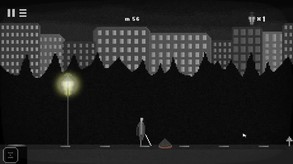
Game about a blind old man. Who includes street lights. Because the whole world is in darkness. The blind man can only stop, using the space bar. Help him to lighten the dark cities. Avoiding obstacles using the left mouse button.
Modeled estimate, not a reported figure. How we estimate →
Media

About


Stats
All-time low is the lowest price we've recorded for this game since we started tracking it.
Languages: English
Engagement
Hours played at review time, across 40 reviews with recorded playtime.
Reviews
Themes across 40 recent reviews and how positive each mention is. A keyword signal, not full sentiment analysis.
positive critical· bar length = how often the theme comes up
Reviews
The game is based around a blind person who claims to have superpowers, such as being able to turn on lights, destroy fires, and move manholes, but the most tedious thing to deal with in this game are the spikes. While there are only six levels, each are repetitious and uninteresting. It's an unchallenging game that's overwhelmingly expensive, even on 90% it's not worth getting.
Boring and repetetive gameplay, with the graphic quality being no better, not worth 5$.
Ablepsia is a minimalist arcade-style title developed and published by NedoStudio that revolves around a strikingly simple yet unconventional premise. The player accompanies a blind elderly man who continuously walks forward through cities engulfed in total darkness. Electricity has failed, streetlights are extinguished, and danger lurks in unseen obstacles scattered across each urban landscape. The objective is not traditional exploration or narrative discovery, but rather survival and progression through reactive timing. By metaphorically “bringing light back” through lighting street lamps and clearing hazards, the game frames its mechanical loop within a symbolic journey through darkness. The most distinctive feature of Ablepsia is its unusual control scheme. The protagonist moves automatically at a steady pace, and players cannot directly steer him left or right. Instead, interaction is limited to a few core actions: stopping movement, accelerating temporarily, and clearing obstacles with mouse clicks. This constrained design shifts the focus entirely onto timing and anticipation. Since the character cannot see, and movement is constant, every decision revolves around judging when to halt or remove hazards before collision. It creates a gameplay rhythm that blends reflex-based action with pattern recognition. Each city introduces new arrangements of obstacles and environmental hazards that demand quicker reactions as the pace increases. The escalating challenge relies less on introducing complex new mechanics and more on tightening reaction windows and layering obstacle density. The tension stems from the constant forward motion—there is no option to move backward or reposition strategically. Mistakes are often immediate and punishing, reinforcing the arcade-like emphasis on short bursts of focused attention. This structure makes the game particularly suited for brief sessions rather than extended play. Visually, Ablepsia embraces stark minimalism. The environments are dark and simplified, composed primarily of silhouettes and limited color contrasts. The lack of elaborate detail reinforces the thematic focus on blindness and darkness, but it also results in a presentation that feels deliberately bare. Animations are basic, and the aesthetic prioritizes functional clarity over artistic complexity. Sound design follows a similarly stripped-down approach, offering straightforward audio cues that support gameplay without contributing heavily to atmosphere. One of the more thought-provoking aspects of Ablepsia lies in how it reinterprets control and perception. By removing direct navigation and emphasizing reaction over planning, the game creates a feeling of limited agency that aligns with its central character concept. This design can be interpreted as a deliberate mechanical metaphor for navigating an uncertain world without sight. However, while the concept is compelling, the game does not expand significantly beyond this central idea. The absence of additional layers—such as evolving mechanics, story progression, or meaningful upgrades—means the novelty may wear thin after repeated sessions. Replay value is modest and primarily tied to mastering reaction timing or achieving better performance across levels. There are no extensive progression systems or branching pathways to encourage long-term investment. Instead, Ablepsia remains tightly focused on its core loop from beginning to end. For some players, this singular focus provides a sharp and contained challenge. For others, it may feel too limited in scope. Ultimately, Ablepsia stands as an experimental indie project that prioritizes concept over complexity. Its automatic movement system and reflex-driven gameplay create moments of tension and urgency, particularly for players who enjoy arcade-style challenges. While its minimalist presentation and limited mechanical variety may prevent it from achieving broader appeal, it remains an intriguing example of how unconventional control schemes can shape player experience. As a compact, concept-driven game, it offers a brief but distinctive journey through darkness that highlights both the strengths and limitations of minimalistic design. Rating: 5/10
gg
göbeğimi kaşısam kendime daha çok faydam olurdu
Даже не знаю, что сказать. Глаза болят)
Теперь могу всякие похабные слова на витрине писать 🗿🗿🗿
игра норм но 289р за такую игру много ведь за такую цену есть очень топовые по проработки игры такие как террария, портал 2 и другие игра короткая но расслабляющая играть после школы самое то я бы не советовал покупать без скидки (или покупайте на сторонних сайтах )
[h1] Ablepsia [/h1] 가격 : 560원 (2026.02.12) ㄴ[strike] 5600 90% [/strike]
Why they gotta name the blind man "Blind" ?!?
Related
Related
Trends
Modeled estimate over time, reconstructed from Steam's monthly review histogram.
Momentum
Pace estimated from the game's recent review growth (our daily snapshots) at its own sales-per-review ratio — a momentum signal, not booked sales.
Audience
Estimated from the language of this game's reviews — a proxy for where players are, not official Steam demographics.
Related
| Stardust Trial | $1.4K | 76 | 99% | $0.99 |
| Quiver Dick's Terrible Tale For Terrible Parents To Read To Their Equally Terrible Children | $1.4K | 116 | 88% | $0.99 |
| Black River | $1.4K | 58 | 55% | $0.79 |
| Impostor Inside Us | $1.4K | 53 | 66% | $0.99 |
| Jad | $1.4K | 70 | 74% | $1.18 |
| No Way Out | $1.4K | 140 | 45% | $0.99 |