Cold War turns hot in 1953: massive hex strategy with nukes, supply, and sabotage.
Modeled estimate, not a reported figure. How we estimate →
Media
About
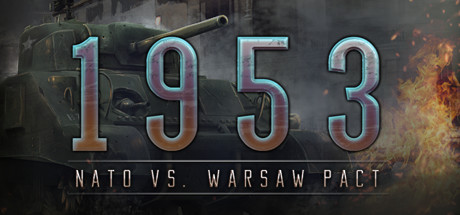
1953: NATO vs Warsaw Pact is a large-scale, turn-based wargame that simulates a fictional Third World War triggered by Stalin’s death and a breakdown in East-West diplomacy.
Take control of over 30 nations across a detailed hex-based map of Europe, covering more than 40,000 tiles. Whether you're commanding NATO forces or the Warsaw Pact, you'll face a brutal campaign of attrition, diplomacy, and nuclear brinkmanship.
🧭 Features:
– Massive hex map of Europe with historical geography and borders
– Playable nations include the US, UK, France, USSR, East Germany, Poland, and many more
– 5 tech trees including nuclear weapons, advanced logistics, air and naval upgrades
– Sabotage and coups: Influence neutral countries and destabilize opponents
– Detailed supply mechanics: Weather, fuel, morale, and fog of war all matter
– Hotseat support: Play solo or against another human on the same PC
This is a system-heavy strategy game with a classic interface and long turn processing times. It's made for fans of traditional hex wargames and Cold War history. There's no hand-holding — only hard decisions in a brutal alternate timeline.
Genres
Stats
All-time low is the lowest price we've recorded for this game since we started tracking it.
Languages: English**languages with full audio support
Engagement
Hours played at review time, across 40 reviews with recorded playtime.
Reviews
Themes across 40 recent reviews and how positive each mention is. A keyword signal, not full sentiment analysis.
positive critical· bar length = how often the theme comes up
Reviews
整个游戏不咋样
meh
5
[h1]1953: NATO vs Warsaw Pact – A Strong Wargame Idea Buried Under Waiting and Poor Onboarding[/h1] [i]I have been gaming since the 1980s, have played thousands of games across PC and consoles, and have written close to 500 Steam Curator reviews. I spent 7.2 hours with 1953: NATO vs Warsaw Pact. I tried to judge it as an old-school hex wargame rather than expecting a fast modern strategy game, but its presentation and pacing made it difficult for me to remain engaged.[/i] [hr][/hr] [h2]An interesting alternate Cold War[/h2] The premise is immediately attractive to anyone interested in military history or alternate history. Stalin dies in 1953, diplomacy between East and West collapses, and Europe becomes the battlefield of a fictional Third World War. The title is technically anachronistic because the Warsaw Pact was not formally created until 1955. Here it works as convenient shorthand for a Soviet-led Eastern bloc fighting NATO rather than as a strictly historical label. You can command NATO or the Soviet-aligned side across a very large hex map of Europe. The game advertises more than 30 nations and over 40,000 map tiles, so this is not a small tactical scenario. It attempts to model an entire continental conflict involving land forces, air power, navies, diplomacy, technology, sabotage, logistics and nuclear escalation. That scale is the main reason the game is interesting. It is also the source of many of its problems. [h2]Systems and strategic depth[/h2] This is a traditional turn-based wargame rather than something designed around spectacle. Units are represented by counters and statistics, while the map and menus carry most of the information. Supply, fuel, morale, weather and fog of war all influence operations. Moving units forward without maintaining logistics can make an offensive collapse, while terrain and positioning matter more than simply collecting the largest army. There are five technology trees covering areas such as nuclear weapons, logistics, air forces and naval development. The political side also allows sabotage, coups and attempts to influence neutral countries. These systems create the possibility of a deep campaign. A player can think beyond individual battles and consider production, reinforcement routes, diplomacy and whether escalating to nuclear weapons is worth the consequences. The game also includes hotseat play, allowing two people to control opposing sides on the same computer. There is no normal online multiplayer listed. [h2]The interface does not teach the game[/h2] Complexity is not automatically a flaw. I have played games for decades, and I do not expect every strategy title to simplify itself for casual players. However, a complicated game still needs to communicate its rules. 1953 gives the player a large map, many countries and several interconnected systems with very little useful onboarding. There is no proper guided tutorial that gradually introduces movement, combat, supply, diplomacy and research. The interface is functional in the sense that buttons and information exist, but it feels dated and assumes that the player already understands what the game wants. Important information is spread across menus, while actions and consequences are not always explained clearly. There is a difference between refusing to hold the player’s hand and failing to provide the information needed to make informed decisions. Too often, this game falls into the second category. [h2]Turn processing is the largest problem[/h2] Slow and deliberate decision-making can be appropriate for a large wargame. Waiting for the computer to process dozens of countries is something else. The official store description now openly warns about long turn-processing times, and this issue dominates many player reports. With more than 30 nations taking actions, a single AI phase can take an excessive amount of time. That damages the central loop. A strategy game should make me spend time studying the map, planning an offensive and reacting to the opponent. Here, too much time can be spent waiting for the simulation to return control. A huge map and many independent nations sound impressive, but scale only improves a game when the engine can process it at a reasonable pace. Otherwise, the size becomes a burden rather than a strength. [h2]Presentation and atmosphere[/h2] Visually, this is a practical 2D wargame. The map, counters and menus are made to display information rather than cinematic battles. That is acceptable for the genre, but the presentation is still rough. The interface looks old, the feedback is limited and the overall experience lacks polish. Players who need animated battles, detailed unit models or dramatic storytelling will find very little here. The Cold War setting does provide atmosphere through the map, alliance structure, early nuclear technology and constant possibility of escalation. The tension comes from the scenario and the player’s imagination rather than graphics or narrative scenes. [h2]Content and value[/h2] There is a great deal of theoretical content for the price. The map is enormous, many nations are represented, and the combination of military, political and technological systems could support long campaigns. That explains why some dedicated wargame players are willing to recommend it. For someone who enjoys studying counters, supply networks and alternate military history, the low price may justify experimenting with it. However, quantity is not the same as usable value. A large campaign is difficult to appreciate when the game does not teach its systems well and repeatedly interrupts play with long processing times. Steam Trading Cards and Points Shop items exist, but they should not be the main reason to buy a strategy game. [h2]Final verdict[/h2] 1953: NATO vs Warsaw Pact has a premise I wanted to like. A continent-wide Cold War conflict with logistics, diplomacy, sabotage, technology and nuclear brinkmanship could make an excellent grand wargame. The underlying ideas are stronger than the finished experience. The dated interface, weak onboarding and extremely slow turn processing make the game harder to learn and more exhausting to play than its strategic systems justify. This is not simply a demanding strategy game. It is a game where technical and presentation problems stand between the player and the strategy. [b]Not recommended for most players.[/b] Very patient fans of traditional hex wargames may still find something worthwhile here, especially at a deep discount. Everyone else is likely to spend more time trying to understand the interface or waiting for the AI than enjoying the alternate war itself.
kaif
старая но при этом все еще занимательная стратежка
👍👍👍
以欧洲为地图的回合战略游戏,感觉一般,看好评率也确实不太好
Не знаю как вам , а мне понравилась эта олдскульная игра) Мне зашло 8/10 котеек
for me, this game so interested. I love history and everything related to her. in two words - i recommend
Related
Related
Trends
Modeled estimate over time, reconstructed from Steam's monthly review histogram.
Momentum
Pace estimated from the game's recent review growth (our daily snapshots) at its own sales-per-review ratio — a momentum signal, not booked sales.
Audience
Estimated from the language of this game's reviews — a proxy for where players are, not official Steam demographics.
Related
| Demon Command Token 御妖令 | $3.6K | 62 | 74% | $2.09 |
| Deep, In the Forest | $3.6K | 60 | 67% | $3.59 |
| NightGhast | $3.6K | 78 | 91% | $2.99 |
| Radium | $3.6K | 162 | 80% | $0.99 |
| Kittenwood Cats - A Hidden Object Game | $3.6K | 214 | 98% | $1.29 |
| Jump Fucker | $3.6K | 52 | 58% | $4.99 |