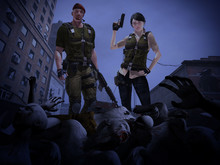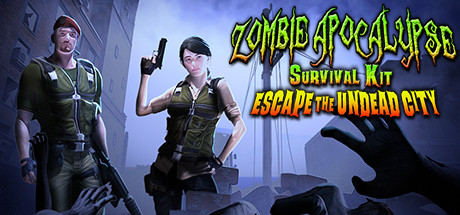
Battle through Zombie Apocalypse horror! Which is better - shotgun, pistol or AK-47? Blast their rotten, infected brains out and choose your favorite! Scavenge weapons and armor to pimp out your souped up zombie slaying car - then plow down the man-eating hordes to Escape the Undead City, and try not to get your guts torn out!!!
Modeled estimate, not a reported figure. How we estimate →
Media

About
Stats
All-time low is the lowest price we've recorded for this game since we started tracking it.
Languages: English**languages with full audio support
Engagement
Hours played at review time, across 40 reviews with recorded playtime.
Reviews
Themes across 40 recent reviews and how positive each mention is. A keyword signal, not full sentiment analysis.
positive critical· bar length = how often the theme comes up
Reviews
It is worth playing at least once .
Zombie Apocalypse: Escape The Undead City is a heart-pounding survival thriller! Navigate zombie-infested streets, scavenge for resources, and make split-second decisions in this intense action-adventure. The gripping storyline, atmospheric horror elements, and strategic gameplay keep you on edge, while stunning visuals and eerie sound effects heighten the excitement. A must-play for horror enthusiasts-thrilling and addictive!
BU OYUNU SATIN ALIP KOLEKSİYON KARTLARINI SATARAK KAR ELDE EDEBİLİRSİNİZ.BU VE BUNUN GİBİ 250 ADET OYUNU GÖRMEK İÇİN PROFİLİMİ ZİYARET EDİN! ARKADAŞ EKLEMEKTEN ÇEKİNME
masterpiece
It was ok...
Thiago: Isso parece um jogo de terror que apareceria em um filme de terror
норм
ничего не понял...
Zombie Apocalypse: Escape The Undead City, developed and published by Anarchy Enterprises, is an indie action game that attempts to blend the intensity of zombie survival with the accessibility of casual shooting and hidden-object gameplay. On paper, it presents an enticing premise: a desperate escape through a city overrun by the undead, armed with an assortment of makeshift weapons and a customized car designed to mow down zombies by the hundreds. However, beneath this intriguing concept lies a title that struggles to balance its hybrid mechanics, offering a mix of ideas that never quite coalesce into a cohesive or memorable experience. While it has moments of frantic fun, the game’s simplistic design, lack of depth, and repetitive structure prevent it from standing out in an already crowded genre. The story, such as it is, sets the stage quickly. The player finds themselves trapped in a metropolis collapsing under the weight of a zombie outbreak, forced to scavenge for supplies, upgrade weapons, and carve a path to safety. The narrative is almost entirely told through brief text prompts between levels, with little context or character development to drive the player’s motivation beyond the surface-level goal of survival. The atmosphere tries to evoke desperation and chaos, but the minimalist storytelling and lack of tension leave the experience feeling hollow. There is no real sense of progression or mystery to uncover—no worldbuilding beyond the immediate backdrop of ruined streets and faceless hordes. The city itself serves as a backdrop rather than a living environment, functioning primarily as a stage for shooting galleries and timed sequences. Gameplay follows a formulaic loop that combines two primary modes: stationary shooting sequences and hidden-object intermissions. The shooting segments place the player on fixed rails, defending against waves of zombies that approach from multiple directions. Weapons include pistols, shotguns, assault rifles, and grenades, though the shooting mechanics are simplified to a point-and-click system that lacks the tactile feedback of a true action title. These encounters are occasionally interrupted by scavenging scenes, where the player must locate items in cluttered environments to repair their vehicle or upgrade gear. The idea of alternating between frantic combat and quiet exploration could have introduced variety, but the transitions feel abrupt and disconnected. Rather than complementing one another, the two gameplay types compete for attention, resulting in a jarring rhythm that keeps the experience from finding a natural flow. The progression system offers limited customization, mostly through upgrading the so-called “zombie-slaying car” that serves as a symbol of survival. In concept, this upgrade feature should provide a sense of growth—adding armor, better weapons, or speed to your vehicle as the campaign advances. In practice, it’s underutilized, with upgrades arriving late and offering negligible changes to gameplay. The car sequences themselves, which should have provided exhilarating moments of vehicular chaos, instead feel scripted and repetitive. The player watches as zombies splatter across the windshield or get knocked aside, but the sense of control is minimal, reducing what could have been a dynamic feature to little more than a visual gimmick. Visually, the game is functional but uninspired. The graphics rely on basic 3D models and repetitive textures, with zombie designs that quickly lose any sense of menace after the first few encounters. The environments—crumbling city blocks, underground tunnels, and industrial zones—are presented in dull palettes of gray and brown that do little to establish a unique identity. The animations are stiff, and the lack of variety in enemy behavior makes most encounters feel identical. While performance remains stable even on low-end systems, the lack of visual flair or detail makes the world feel lifeless, ironically undermining the premise of a city teeming with the undead. The sound design fares slightly better, with punchy weapon effects and an occasionally effective soundtrack that tries to inject urgency into the action, though the repetitive loops can become grating after extended play sessions. The game’s pacing is uneven, oscillating between moments of chaotic action and monotonous downtime. Early levels ease players in with manageable waves of enemies and clear objectives, but later stages can become frustrating as difficulty spikes occur without much warning or proper scaling. The click-based shooting mechanics fail to evolve, meaning that by the halfway point, players have likely seen everything the game has to offer. Enemy behavior remains static, and new weapon unlocks rarely alter strategy beyond doing slightly more damage per shot. The hidden-object sequences, while initially a nice change of pace, quickly wear thin as they recycle environments and item lists, making the act of scavenging feel like busywork rather than survival. Without meaningful rewards or tension, these interludes feel like filler between shooting sections. Despite its shortcomings, there are traces of ambition beneath the surface. The developers clearly aimed to create a hybrid experience that merged arcade simplicity with survival themes, and in brief moments, that goal shines through. The instant gratification of blasting waves of zombies can provide a fleeting sense of satisfaction, especially in short bursts. The low system requirements and modest price point also make it accessible to players looking for a casual distraction rather than a fully-fledged horror experience. For younger or less experienced gamers, its straightforward mechanics might offer a digestible introduction to zombie shooters without overwhelming complexity. However, the lack of refinement and depth limits its appeal for seasoned players. With only 36 short levels and little variety between them, the game’s replay value is minimal. There is no overarching progression system beyond superficial upgrades, no evolving challenges, and no incentive to replay once the final stage is cleared. The absence of narrative depth or meaningful tension prevents the experience from achieving even the campy charm that can make low-budget zombie titles endearing. Instead, Zombie Apocalypse: Escape The Undead City feels like a relic of a bygone era of early mobile gaming—competent enough to function, but unable to leave a lasting impression. In the end, Zombie Apocalypse: Escape The Undead City is a game with good intentions trapped by its limitations. Its hybrid design—part shooter, part scavenger hunt—suggests creativity, but execution issues prevent those ideas from coming together. The visuals and gameplay are serviceable at best, the story practically nonexistent, and the mechanics too shallow to sustain long-term engagement. It may hold brief appeal for those looking for simple, low-stakes zombie action or for fans of casual shooters seeking something short and undemanding. Yet for most players, it will likely feel repetitive, forgettable, and far too basic to stand alongside the genre’s more polished offerings. Rating: 4/10
Hidden item game/action game. This pairing means that the crowd who likes adventure games won't like the sudden action and the action crowd won't enjoy the boring finding items section. There's a story, but it's not interesting and is shallow. A zombie puzzle game would be interesting. As the House of the Dead shows, zombie rail games are fun. This combines both into something worse than the sum of it's parts.
Related
Related
Trends
Concurrent players on Steam, sampled daily since tracking started.
Audience
Estimated from the language of this game's reviews — a proxy for where players are, not official Steam demographics.
Related
| Nya Nya Nya Girls (ʻʻʻ)_(=^・ω・^=)_(ʻʻʻ) | $4.4K | 635 | 81% | $0.99 |
| the white chamber | $4.4K | 106 | 99% | $2.99 |
| Mosaic: Game of Gods | $4.4K | 87 | 87% | $2.99 |
| Geeksos | $4.4K | 60 | 77% | $3.99 |
| Wirewalk()↳ | $4.4K | 88 | 97% | $2.99 |
| UBERMOSH Vol.7 | $4.4K | 520 | 82% | $0.49 |