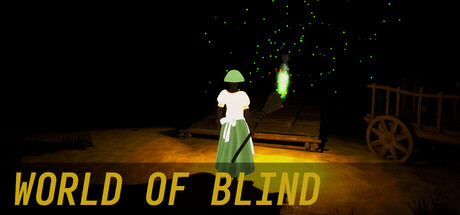
This is a game that simulates blind people. In the dark game, you can discover different animals and natural environments through the sounds coming from the surroundings, and unlock related achievements. you can simulate the movement of blind people
Modeled estimate, not a reported figure. How we estimate →
About
This is a game that simulates blind people.
In the dark game, you can discover different animals and natural environments through the sounds coming from the surroundings, and unlock related achievements.
In the game, you can simulate the movement of blind people, such as using a broom to move left and right in front of you to sense whether there are obstacles in front.
If you don't like not being able to see anything, you can press the [Q] key on the keyboard to light a small torch.
The size of the flame can be changed with the number in the lower right corner of the game. The larger the number, the larger the illuminated range.
If you want to open the game menu, you can press the [ESC] key on the keyboard.
If you want to get a mouse, you can press the [~] key on the keyboard.
You can press [Shift] to turn on the running mode, or press [ctrl] to turn on the slow movement mode.
You can change the perspective of the game with the mouse wheel.
You can press [Alt] to lock the perspective.
If you need to guide the direction, you can press [E].
For more shortcuts, just open the main menu and click on the key settings to see them.
Genres
Stats
All-time low is the lowest price we've recorded for this game since we started tracking it.
Languages: English, French, German, Russian, Japanese, Simplified Chinese, Traditional Chinese, Arabic, Korean, Hindi, Italian, Spanish - Spain +6 more
Reviews
Firstly, I am blind. Has the Dev ever met someone who is blind? If so did they discover a cure where turning on a torch removes blindness. Hmmmm, no that did not cure my blindness, I must be the wrong sort of blind. The game has zero accessibility options, but once in game the story arc seems to consist of blundering around hoping to bump into something that will give you an acheivement. Don't trust the sounds as they seem to have little bearing on what you are heading towards. I never got the pig acheivement despite being hounded by oinks consistently through the game, the damn things even followed me underwater. Where you are is portraid by sound so you can tell if you are on grass, flooring or in water. Maybe a simulation of someone who is blind with a strange hearing condition? It would have been more fun if you could rely on the animal noises to actually locate the animals instead you just wander around randomly hitting something that gives you the odd acheivement. Just not the pig one.... Damn pigs. Dev do research if you want to accurately potray blindness, no torchy cures. And sort the sound out. And did I mention the damn pigs?
World of Blind by QIPAWORLD is a rare kind of experiment that deliberately challenges one of the most fundamental expectations in gaming: the reliance on sight. Instead of building a world meant to be seen and visually interpreted, the game places players into an environment where vision is severely limited or nearly absent, forcing a complete shift in how interaction and awareness are handled. It immediately establishes itself as something unconventional, not by offering complex systems or expansive content, but by committing fully to a single, focused idea of sensory immersion through sound. The core of the experience revolves around navigating spaces using audio cues and subtle feedback rather than visual clarity. Movement becomes slower and more deliberate, as players must rely on directional sounds, environmental echoes, and contextual hints to understand what surrounds them. Even basic actions like walking forward or avoiding obstacles require a level of attention that most games rarely demand. This creates a constant sense of uncertainty, where every step feels tentative and every sound carries meaning. It is not about speed or mastery in the traditional sense, but about learning to interpret a different language of interaction. As players explore, the game introduces a light sense of progression tied to discovery. Various elements of the environment, including animals and ambient features, can be identified through their unique sounds. Recognizing these elements adds a layer of engagement, giving players small objectives to pursue as they move through the world. However, this system remains fairly simple, and the motivation to continue often comes more from curiosity than from structured goals. The experience leans heavily on the player’s willingness to engage with its concept rather than providing strong external incentives. One notable design choice is the inclusion of optional visual assistance. Players can enable a limited light source to partially illuminate their surroundings, making navigation easier. While this option improves accessibility and reduces frustration, it also slightly weakens the core idea of the game. The tension between immersion and usability becomes apparent here, as the most authentic version of the experience is also the most demanding. Players must decide how much they are willing to adapt to the game’s intended design versus making it more comfortable to play. The simplicity of the mechanics is both a strength and a limitation. On one hand, the focused design allows the central concept to shine without unnecessary distractions. On the other hand, the lack of variety means that the experience does not evolve significantly over time. Once players become accustomed to how the audio cues work and how to navigate the environment, there are few new mechanics or challenges introduced to keep the gameplay feeling fresh. This can make the experience feel repetitive after the initial sense of novelty fades. Visually, the game remains minimal and subdued, which aligns with its design philosophy. When elements are visible, they are functional rather than detailed, serving more as context than as a primary feature. The real emphasis is placed on sound design, which carries the weight of the experience. Audio cues are carefully used to represent distance, direction, and identity, allowing players to construct a mental map of the world without relying on sight. This makes the sound design the most critical and successful aspect of the game, as it directly supports its core concept. The overall tone is quiet and introspective, encouraging players to slow down and engage with the environment in a more thoughtful way. There is no urgency or high-stakes tension in the traditional sense, but rather a steady, almost meditative pace that invites focus and patience. This approach will resonate with players who are open to experimental designs and unconventional gameplay, while others may find it lacking in excitement or depth. In the end, World of Blind stands as an interesting and commendable attempt to explore a different way of experiencing games. It succeeds in presenting a unique perspective and demonstrates how sound can be used as a primary tool for interaction. However, its limited scope and lack of evolving gameplay prevent it from becoming a fully engaging long-term experience. It is best appreciated as a short, thought-provoking experiment rather than a complete and content-rich title. Rating: 6/10
This game is an absolutely trash! Could you image that a blind can recover his vision by lighting a torch? The game must use my PC to mine BitCoin, otherwise, why my computer be so slow.
Yes.
新奇有趣好玩的修仙游戏。休闲堪比黑神话.学习UE必下载
Related
Related
Trends
Concurrent players on Steam, sampled daily since tracking started.
Momentum
Pace estimated from the game's recent review growth (our daily snapshots) at its own sales-per-review ratio — a momentum signal, not booked sales.
Related
| Bongo Quest | $315.6 | 51 | 45% | $0.49 |
| Food and Girls | $315.6 | 51 | 86% | $0.99 |
| Glasses and Girls | $315.6 | 51 | 82% | $0.99 |
| Dances and Girls | $322 | 52 | 83% | $0.99 |
| Carnival and Girls | $334.4 | 53 | 85% | $0.99 |
| Anime Sunset Ride | $334.4 | 54 | 67% | $0.49 |