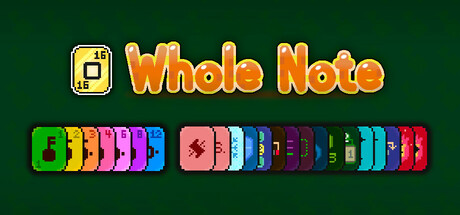
A casual card game where you use note cards and various items to combine cards and create Whole Note Cards.
Modeled estimate, not a reported figure. How we estimate →
Media

About

A casual card game where you use note cards and various items to combine cards and create Whole Note Cards.

Use Note Cards and Item Cards to create a Whole Note Card, earn coins, and reach the highest score!
Focus on the two cards you can combine!

Enjoy the game in two modes: Studio and Artisan !
Stats
All-time low is the lowest price we've recorded for this game since we started tracking it.
Languages: English
Reviews
Whole Note, developed and published by Redsen Game, is a compact and highly minimalist puzzle experience that revolves around simple numerical logic presented through a card-based system. Rather than aiming to deliver a complex or layered game, it focuses on a very narrow idea: combining cards to reach a specific value. This immediately defines the tone and scope of the experience, positioning it as a quick, almost experimental title that emphasizes clarity and accessibility above all else. The central gameplay loop is built around selecting and merging cards in order to create a target value, most commonly a complete or “whole” note. Each card represents a number, and players must determine how to combine them efficiently to achieve the correct total. The concept is extremely easy to grasp, requiring little more than basic arithmetic and pattern recognition. Because of this, the game can be picked up and understood within moments, making it approachable even for players with little experience in puzzle or card-based games. The simplicity is effective in creating an immediate sense of engagement, as players can jump directly into solving without needing to learn complicated rules. However, this same simplicity also defines the game’s limitations. The mechanics remain largely unchanged throughout the experience, with only minor variations introduced through different card types or small adjustments in structure. While these additions provide some variety, they do not significantly alter the way the game is played. As a result, the challenge becomes more about optimizing combinations than discovering new mechanics or strategies. For a short period, this can be satisfying, especially for players who enjoy quick, logic-based puzzles, but the lack of evolution means the experience can feel repetitive once the core system is fully understood. The game includes a couple of different modes that slightly adjust the conditions under which puzzles are presented. These modes offer small variations in pacing or structure, but they still rely on the same fundamental mechanics. They serve more as alternate ways to engage with the same idea rather than as fully distinct experiences. Because of this, they add only a modest amount of replay value, extending the game’s lifespan slightly without significantly deepening it. Visually, Whole Note adopts a clean and colorful 2D style that prioritizes readability. The cards are clearly labeled and easy to distinguish, allowing players to quickly identify values and make decisions without confusion. The interface is uncluttered, which helps maintain a smooth and uninterrupted flow during gameplay. While the presentation is functional and pleasant, it is also quite minimal, lacking the kind of visual variety or flair that might make it stand out more strongly. The audio design follows a similarly restrained approach. Sound effects provide basic feedback for interactions, and background audio remains subtle, serving more as a neutral backdrop than as a defining element. There is little emphasis on creating atmosphere through sound, and the audio does not significantly enhance or detract from the experience. It simply supports the gameplay in a straightforward and unobtrusive way. One of the most noticeable aspects of Whole Note is its brevity. The game can be completed very quickly, often within a short sitting, which reinforces its identity as a small, focused project rather than a fully developed title. This short duration can be appealing for players looking for a quick mental exercise, but it also limits the overall impact. Once the puzzles have been solved and the system mastered, there is little reason to return, as there are no additional layers of content or progression to explore. Overall, Whole Note is a simple and accessible puzzle game that succeeds in delivering a clear and focused concept but does little to expand beyond it. Its strengths lie in its ease of use and straightforward mechanics, making it suitable for brief, casual play sessions. At the same time, its lack of depth, minimal variation, and short length prevent it from offering a more substantial or memorable experience. It feels more like a concise proof of concept than a fully realized game, providing a glimpse of an idea without fully developing its potential. Rating: 5/10
Related
Related
Trends
Concurrent players on Steam, sampled daily since tracking started.
It's a very simple card game. It's a game where you add a number and get 16. It's fun.
Momentum
Pace estimated from the game's recent review growth (our daily snapshots) at its own sales-per-review ratio — a momentum signal, not booked sales.
Related
| Glasses and Girls | $315.6 | 51 | 82% | $0.99 |
| Bongo Quest | $322 | 52 | 46% | $0.99 |
| Dances and Girls | $322 | 52 | 83% | $0.99 |
| Anime Sunset Ride | $334.4 | 54 | 67% | $0.49 |
| Cosmic Journey PC Live Wallpaper | $336.3 | 52 | 71% | $0.99 |
| Girls and Dragons | $340.5 | 55 | 76% | $0.99 |