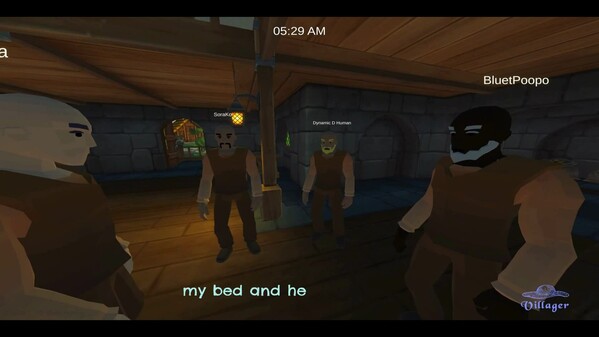
A medieval mystery, 4 to 12 players, where villagers scheme and werewolves hunt. Sharpen your wits, trust no one, and see who makes it through the night.
Modeled estimate, not a reported figure. How we estimate →
Media

About
Play with 4–12 players on a private party with friends or join a public party placing you on either Team Villager or Team Werewolf.
Team Werewolf: consists of 1 Werewolf, 1 Traitor, 1 Pookie, and 1 Wolf Cub.
Werewolf: You transform during the night to begin your hunt. In the morning, strategize with the traitor to decide who to eliminate.
Traitor: You secretly team up with the werewolf and will become the new werewolf if the original one is killed.
Note to Werewolf Team: Werewolf, Traitor, and Wolf Cub see each other’s names in red. Be discreet when talking—villagers might be listening.
Pookie: An immortal feline-like ally to the Werewolves. Only the priest's "Holy Slap" can kill you. Avoid detection.
Wolf Cub: If voted out, you trigger a Blood Moon Night—unless 2 villagers sacrifice themselves at the cemetery gate. If both Werewolf and Traitor die, you rise as the new Werewolf.
Team Villager: Includes Villagers, Guard, Seer, Priest, Witch, Clown, Insomniac, Moosklar, and Cursed Villagers.
Villager: No special powers, but essential for voting and deduction. If you’re the last villager, you get a pitchfork at night.
Guard: Protect a bed each night by placing a shield that blocks the werewolf’s attack.
Seer: Visit a player’s home before the werewolf wakes to determine if they’re Innocent (Villager team) or Guilty (Werewolf team).
Priest: Slap a player once per day. If they’re guilty (Werewolf, Traitor, or Pookie), they die. If innocent—you die.
Witch: Once per day, transform a Villager into a Cursed Villager. Green smoke = success. Red = they were a Werewolf. A failed attempt kills you instantly.
Cursed Villager: Start as a normal villager, then get transformed by the Witch to fight for good. Be careful at night—getting caught means death.
Clown: At night, place clown shoes on a sleeping player. It slows down werewolves and speeds up villagers—perfect for escapes.
Insomniac: Once you wake up, you stay up. You get a pitchfork to defend yourself and must silently observe the night’s events.
Moosklar: Complete physical workouts during the day to power up. At night, you can wrestle the Werewolf and save your team.
Day Cycle: Players discuss, play games and vote. Night begins sooner if half the village sleeps.
Night Cycle: Roles wake up one by one. The Werewolf last.
*Note: You cannot use powers or vote on the first day.
Head to the village tower and pull the rope to initiate voting. Press "K" to open the panel and recast your vote. Everyone eligible is teleported to the tower.
The village has 12 beds spread across several homes. Players sleep, hide, or interact indoors—or take a nap on a bench outside.
At the heart of the village is the Playhouse. On Playhouse days, the Lycan Shop opens, mini-games become available, and players can engage in private LC trades.
Play once per half-day to earn LC (Lycan Coins):
Test of Strength: 1 LC on loss, 6 LC on win
Light Up the Candles: 1 LC on loss, up to 6 LC based on candles lit
Perfect Log Split: 1 LC on loss, 3 LC on win
The Jester’s Balance: 1 LC on loss, 3 LC on win
The Cup Shuffle: 1 LC on loss, up to 8 LC with gambling
Land the Horseshoe: 1 LC on loss, 5 LC on win
The Mystic Sequence: 1 LC on loss, 5 LC on win
Spin for Fortune: 6 random outcomes based on luck
Night Altar: A human can use it to cage the Werewolf for one night.
Private Booths: Secretly exchange LC (5 LC/day limit).
Ghost Mode: After death, you roam in first-person, hear the living, and talk to other ghosts.
Villagers: Identify and eliminate the Werewolf to protect the village.
Werewolves: Kill villagers one by one without being exposed.
3D proximity voice chat
In-game text chat
Public/private party system
12-player support
Multiple homes and sleeping options
Mini-games & LC economy
Voting system with rope bell
Unique abilities for every role
Ship escape mechanic
Ghost Mode for the dead
Stats
All-time low is the lowest price we've recorded for this game since we started tracking it.
Languages: English*, French*, Spanish - Spain*, Japanese*, Korean*, Russian*, Simplified Chinese*, Turkish*, German**languages with full audio support
Engagement
Reviews
Themes across 41 recent reviews and how positive each mention is. A keyword signal, not full sentiment analysis.
Reviews
非常好游戏,在今晚的游戏中我们达到了12的游玩人数,这导致了房间满人,我觉得可以再新的增加非常多职业和床位,比如献祭台那边再建立一个小屋,以及在远处被空气墙挡住的大航海船,我觉得你们的团队可以参考下非常多其他游戏的职业,我喜欢这个游戏,我的朋友们也同样是的,加油!
8=====D
holy ♥♥♥♥♥♥♥ ♥♥♥♥ this game might be insanely peak
Related
Related
Trends
Concurrent players on Steam, sampled daily since tracking started.
Hours played at review time, across 41 reviews with recorded playtime.
positive critical· bar length = how often the theme comes up
esta bueno pero le falta gente
Волк бегал от лунатика, который нецензурно выражался, на волка. Еще и на Украинском
어! 웨어울프 너지!? 대반전 시민팀이었답니다.. 친구랑 같이 하면 재밌어요~
super good
Werewolf Party is a multiplayer social deduction experience developed and published by Absam Studios that takes the familiar rules of the classic Werewolf party game and transforms them into an interactive first-person adventure. Instead of relying solely on text or menu-driven discussions, players physically navigate a lively medieval village, communicate through proximity voice chat, and use observation as their greatest weapon. Every session revolves around deception, trust, and deduction, but the immersive setting makes every accusation and every suspicious movement feel much more personal. The game's approach successfully captures the excitement of gathering around a table with friends while adding environmental interaction that gives each round its own memorable story. The foundation of the gameplay is built around two opposing factions: the villagers and the werewolves. However, the game goes far beyond a simple good-versus-evil setup by introducing a wide selection of specialized roles. Each character possesses unique abilities that influence investigations, protection, sabotage, or survival, ensuring that every match unfolds differently. Villagers can gather valuable information through roles like the Seer, defend teammates with the Guard, heal or poison through the Witch, or manipulate situations using several other distinctive classes. Meanwhile, the werewolf team receives its own strategic variety through characters that create unexpected complications, making it difficult for the innocent side to identify the true threat. Since identities are randomly assigned every game, players are encouraged to adapt rather than rely on repetitive strategies. Matches alternate between daytime investigation and nighttime action, creating a satisfying rhythm that steadily builds tension. During the day, everyone is free to explore the village, hold conversations, form alliances, and accuse suspicious individuals before gathering for a public vote. Once darkness falls, every special role secretly performs its ability before the werewolf begins its hunt. This cycle creates a constant sense of uncertainty because every morning introduces new clues, missing players, and fresh theories. Voting itself becomes a dramatic event rather than a simple interface selection, reinforcing the social atmosphere and encouraging players to carefully defend themselves before facing possible execution. One of the game's most refreshing features is the amount of interaction available outside the core deduction mechanics. The village contains numerous activities and mini-games that reward players with Lycan Coins while providing entertaining distractions between discussions. These include physical challenges, carnival-style games, and other interactive tasks that make exploration worthwhile. More importantly, these activities naturally create opportunities for suspicious behavior, allowing observant players to gather subtle evidence without relying exclusively on spoken conversations. The environment itself becomes another source of information, adding depth to every investigation. Additional systems further strengthen the overall experience. Eliminated players are not forced to simply wait for the next round, as Ghost Mode allows them to continue exploring the map alongside other spirits. This helps keep everyone engaged even after being removed from active play. The Night Altar introduces another layer of strategy by giving players an alternative method of dealing with the werewolf under the proper circumstances, preventing matches from becoming overly dependent on voting alone. These mechanics demonstrate thoughtful design choices that keep gameplay varied while reducing the frustration commonly associated with early elimination in social deduction games. From a presentation standpoint, Werewolf Party embraces a colorful medieval visual style that favors atmosphere and readability over photorealism. The village is detailed enough to encourage exploration without becoming confusing, and its various buildings, gathering spots, and landmarks make communication easier during tense discussions. Sound design deserves particular recognition because proximity voice chat becomes one of the game's defining features. Conversations overheard from nearby players, whispered plans, nervous reactions, and panicked accusations all contribute to the illusion of participating in a genuine village mystery rather than simply playing another online multiplayer title. The game naturally shines brightest with a full group of friends who are willing to communicate and embrace the role-playing aspects of each match. Public sessions can still provide entertaining moments, but coordinated groups are far more likely to create the dramatic betrayals, clever bluffs, and humorous misunderstandings that define the experience. New players may need time to learn every role and special mechanic, yet the gradual discovery of different character abilities gives the game excellent replay value and keeps returning matches feeling fresh. Overall, Werewolf Party successfully expands the traditional social deduction formula by combining immersive first-person exploration, a large roster of unique roles, enjoyable side activities, and creative multiplayer systems into a cohesive package. Its strongest qualities come from encouraging genuine player interaction instead of relying solely on scripted mechanics, making every match feel like a unique story shaped by the personalities of those participating. While the experience depends heavily on maintaining an active player community and benefits most from voice communication, it offers an engaging and highly replayable interpretation of a beloved party game concept. Fans of deception-based multiplayer games who enjoy reading people as much as mastering mechanics will find plenty of reasons to return for another round. Rating: 8/10
fun as flip
oyunu oynayan kimse yok ki nasıl oynayak
Audience
Estimated from the language of this game's reviews — a proxy for where players are, not official Steam demographics.
Related
| Basketball Classics | $34.5K | 175 | 93% | $9.99 |
| Forsake: Urban horror | $34.5K | 222 | 79% | $9.99 |
| Abyss Of Pleasure | $34.5K | 135 | 90% | $11.80 |
| Bouncing Duck Simulator | $34.5K | 228 | 90% | $4.99 |
| Jelly Killer | $34.5K | 380 | 80% | $3.99 |
| Shadow Album | $34.5K | 111 | 75% | $8.99 |