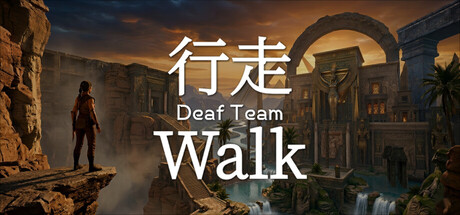
A parkour exploration game built with Unreal Engine 5 by an all-disabled team.With smooth controls, freely traverse mysterious ancient ruins and complete challenges to pass through more time gates.No combat or pressure, only focus on parkour and scenery.
Modeled estimate, not a reported figure. How we estimate →
Media

About
Walk is a parkour exploration game built with Unreal Engine 5.
Set in a world of ancient ruins and mysterious atmosphere,
you are free to explore layered environments and traverse complex structures using fluid movement.
There is no combat or pressure—
you can focus purely on movement,
or simply slow down and take in the scenery.
This is a parkour exploration experience centered around movement and control.
Navigate complex level structures and overcome challenging terrain through precise execution and timing.
The game features a complete movement system, including:
* Walking / Sprinting
* Jumping
* Climbing
* Vaulting
* Grabbing / Aerial traversal
All actions can be seamlessly chained together,
allowing you to develop your own movement rhythm and routes.
In each level, you must explore the environment and locate hidden crystals.
Only by activating all crystals can you unlock the portal to the next stage.
The game blends medieval ruins, ancient civilizations, and subtle sci-fi elements.
You will explore vast and mysterious environments,
uncovering the stories embedded within the world.
The game features a fully dynamic environment system, including:
* Day-night cycle
* Weather changes
* Seasonal transitions
The same map can offer different visual experiences depending on time and conditions.
* No combat system
* No progression or leveling
* Focused entirely on player skill and route selection
Your progress is defined by your control and decisions.
The game currently does not include complete sound effects.
This is because we are unable to accurately judge audio content. We will work to gradually overcome this challenge and complete the sound effects as much as possible in future updates.
We are a small team composed entirely of disabled developers.
Some of us can only type out code using a single finger. Some cannot see the pixels on the screen. Some need immense courage just to sit at a computer for more than an hour. Most of us will never be able to freely walk, run, or see the world as others do.
So, we decided to build a world within a game.
Walk is the game we have crafted bit by bit over the course of two years, through countless days and nights. It has no flashy combat, no intricate systems — only our longing for life and our understanding of it. We climb a little higher at a time, and the higher we go, the better the view becomes.
For us, making games has never merely been a job; it is our way of communicating with the world. We want to tell everyone who is facing hardship: even if your steps are unsteady, even if the path ahead is unknown, there is hope as long as you keep moving forward.
Thank you to everyone who purchases this game. Every single one of your supports keeps us walking — and gives more people like us a chance to be seen by the world.
Stats
All-time low is the lowest price we've recorded for this game since we started tracking it.
Languages: Simplified Chinese*, English**languages with full audio support
Reviews
抖音刷到的,就来支持一下。我也不怎么玩steam游戏,就纯纯为了支持,没想到非常惊喜,简洁的画面,画质的确不错,最喜欢的是手感,玩着很舒服。我最喜欢下雪天,如果有个单独的冬季场景肯定非常好玩。不知道为什么玩着上头。祝福你们,祝你们大卖。
一款3D平台跳跃游戏,没有剧情,单纯的考验玩家的空间感和操作熟练度。 本作最大的问题是跳跃机制本身,玩家无法做到边缘起跳,起跳必须提前也就是说一个标准方格无法提供玩家助跑的空间,爬上方格时角色不是站在方格边缘而是中间,也就是这个位置即为起跳点,但是玩家还需要带方向键,这就是诡异之处,所以即使是此类高手也免不了一个漫长的适应过程。
虽然存在大量的免费素材,感觉环境有点廉价,但人物运动调的挺流畅的,关卡设计也算合理(除了没有保存点),作为跑酷模拟器还是非常合格的。作为一款残疾人制作的游戏,真的要比太多粗制滥造的小游戏好太多了,支持制作组继续努力!!!!
跑酷开灯,要适应爬塔和跳跃,不然不小心掉下去重新爬过还是很麻烦的。
行走 Walk, developed and published by 无音 Deaf Team, is an introspective and unconventional entry into the walking simulator genre that leans heavily into atmosphere and personal expression rather than traditional gameplay structure. At first glance, it may resemble other exploration-focused titles, but it quickly establishes its own identity through a stripped-down, almost meditative approach to interaction. There are no enemies to fight, no complex objectives to chase, and very little in the way of explicit direction. Instead, the experience revolves around movement itself—wandering, climbing, and navigating a series of expansive environments that feel more like abstract spaces than fully realized worlds. The result is a game that invites patience and curiosity, asking players to engage with it on a quieter, more reflective level. Traversal is the primary mechanic, and while it appears simple on the surface, it carries surprising depth. Players can walk, sprint, jump, and climb across a variety of vertical landscapes, with some sequences requiring careful timing and spatial awareness. The design occasionally flirts with precision platforming, where a single misstep can send you tumbling down from a great height, forcing you to retrace your path. These moments introduce a subtle tension that contrasts with the otherwise calm pacing, though they can also become frustrating due to inconsistent controls and a lack of forgiving checkpoints. The game seems to walk a fine line between encouraging deliberate movement and unintentionally punishing the player, and how one perceives that balance will likely shape their overall experience. Visually, 行走 Walk stands out as its most compelling aspect. Built using Unreal Engine 5, the environments are spacious, minimalistic, and often striking in their use of lighting and scale. Wide-open skies, distant structures, and clean architectural forms create a sense of solitude that aligns perfectly with the game’s tone. There’s a deliberate absence of clutter, which allows each scene to feel calm and uncluttered, almost like a digital painting you can move through. While the environments may lack variety in some areas, they consistently deliver a sense of quiet beauty that rewards players who take the time to slow down and observe their surroundings. Perhaps the most defining feature of the game—and the one that will divide players the most—is its complete lack of sound. This is not a stylistic flourish but a conscious limitation: the developers, being a deaf team, chose not to include audio because they could not accurately judge its quality or effectiveness. The result is an entirely silent experience, which can feel either deeply immersive or noticeably empty depending on the player. Without music, ambient noise, or feedback cues, the game becomes an almost meditative space where every action unfolds in silence. Some players may find this enhances the sense of isolation and introspection, while others may feel it strips away an essential layer of engagement. The suggestion to play your own background music underscores this duality—it’s a flexible experience, but one that requires personal input to feel complete. From a technical and design perspective, the game shows clear signs of being a small-scale project. The user interface is minimal to the point of feeling underdeveloped, and the controls can occasionally lack the responsiveness needed for more precise movement. These shortcomings become more noticeable during sections that demand accuracy, where even minor inconsistencies can lead to repeated mistakes. Despite these issues, there is a sense of earnestness behind the design. The developers have been transparent about their limitations and appear committed to refining the experience over time, which lends the game a certain authenticity that more polished titles sometimes lack. What gives 行走 Walk a lasting impression is the context of its creation. Developed by a small team facing significant physical challenges, including hearing impairments, the game feels like a deeply personal project—one that prioritizes expression and accessibility over conventional expectations. This perspective doesn’t necessarily elevate the gameplay itself, but it adds a layer of meaning that makes the experience more memorable. It’s not just about what the game is, but what it represents: a creative effort shaped by unique circumstances and a desire to share a quiet, contemplative space with others. Ultimately, 行走 Walk is a niche experience that will resonate strongly with a specific type of player. Those looking for action, narrative depth, or mechanical polish may find it lacking, but players who appreciate slow-paced exploration and minimalist design may discover something genuinely refreshing. It is imperfect, occasionally frustrating, and undeniably unconventional, yet it succeeds in creating a distinct atmosphere that lingers beyond the screen. Rating: 6/10
First of all, there is no English option, despite the game’s Steam page stating that there is. In fact, there are no options whatsoever. All you can do is start a game or quit. Although the controls are easy to figure out because they follow the standard action platformer layout, the lack of settings becomes a problem if your computer can’t handle the graphics, as you are stuck with the default configuration. The reason for this is a very detailed and rich world. You start in one spot, and there is a huge area in front of you filled with several structures and plenty of interesting objects. There is also a day night cycle and changing weather, although neither has any effect on gameplay. The goal of the game is unclear, but you are guided toward clues about what you are supposed to do. It turns out that you need to reach pillars with gems and activate them. The problem is that most of them are positioned high up and can only be accessed using platforming skills. Fortunately, this is not a precision platformer. You will still fall and have to restart challenges, but your character can grab onto platforms, so you do not have to be perfect. The two main things to pay attention to are aiming properly at platforms, because you will not grab them if you jump at an angle, and performing running jumps for longer distances. Challenges are spread throughout the area, and each one contains only a few platforms, making them easy to complete on your first try. Sadly, there is no counter showing how many crystals you have collected or how many remain, and there are no waypoints to guide you to the nearest one. A more serious issue is that you can fall into a hole and lose all progress, as there is no way to get out. The only option is to respawn at the starting point, which resets everything. Although it is true that the game was made by people with disabilities, I would still prefer some kind of clear objective or purpose, rather than just an obstacle course.
Related
Related
Trends
Concurrent players on Steam, sampled daily since tracking started.
Momentum
Pace estimated from the game's recent review growth (our daily snapshots) at its own sales-per-review ratio — a momentum signal, not booked sales.
Related
| ANDOR Ladies | $2.4K | 70 | 84% | $0.99 |
| Royal Booty Quest | $2.4K | 126 | 60% | $0.69 |
| thanks mom | $2.4K | 59 | 83% | $1.99 |
| Solar Shifter EX | $2.4K | 115 | 47% | $0.99 |
| Cyber Pussy 2020 | $2.4K | 53 | 66% | $1.99 |
| Energy Invasion | $2.4K | 57 | 61% | $2.99 |