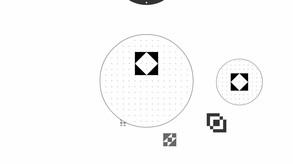
VOI is a minimalist puzzle game developed and published by Yunus Ayyildiz that distills logic and spatial reasoning into its purest form. It presents itself with a simple premise and aesthetic, but beneath its clean surface lies a game that demands focus, patience, and an appreciation for abstract thinking. The entire experience revolves around a single rule that redefines how you approach shapes and space: overlapping identical areas causes them to cancel out, following the logic of “1 + 1 = 0.” What seems straightforward at first gradually becomes an elegant test of perception, forcing players to see patterns, alignments, and negative space in ways that feel both logical and artistic.
The visual presentation of VOI is striking in its simplicity. The game uses monochrome graphics—black and white only—creating a stark contrast that enhances clarity and concentration. There are no unnecessary textures, no menus cluttering the screen, and no storylines or dialogue to distract you. Every level consists of geometric shapes—squares, triangles, circles, and polygons—that must be manipulated and overlapped to recreate a target silhouette. The beauty of this design is in its restraint: the game communicates entirely through shape and movement, allowing the player’s mind to fill in the gaps. The minimal interface feels meditative, as if the player is solving puzzles in an empty gallery, where only the essential elements remain.
The gameplay unfolds in a rhythm that is as soothing as it is challenging. Early levels ease the player into the mechanics, presenting simple outlines that can be solved with a few intuitive overlaps. But as new shapes and more complex silhouettes appear, the difficulty increases subtly yet steadily. The brilliance of VOI lies in how it teaches its logic through play. You begin to understand how overlapping creates subtraction, how positioning affects perception, and how each move must be deliberate. The absence of timers or scoring systems reinforces this contemplative pace. It’s not about racing to the finish but about arriving at understanding through observation and experimentation. The challenge isn’t physical reflex—it’s mental clarity.
As levels progress, the puzzles become increasingly intricate, requiring layers of forethought and precision. The logic behind VOI’s puzzles isn’t just about filling space; it’s about understanding how negative space defines form. In later stages, you’ll find yourself juggling multiple shapes, constantly rotating, flipping, and overlaying them in search of symmetry or cancellation. This growing complexity is where the game’s design truly shines—it never overwhelms with arbitrary difficulty but instead expands naturally from the player’s understanding of its core rule. The sense of satisfaction from solving a particularly complex shape is profound, not because the game rewards you with fanfare or points, but because the solution feels earned, clean, and inevitable.
The sound design complements this minimalist philosophy perfectly. There is no booming soundtrack or dramatic cues—just soft, ambient tones that create a sense of quiet focus. The silence between sounds becomes as important as the notes themselves, allowing you to concentrate deeply on the geometry before you. The effect is almost meditative, turning each session into a calm exercise in logic and design. The lack of urgency allows players to immerse themselves completely in the act of solving, free from external pressure. This understated audio atmosphere gives VOI a unique personality—it feels more like a peaceful workshop of ideas than a conventional puzzle game.
Technically, the game is clean and efficient, running smoothly even on low-end systems. The controls are intuitive, relying primarily on dragging and rotating shapes with the mouse. However, the precision of placement can sometimes be a minor frustration, especially when multiple shapes overlap tightly. Selecting or adjusting the correct layer occasionally requires extra care, but these small quirks never significantly detract from the experience. They serve as reminders that the game’s simplicity hides a certain tactile challenge—part of the satisfaction lies in mastering the spatial manipulation as much as the logical deduction.
VOI’s greatest strength is its purity of vision. It is a game stripped of everything extraneous, leaving only the relationship between form, function, and thought. It doesn’t try to impress with spectacle or narrative; instead, it respects the intelligence of the player, inviting them into a quiet dialogue of ideas. Each level feels like a small experiment in balance and geometry, rewarding not with points but with the simple joy of discovery. It’s a game that appeals to those who find beauty in simplicity, who appreciate puzzles that make you slow down and think rather than rush toward instant gratification.
In its entirety, VOI is a contemplative journey into logical minimalism. It’s short enough to complete in a few sittings but rich enough in design to linger in the mind long after. It belongs in the same lineage as other minimalist puzzle masterpieces like Thomas Was Alone or Hook, where every element exists for a reason, and nothing is wasted. Yunus Ayyildiz has created something both intellectually stimulating and aesthetically calming—a rare combination in modern gaming. VOI doesn’t shout to be noticed; it quietly earns your attention, proving that complexity can arise from the simplest of rules and that sometimes, less truly is more.
Rating: 9/10