VARDIA, developed and published by 2Kek Games Bilisim Teknolojileri Anonim Sirketi, is an atmospheric indie title that immediately signals its priorities through tone rather than exposition. It drops players into an unfamiliar landscape without ceremonial introductions, trusting curiosity, intuition, and observation to guide early impressions. That lack of handholding establishes a relationship between player and world that feels organic—VARDIA wants you to earn understanding, not receive it. Instead of overwhelming players with tutorials or narrative summaries, it allows uncertainty to linger. The effect is quietly powerful, setting the stage for a journey defined not just by action, but by slow unraveling—of systems, threats, motivations, and history. It’s a game that believes mystery should be experienced, not narrated.
Moment-to-moment play blends exploration, environmental awareness, cautious combat encounters, and resource considerations. The mechanics are straightforward on the surface—move, fight, search, survive—but the game’s pacing turns these into layered decisions. Every new area raises questions: what can be scavenged, who or what lurks nearby, how much risk is worth taking, and what secrets might be buried beneath clutter or scenery? Combat is intentionally measured rather than flashy. Enemies feel threatening not because they swarm endlessly, but because each confrontation depletes something—health, ammunition, confidence, or time. Weapons and tools feel like lifelines rather than power-ups, encouraging thoughtful engagement instead of reckless aggression. When victories come, they feel earned, not guaranteed.
The world of VARDIA is constructed with careful restraint. Instead of grand open vistas or endless maps, the game favors tightly designed spaces where level geometry, lighting, and environmental objects suggest stories rather than explicitly telling them. Derelict buildings, half-functioning machinery, abandoned camps, scattered personal belongings, and strangely altered natural elements create hints of civilization touched by trauma or transformation. The player becomes a detective by necessity, piecing together meaning from fragments rather than scripted explanations. This approach to worldbuilding rewards slow exploration—turning corners, reexamining details, and questioning assumptions often reveal more than combat or dialogue ever could. The world feels alive not through movement, but through implication.
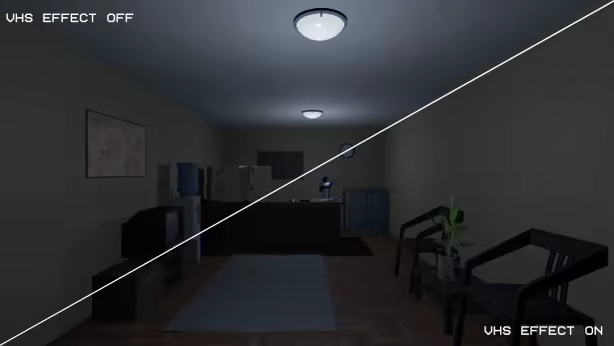
Aesthetic direction strengthens this sense of place. VARDIA’s visual identity does not chase hyperrealism, instead opting for distinct textures, deliberate color palettes, and environmental contrasts that evoke emotional responses. Foreboding shadows, sterile artificial lighting, and unexpected splashes of natural beauty coexist uneasily, reflecting a world caught between decay and resilience. Sound design amplifies that atmosphere—distant echoes, shifting wind, mechanical hums, and the absence of music during tense exploration create a persistent awareness of space. When music appears, it carries weight, signaling narrative or emotional shifts rather than filling silence for the sake of it. The audio-visual partnership ensures that tension never fully dissipates, even during moments of calm.
Narrative progression adopts a similarly understated philosophy. Instead of overwhelming players with dialogue or cutscenes, VARDIA scatters its storytelling across found documents, environmental clues, character interactions, and contextual shifts. The result feels less like reading a script and more like excavating memory. Many narrative elements remain deliberately unexplained, inviting interpretation rather than dictating meaning. This ambiguity will divide players—those who prefer clearly defined plots may feel underfed, while players who enjoy piecing together narrative mosaics will find satisfaction in assembling theories and emotional connections. The writing recognizes that sometimes unanswered questions make a world more compelling than tidy resolutions.
That commitment to subtlety also shapes the game’s strengths and vulnerabilities. VARDIA is not designed for players seeking constant action, streamlined progression, or immediate gratification. Its pacing can feel slow or even disorienting if approached with power-fantasy expectations. Combat, while functional, prioritizes tension and caution over spectacle, which may frustrate players accustomed to fast, fluid engagement. The game asks for patience, attention, and willingness to be lost for a while. Technical rough edges and occasionally uneven difficulty spikes also reveal the game’s indie roots, though these rarely overshadow the overall experience. Rather than feeling unfinished, its imperfections contribute to the sense of raw, textured authenticity.
What ultimately defines VARDIA is its unwavering dedication to atmosphere-driven exploration. Many modern games promise mystery, but few commit to it structurally, mechanically, and emotionally the way this one does. It invites players to inhabit its world rather than merely pass through it, to sit with uncertainty, to stare at environments long enough for them to speak. It grants agency not through branching dialogue trees or massive inventory systems, but through interpretation—trusting the player to make meaning out of what they see, hear, and survive. That respect for player intelligence is rare and refreshing.
For those who appreciate meditative pacing, environmental storytelling, subdued sci-fi or post-apocalyptic aesthetics, and survival gameplay rooted in caution rather than dominance, VARDIA offers a deeply engaging and memorable experience. It is a game about learning to navigate unfamiliar spaces—physically, narratively, and emotionally. And when its world finally reveals enough to feel understood, the journey to get there feels personal, not prescribed. In a landscape filled with loud, fast, and guided experiences, VARDIA thrives by being patient, observant, and quietly unsettling.
Rating: 6/10