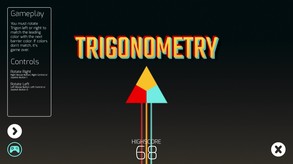
Trigonometry is a fun casual game, The rotating triangle in Trigonometry is the pivoting center of this exciting action game! Match colors to go further and try to beat your own score!
Modeled estimate, not a reported figure. How we estimate →
Media

About


Stats
All-time low is the lowest price we've recorded for this game since we started tracking it.
Languages: English
Engagement
Reviews
Themes across 40 recent reviews and how positive each mention is. A keyword signal, not full sentiment analysis.
Reviews
very fun and simple dont like the soundtrack wish it would change
Trigonometry is a minimalist arcade reflex game developed and published by XiNFiNiTY Games that builds its entire identity around speed, precision, and color recognition. Rather than offering a sprawling campaign or layered progression systems, it distills gameplay down to a single, focused challenge: survive as long as possible by rotating a triangular object to match incoming colors. The simplicity of its premise is deliberate, positioning it squarely within the tradition of score-chasing arcade titles that reward concentration and quick reactions above all else. At the center of the experience is the Trigon itself, a three-sided rotating shape that the player controls by turning it left or right. Each side is colored differently, and waves of colored barriers approach from the edges of the screen. To survive, players must align the correct colored face of the triangle with the matching incoming barrier. A mismatch results in immediate failure, resetting the run and sending the player back to try again. The rules are easy to understand within seconds, but as with many well-designed arcade games, mastery takes much longer. The pace gradually accelerates, reducing the window for decision-making and turning simple color matching into a tense exercise in split-second judgment. The game’s difficulty curve is driven primarily by speed. Early moments allow players to acclimate to the rotation mechanic and develop muscle memory. As the tempo increases, patterns become less forgiving and visual scanning becomes more demanding. The design encourages players to enter a state of focused flow, where conscious thought gives way to instinctive reaction. This rhythm—fail, retry, improve—creates an addictive loop that is fundamental to arcade design philosophy. Each attempt is short, making it easy to justify “just one more run” in pursuit of a higher score. Visually, Trigonometry adopts a clean and uncluttered 2D aesthetic. Bright, contrasting colors dominate the screen, ensuring that gameplay information is always clear and readable. There are no unnecessary visual distractions; everything exists to support the core mechanic. The background remains simple and unobtrusive, allowing players to focus entirely on incoming threats. While the graphics do not aim for realism or complexity, they succeed in maintaining clarity even at high speeds, which is crucial for a game built around reflex precision. The audio presentation complements the minimalist visuals. Sound effects provide immediate feedback for correct matches and failures, reinforcing the rhythm of play. The soundtrack maintains an energetic yet restrained tone, supporting concentration without overwhelming the senses. Like the visuals, the audio design avoids excess, aligning with the game’s streamlined philosophy. The result is a cohesive sensory experience that enhances immersion without complicating the core loop. Replayability stems almost entirely from its scoring system. There are no elaborate unlock trees or narrative arcs to follow; instead, progression is personal. Players compete against their own best scores or compare results via leaderboards. This competitive element adds longevity for those who enjoy incremental improvement and mastery. Steam achievements provide additional milestones, offering tangible goals beyond raw high scores. For players who thrive on measurable progress and optimization, this structure can be highly motivating. However, the very qualities that define Trigonometry also shape its limitations. The gameplay revolves around a single mechanic with limited variation, and extended sessions may begin to feel repetitive. There are no alternate modes, significant mechanical evolutions, or thematic shifts to break up the core formula. For players seeking depth through variety or narrative context, the experience may feel narrow. Its appeal is strongest in short sessions rather than prolonged play. Ultimately, Trigonometry succeeds as a focused arcade experiment. It embraces minimalism, refining one mechanic instead of layering multiple systems. Its accessible controls, escalating challenge, and score-driven structure make it ideal for players who enjoy reflex-based gameplay and quick bursts of competitive tension. While it does not attempt to redefine the genre or expand beyond its central concept, it delivers a polished and satisfying experience within its chosen scope. For fans of pure arcade design, it offers a compact but engaging test of speed and precision. Rating: 7/10
Related
Related
Trends
Modeled estimate over time, reconstructed from Steam's monthly review histogram.
Hours played at review time, across 40 reviews with recorded playtime.
positive critical· bar length = how often the theme comes up
休闲小游戏,主要是控制三角形转动使其颜色与目标颜色一致,前面很简单,分数高了之后会稍有难度,游戏本身还可以,音乐方面感觉一般般甚至不太行,如果能配合上一个更好的音乐的话,应该会是个不错的游戏
100% is change the configuration to turn it and use the windows to pause
Так себе.
nice game
There's lots of endless arcade games, and I love the genre, but Trigonometry is far from being called a completed one: bad controls, bad music and bad game progression. XiNFiNiTY has lots of cheap arcade games, and I liked some of them, but Trigonometry is definitely not one of them.
its ok
[b]Trigonometry[/b] is an Action game that requires you to go through a bunch of barriers by rotating your ship? to match the same colour as the barriers. The controls are just a simple click of the left mouse button. The game becomes ridiculously hard after the 60 score mark. It's extremely repetitive and there is only one music track that will drive you mad. The game also has nothing to do with trigonometry. Not recommended.
Das Spiel "Trigonometry" ist ein Geschicklichkeitsspiel. Man muss verschieden farbige Balken mit der richtigen Farbe eines Dreiecks zu treffen. Es gibt drei unterschiedliche Farbtöne die jeweils eine Ecke entsprechen. Links drehen und rechts drehen macht man mit der linken bzw. rechten Maustaste. Sollte Jemand Geschicklichkeitsspiele mögen kann ruhig den einen Euro investieren. Tipp: Ab Stufe 60 wird es sehr anspruchsvoll über die Maus zu spielen. Man sollte sich dann überlegen aufs Keyboard zu wechseln. Man sollte aber die Input-Tasten tauschen (rechte mit linken Taste). Durch das Starten des Spiels erhält man ein zusätzliches Fenster wo man die Inputs ändern kann. Das Spiel selbst hat keine Optionen.
Momentum
Pace estimated from the game's recent review growth (our daily snapshots) at its own sales-per-review ratio — a momentum signal, not booked sales.
Audience
Estimated from the language of this game's reviews — a proxy for where players are, not official Steam demographics.
Related
| Trapped In Stone - World War II Horror | $979.4 | 53 | 79% | $0.99 |
| BYTE FYTE (MULTIPLAYER) | $979.4 | 53 | 72% | $0.69 |
| Hidden Cats: Rome | $982.7 | 58 | 95% | $0.99 |
| Invisibox | $983.3 | 92 | 88% | $0.75 |
| 魔法少女は自由に変身できない。 | $983.9 | 59 | 98% | $0.99 |
| Gachi Bird | $983.9 | 60 | 83% | $0.99 |