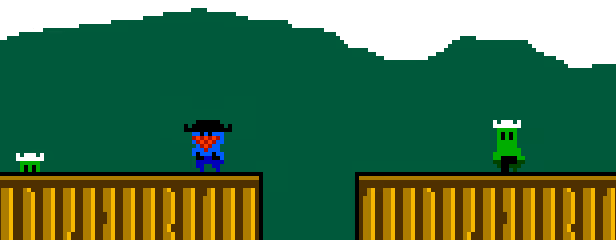
THE LAW!! Looks to be a showdown atop a train. This will be your last fight. Good luck, Train Bandit.
Modeled estimate, not a reported figure. How we estimate →
Media

About


Stats
All-time low is the lowest price we've recorded for this game since we started tracking it.
Languages: English, French, Italian, German, Spanish - Spain, Japanese, Portuguese - Brazil, Russian, Simplified Chinese, Traditional Chinese
Engagement
Reviews
Dinky Guardians, developed by Endless Loop Studios in collaboration with Code Monkey and published by Endless Loop Studios, is a surprisingly layered blend of colony management, automation building, and light defensive strategy wrapped in a colorful and approachable presentation. At first glance, it appears simple—cute creatures, compact environments, and a playful tone—but beneath that surface is a game driven by efficiency, scaling systems, and the satisfaction of turning chaos into order. It’s a title that gradually reveals its depth as players move from basic survival tasks into more complex, interconnected systems. The gameplay begins on a small scale, with players creating and managing “Dinkys,” small worker units responsible for gathering resources and keeping the colony running. Early on, the experience is hands-on, requiring players to assign tasks and ensure that basic needs such as food and resource collection are met. This stage feels almost like a traditional colony simulator, where careful planning and attention are necessary to maintain balance. However, as the game progresses, it begins to shift toward automation, encouraging players to replace manual labor with machines and systems that can operate independently. This transition is one of the game’s most satisfying aspects, as it creates a clear sense of growth and progression. What makes the experience engaging is how these systems interconnect. Machines require power, Dinkys need food, and production chains depend on a steady flow of resources, forcing players to think about the bigger picture rather than isolated tasks. Over time, the colony evolves into a network of processes that must be optimized to function efficiently. This creates a gameplay loop centered on problem-solving—identifying bottlenecks, adjusting workflows, and improving output. It’s not about reacting quickly, but about thinking ahead and refining systems until they run smoothly. As the game expands, it introduces a broader scope by allowing players to explore and establish operations on multiple planets. This adds a logistical layer to the experience, as resources must be transported and managed across different locations. Each new environment brings its own challenges, requiring players to adapt their strategies and rethink how their systems are structured. Managing these interplanetary connections adds complexity without overwhelming the core gameplay, making the progression feel natural rather than forced. Alongside the simulation and automation elements is a defensive component that introduces periodic threats to the colony. Enemies appear and attempt to disrupt operations, requiring players to build defenses and protect their workforce. While this aspect is not as deep as a dedicated tower defense game, it adds a sense of urgency that contrasts with the otherwise methodical pace. Balancing expansion with protection becomes an important part of the experience, ensuring that players cannot focus solely on growth without considering risk. The game’s presentation supports its design with a bright, low-poly art style that emphasizes clarity and charm. Environments are easy to read, which is crucial given the number of systems players must manage simultaneously. The visual style may not be highly detailed, but it effectively communicates information and maintains a cohesive tone. Animations are simple but functional, and the overall aesthetic helps make the complexity of the gameplay feel more approachable. Audio design is understated, providing feedback for actions and events without drawing attention away from the core systems. It complements the experience rather than defining it, allowing players to focus on managing their colony and optimizing their processes. While not particularly memorable, it fits the game’s overall design philosophy. One of the most rewarding aspects of Dinky Guardians is the sense of progression it offers. Watching a small, manually operated colony grow into a fully automated, multi-planet network provides a clear and satisfying arc. However, this same progression can also lead to moments of overwhelm, especially as systems become more intricate and interconnected. The game does not always guide players clearly through its more complex mechanics, which can result in confusion for those unfamiliar with automation-heavy gameplay. Despite its strengths, the game does have limitations. The core loop, while engaging, does not change significantly over time. Much of the experience revolves around scaling and optimizing existing systems rather than introducing entirely new mechanics. This can lead to repetition, particularly in longer sessions. Additionally, while the game supports cooperative play, its full potential is best realized when shared with others, and solo players may find the experience less dynamic. Ultimately, Dinky Guardians is a well-crafted indie title that successfully combines multiple gameplay elements into a cohesive and rewarding experience. It offers a satisfying balance between accessibility and depth, allowing players to gradually build and refine complex systems at their own pace. While it may not have the variety or polish of larger titles in the genre, it stands out through its thoughtful design and clear sense of progression. Rating: 7/10
Related
Related
Trends
Concurrent players on Steam, sampled daily since tracking started.
Hours played at review time, across 40 reviews with recorded playtime.
Blue Scuti would like this game.
looks easy at first but gets difficult gradually. Its a good game if you like high reflex and quick response demanding games
Even though this game is so simple and cheap, it is so much fun to play. Brings me back to the times of flash games (RIP) and it is so addicting to try and improve your pb
ちかちかして目がすごく痛いです
MT MANEIRO MESMO , TEM Q TER MT CEREBRO PRA ISSO , QUE BOM Q EU TENHO CEREBRO , SUCO DE CAJU
слишком низкая цена
ITS GENUINELY SIMPLE AND FUN BEST 44P OF MY LIFE
fun lil timberman type game
Im posting a good review before I get mad and post a bad review
Audience
Estimated from the language of this game's reviews — a proxy for where players are, not official Steam demographics.
Related
| Evil Spirits | $1.8K | 60 | 43% | $0.99 |
| Zoo Cleaner | $1.8K | 72 | 54% | $0.99 |
| Stickman Jetpack | $1.8K | 60 | 63% | $0.99 |
| The Quarter Game | $1.8K | 90 | 97% | $0.99 |
| It's Hasegawa-san!? | $1.8K | 65 | 58% | $0.99 |
| Idle Hamburgers Save the World | $1.8K | 65 | 74% | $0.99 |