(UPDATE: This review has been edited to correct some factual inaccuracies. I apologize for any accidental misinformation.)
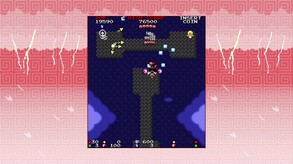
This is a typical Touhou fan game that features a largely original cast and a playstyle that attempts to emulate a console re-release of an arcade title, which is a unique approach for a Touhou game. The developers did a good job imitating this type of format; the title screen allows you to change settings and listen to the OST in the music room (complete with artist commentary like an official touhou game), but when you press start you're sent into a simulation of an arcade experience complete with an attract mode and the ability to insert coins as if you're in MAME. There's even an intro cutscene that tells the story, something ZUN's own games never do (though lately the in-game manuals tell all the story)
This works well, but I feel there's a good bit of QoL missing from this structure: The thing that makes modern releases of arcade titles special are the options given. If you go to the options screen you're given only music/sfw selection (which is displayed as a vertial list of integers to choose from), fullscreen toggle, language select (only EN/JP), the brightness of the in-game border, and spell card history, which for some reason is in the options menu (in fact, there's no spellcard practice; only stage practice in the form of "Free Play" mode)
While in-game, you really don't have a whole lot of ability to change in-game options; you can pause and decide if you want to quit the game, but no retry, key config, manual, or anything. I would have appreciated some extra flourishes to make it feel like a fake M2-style release of a lost arcade title, maybe add unlockable features and secret cheats? Spell Practice? Overdrives ala Ten Desires? A caravan mode? Perhaps even more borders to unlock or even 'gadgets' on the borders themselves.
The gameplay itself strives to be like Touhou, simple shooting mechanics with boss battles that utilize the series' signature spell card system. You can hold the focus key to slow down your movement, and there's point and dream items that appear to be similar to Mystic Square, but I might be wrong on that since the game doesn't really elaborate on its systems much. The core gameplay itself is fine, but like the menus it also suffers from a lack of polish and QoL: There's no "radar" on the bottom to tell you where the boss is horizontally for when you're at the bottom of the screen and focused on dodging, the player has a very weak item 'magnet', making it harder to grab smaller items compared to official games (Thankfully this game has an auto collection field at the top of the screen but for some reason it's REALLY high up in this game), your shot type doesn't change when in focus, bombs do not draw items to you, and the most egregious flaw of all: either your hitbox is too big or the bullets' hitboxes are massive, but either way it leads to a lot of unintended deaths and inadvertently discourages grazing. To make things more confusing, dying is quick and unceremonious, and respawning is equally sudden and jarring; rather than your character moving upwards into the playing field, upon dying you are instantly repositioned towards the lower left corner of the screen, giving you little time to process the life you just lost. This feels like an STG rule that most games know not to break, and this game broke it. Maybe they wanted a more PC-98 style, but the game's graphics don't look very PC-98 and the characters are windows-style, so it makes me wonder what they omitted so much from the windows games.
Also there's some weird bugs in the game too, like how if you die while picking up an item then the item previously magnetized to you will just fly quickly to the side, and how for some reason in single player mode you have to choose two characters despite only playing with one. I initially thought that the game would have some sort of tag team mechanic, but sadly this isn't the case.
The story is kind of strange, too. Pre-release it was described as being a sequel to Double Dealing Character, but "if the events of the extra stage went out of control", but the events feel rather detached from most of DDC. A concert is being held, but violent thunderstorms are occurring that cause problems for the concertgoers and other bands such as The Prismriver Sisters and Choujuu Gigaku, prompting the heroes to investigate. Upon the first stage boss, you learn that the storms are an act of god by someone calling themselves "The Narukami Oumi": the leader of a new christian-inspired religion that appeared in gensokyo, prompting your heroine of choice to fight each religious zealot that comes in your path.
Most of the characters aren't too interesting. The character with the mask has chuuni vibes but none of the designs really spoke to me and they all have the same personality of gassing up their god and wanting to smite you. There's a character at stage 4 that's from a previous work of the author, but I'm not well versed in his extended derivative fan universe. The final boss and leader of the group is [spoiler] Raiko Horikawa; the extra stage boss of Double Dealing Character. She claims to be a living incarnation of an angel raised by a "Church-backed House Horikawa", which makes no sense since Raiko is a tsukumogami who was given life by the miracle mallet's power and can't really have a 'family' in a literal sense. The game implies she's an impostor, but if this isn't the real Raiko, who is she, and where is the real one? The game doesn't seem to give an answer, maybe it's in the 1CC ending, but I only got the bad end. Maybe the answer to this will make sense, but having Raiko, impostor or not, have her backstory changed from a resilient Tsukumogami to christian evangelist and alleged impostor feels random. Maybe they were inspired by the Christian themes of Last Comer, who knows. [/spoiler]
Also... Why is Marisa described as a queen? I believe this is part of the extended universe the creator of the game made, but this element of her is almost never brought up outside of the stage 4 boss referring to her as "your majesty". It almost kind of alienates Touhou players unfamiliar with the works of Drillimation; most people will be more familiar with canon Touhou lore, but expecting people to catch up with this arranged version of gensokyo is a tall order.
The music itself is fine, feels like ZUN-style music. The instrument choice could have been better, but it works.
The idea of an arcade style Touhou game always fascinated me from a "what if" standpoint. The result in this game is one that understands how to make a Touhou game but not how to make one that clicks. With a lack of QoL, various glaring omissions, a questionable story, and an overall lack of polish make this one hard to recommend to most people.