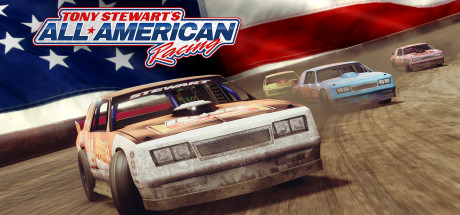
Tony Stewart’s All-American Racing is a down-to-earth, dirt-track racing experience that celebrates the grit and excitement of grassroots motorsports. Developed and published by Monster Games, Inc., it follows up on the studio’s earlier work with Tony Stewart’s Sprint Car Racing but shifts gears toward a broader spectrum of short-track competition. Rather than focusing on high-end professional series, it embraces the energy of local racing culture—the kind of events that unfold on dusty ovals under bright floodlights on a Friday night. With Tony Stewart’s name attached, expectations for authenticity and passion are high, and the game largely delivers on that front. It’s a title that trades the glitz and precision of big-budget simulations for a more accessible, personality-driven approach that captures the heart of small-town racing in the United States.
The game opens with a career mode that immediately gives players a sense of progression and ownership. You begin as a small-time driver scraping together the funds to build your reputation, and over time, you can expand your operations into a full-fledged racing organization. This structure provides a satisfying framework, as it combines the intensity of on-track competition with the strategy of managing a growing team. You can hire staff, upgrade vehicles, and compete across multiple car types, including Street Stocks, Big Block Modifieds, and Legend Cars. Each class brings its own handling style and performance quirks, encouraging players to experiment and adapt as they advance through the ranks. The progression feels organic, and while it lacks the management depth of major simulation franchises, it succeeds in creating the sense of climbing from obscurity to prominence—a theme that resonates with the game’s portrayal of the sport.
When it comes to driving, Tony Stewart’s All-American Racing finds a sweet spot between arcade fun and simulation realism. The physics model emphasizes the tactile feel of dirt racing, where traction, throttle control, and slide management determine success. Cars react convincingly to track conditions, and the sensation of carving through a turn while throwing up a cloud of dust is immensely satisfying. The handling has just enough nuance to challenge experienced players while remaining forgiving for newcomers. It’s easy to pick up, yet mastering corner exits, braking points, and car setup can take time. Each race tends to be a close-quarters affair, with pack racing that’s both exhilarating and chaotic. Bumping and sliding are constant, and the AI drivers—though not flawless—put up enough resistance to make victories feel earned. There’s a real physicality to the races, as cars jostle for position and dirt builds up on your screen, capturing the unpredictable nature of real short-track competition.
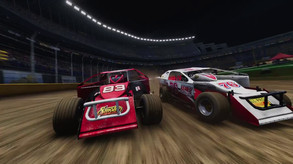
Visually, the game captures the rustic charm of its setting with sincerity. The tracks are compact and intimate, filled with flickering lights, packed grandstands, and that ever-present haze of dust that defines dirt racing. The car models are well detailed, showcasing sponsor decals and battle scars from collisions. While the environments are not lavishly detailed compared to high-end racing sims, they serve the atmosphere well. Each circuit feels unique enough to avoid monotony, though some players may find the scenery repetitive after extended play. The art direction prioritizes clarity over spectacle, ensuring the action remains easy to follow even when chaos erupts on screen. The sound design complements this with throaty engine roars and the crunch of metal-on-metal contact, though the audio lacks variety across vehicle types—an area where the game could have used more attention. Still, the overall sensory experience succeeds in immersing the player in the world of dirt-track racing.
The career mode’s structure adds a surprising amount of replayability. As you climb the ladder, you’re rewarded not just with faster cars but also with new tracks and challenges. The process of upgrading vehicles and hiring staff introduces a light managerial aspect that complements the racing nicely. Between events, you can tweak your car setup, experiment with gear ratios, or invest in team improvements to give you an edge. While these systems are simplified compared to professional motorsport simulations, they add just enough complexity to make your progress feel earned. The ability to participate in multiple racing divisions also keeps the experience from feeling too linear. Each car class has its own personality: Street Stocks feel heavy and raw, Legend Cars are light and nimble, and Big Blocks demand precision and aggression. This diversity ensures that the core racing mechanics stay fresh even after dozens of races.
One of the game’s standout features is its accessibility. It doesn’t demand encyclopedic knowledge of tuning setups or a mastery of simulation physics. Instead, it welcomes players of all skill levels. The controls are tight and responsive, and the difficulty can be adjusted to accommodate casual drivers or those seeking a tougher challenge. Local split-screen multiplayer adds another layer of fun, turning it into a great pick for friends who want to battle it out in short bursts of adrenaline-fueled competition. The lack of robust online multiplayer, however, feels like a missed opportunity. In an era when online racing communities are thriving, having only local multiplayer and offline career modes limits the game’s long-term appeal. That said, for those who prefer solo play or couch co-op, the game’s focus on offline content ensures that it remains enjoyable without relying on servers or matchmaking systems.
While Tony Stewart’s All-American Racing succeeds in delivering excitement, it’s not without its flaws. The visuals, though clean and functional, lack the polish of larger-budget racing titles. Crowd animations are minimal, and environmental variety could be broader. Some players may find the repetition of short-track layouts a bit monotonous after extended play sessions, especially since the game doesn’t stray far from its core formula. The AI, while competent, occasionally behaves erratically, alternating between overly cautious and overly aggressive behavior. Additionally, the sound design, while serviceable, doesn’t fully capture the distinct characteristics of each car type, making races feel aurally similar over time. Still, these shortcomings are minor in the grand scheme, and they don’t detract from the game’s fundamental enjoyment. It’s clear that Monster Games prioritized feel and flow over sheer technical complexity—and in a game like this, that’s the right choice.
What ultimately defines Tony Stewart’s All-American Racing is its authenticity. It doesn’t rely on flashy gimmicks or extravagant production values to make its mark. Instead, it celebrates the unpretentious, grassroots spirit of American dirt racing. Every aspect of the design, from the career progression to the trackside atmosphere, reflects a deep affection for the sport. It’s a game that understands the thrill of fighting for position on a dirt oval, the satisfaction of improving with each race, and the pride of building something from the ground up. It might not have the scope of major simulation franchises like iRacing or Gran Turismo, but it captures something just as valuable: heart. For fans of Tony Stewart, for dirt-racing enthusiasts, or for anyone craving a focused, well-built racing experience, this title delivers exactly what it promises. It’s not perfect, but it’s passionate, fast, and full of that all-American racing spirit that never goes out of style.
Rating: 8/10