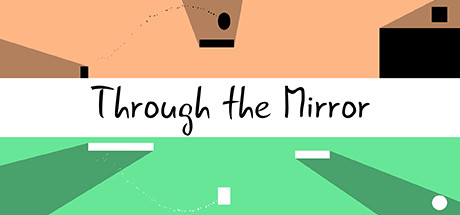
Through the Mirror, developed by Cleiton Oliveira and published by Volens Nolens Games, is a puzzle-platformer built almost entirely around a single idea: navigating two mirrored worlds at once. It’s the kind of concept that sounds simple until you actually try to execute it, and the game leans heavily on that tension—forcing players to constantly think in opposites, anticipate consequences, and adapt to a control scheme that deliberately works against instinct.
The core mechanic defines everything. Movement in one world is mirrored in another, often inverted, meaning that a safe step in one space can create danger in the other. From the very beginning, the game teaches players to think beyond a single perspective, encouraging them to visualize both environments simultaneously. Early levels ease players into this dual-awareness, but the difficulty escalates quickly as hazards become more complex and timing becomes more critical. What starts as a simple coordination challenge evolves into a test of spatial reasoning and mental flexibility.
Level design is structured to emphasize this growing complexity. Each stage introduces new obstacles or tighter sequences that demand more precise control and planning. The game rarely overwhelms with new mechanics; instead, it builds on its central idea, refining and intensifying it over time. This approach keeps the experience focused, but it also means that variety is limited. Players are not learning entirely new systems—they are becoming better at interpreting the same one under increasing pressure.
There is a distinct satisfaction in mastering this system. When both sides of the mirrored world align and movement becomes intuitive, the gameplay flows smoothly, creating moments where the player feels fully in control despite the inherent difficulty. These moments are where Through the Mirror is at its strongest, demonstrating how a single mechanic, when carefully developed, can carry an entire experience.
At the same time, the game’s reliance on repetition can be a double-edged sword. Progress often comes through trial and error, particularly in later levels where precision is essential. While failures are usually fair, they can feel frequent, especially when small mistakes lead to immediate resets. The relatively short length of the game helps mitigate this, preventing frustration from building too far, but it also highlights the limited scope of the experience.
Visually, the game takes a minimalist approach. Environments are composed of simple shapes and clean lines, prioritizing clarity over detail. This makes it easy to track movement and understand spatial relationships, which is crucial for a game built on mirrored mechanics. However, the lack of visual variety or atmosphere can make the world feel somewhat sterile. There is little sense of place or progression beyond the increasing difficulty of the levels, and the aesthetic does not evolve alongside the gameplay.
The audio design follows a similarly restrained path. Background music and sound effects are functional, providing feedback without drawing attention. While this supports the game’s focus on mechanics, it doesn’t add much to the overall experience. Over time, the repetition in audio can become noticeable, reinforcing the sense that presentation is secondary to gameplay.
Another limitation is the lack of replay value. Once the levels are completed, there is little incentive to return. There are no alternative modes, additional challenges, or significant variations to explore. The game feels designed as a single, contained experience rather than something meant for extended engagement. This isn’t necessarily a flaw, but it does place a ceiling on its longevity.
Ultimately, Through the Mirror is a game that succeeds by committing fully to its central idea. It offers a focused, challenging experience that rewards patience and spatial awareness, delivering moments of genuine satisfaction when its mechanics click into place. However, its limited variety, minimal presentation, and short runtime prevent it from reaching a broader level of depth. It stands as a strong example of how a simple concept can be explored effectively, even if it doesn’t expand far beyond its initial premise.
Rating: 7/10