Third is a small but unusually thoughtful experimental adventure that places ideas about control, choice, and manipulation ahead of conventional spectacle. Developed and published by Godfrey Yang, the game began as a student project created for EAE 3720 at the University of Utah before arriving on Steam in February 2023. Its modest origins are apparent in its minimalist presentation, but they also help explain why the game is willing to experiment with concepts that larger productions might avoid. Rather than building its identity around combat, elaborate environments, or complicated progression systems, Third concentrates on the relationship between the player, the person designing the experience, and the rules governing the world.
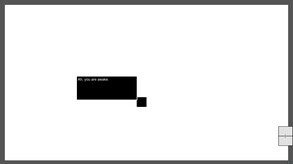
The premise begins inside a mysterious room where the player awakens and hears a man communicating through a speaker. He introduces the situation as an experiment and encourages participation, creating an immediate imbalance of information. The mysterious voice apparently understands what is happening while the player knows almost nothing. As exploration continues, it becomes increasingly apparent that the experiment is not as innocent as initially presented. Escape becomes the central practical objective, but the individual responsible for the situation has little interest in allowing that to happen. This creates a strange conflict in which the player is effectively struggling against the intentions of the person controlling the experiment itself.
Puzzle solving and exploration provide the mechanical foundation. Players examine their surroundings, interact with objects, search for useful information, and gradually determine how different elements of the environment function. The game incorporates characteristics associated with hidden-object adventures and environmental puzzles, but its challenges are closely connected to the larger theme of mistrust. Instructions cannot necessarily be accepted at face value, and information supplied by an apparent authority may exist specifically to manipulate the player's behavior. This turns even relatively simple interactions into part of a broader psychological contest.
Third draws inspiration from works such as The Witness, The Stanley Parable, and The Pervert's Guide to Ideology, and those influences provide useful context for understanding its unusual direction. The game is interested in more than whether a player can solve a puzzle. It asks why players accept objectives, follow instructions, and operate according to rules established by an unseen designer. Most games expect players to cooperate with their creators. Third instead makes that relationship suspicious. The person behind the experiment becomes an embodiment of authority, while the player gradually learns that obedience and progress are not necessarily the same thing.
The idea of repetition also plays an important role. The suggestion of an endless cycle creates the impression that escaping the immediate situation may not be enough. Repetition can become another mechanism of control, especially when the participant believes that following established procedures will eventually produce a different result. This gives the experience a philosophical quality despite its relatively simple construction. The game encourages players to notice patterns and question why those patterns exist rather than merely rushing toward the next objective.
Visually, Third uses a minimalist 2D top-down pixel-art style. It is not technically ambitious, but the presentation complements the project's intentions reasonably well. Sparse environments make individual objects and environmental irregularities easier to notice, while the limited visual detail creates a somewhat artificial atmosphere appropriate for an experimental setting. At times the graphics reveal the project's student origins and can feel closer to a prototype than a fully developed commercial adventure. Nevertheless, elaborate visuals would not necessarily improve a game whose primary purpose is to make players think about the structure surrounding their actions.
The game's treatment of choice is particularly interesting because Third is fundamentally a fairly linear experience. Instead of offering an enormous branching narrative with countless outcomes, it explores the tension between perceived freedom and predetermined possibilities. A player might decide whether to trust information or investigate something suspicious, yet every possible interaction still exists because the designer placed it there. That contradiction fits the game's central concerns remarkably well. Third effectively asks whether meaningful freedom can exist inside a system where someone else has already determined the boundaries.
Its philosophical and ideological elements give the project greater personality than its production values might initially suggest. Themes associated with authority, capitalism, manipulation, obedience, and systems of control appear to inform the game's underlying message. The experiment can consequently be viewed as more than a literal scenario. It functions as a metaphorical structure in which individuals are encouraged to behave according to rules established by someone who possesses greater knowledge and power. The game does not necessarily provide definitive answers to the questions it raises, but its willingness to make those questions part of the gameplay is one of its strongest qualities.
There are clear limitations. Third is lightweight in practically every respect, requiring very little storage and offering nowhere near the scale expected from a major puzzle adventure. Its environments, animations, interface, and overall presentation are deliberately simple. Players searching for sophisticated production values, lengthy storytelling, extensive character development, or highly elaborate puzzle mechanics may therefore find it underwhelming. Some of its philosophical ambitions are also larger than the amount of content available to explore them, meaning certain concepts feel introduced rather than exhaustively developed.
The experience will consequently appeal most strongly to players who enjoy short experimental games and self-aware narratives. Anyone fascinated by games that challenge the relationship between designer and participant is more likely to appreciate what Third is attempting. Players primarily interested in mechanical complexity or visual polish may struggle to see beyond its modest construction. Its value comes from the ideas surrounding the puzzles rather than the complexity of the puzzles alone.
As a free experimental project, Third deserves considerable credit for establishing a distinctive identity with extremely limited resources. Godfrey Yang uses a straightforward premise, minimalist pixel graphics, environmental puzzles, an unreliable authority figure, and philosophical themes to transform a simple escape scenario into commentary on control and player agency. The execution is not consistently polished, and its limited scope prevents some concepts from reaching their full potential, but the game demonstrates creativity and a clear willingness to experiment.
Ultimately, Third is best approached as a brief interactive thought experiment rather than a traditional puzzle adventure. Its greatest achievement is making the player question not only how to escape but also why they trust the rules presented to them in the first place. The combination of exploration, puzzles, repetition, deception, and meta commentary creates an intriguing experience despite the rough edges associated with its small-scale origins. It may not satisfy players looking for a substantial or technically sophisticated adventure, but those interested in philosophical indie games and unconventional approaches to player agency should find something memorable within its peculiar experiment.
Rating: 5/10