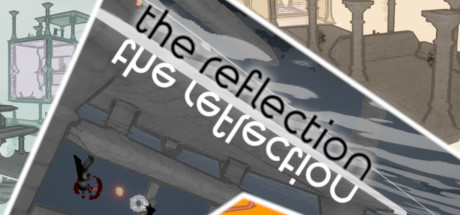
The Reflection explores the connection to an alternate dimension that contains all the matter of the world inverted. From the surface, there appears to be simply a reflection of light, but submerging into the water reveals that this world is completely tangible, mirroring the world perfectly.
Modeled estimate, not a reported figure. How we estimate →
Media

About
Stats
All-time low is the lowest price we've recorded for this game since we started tracking it.
Languages: English
Reviews
Interesting first attempt at making a game. Takes a variety of ideas that all function but never comes together well through the game's short length, in addition to other problems. You start with a side view of your character and the level that makes it look like a platformer before quickly having to switch to a first person mode where you have a gun to fight enemies and the ability to teleport (it says hook to but you just appear next to it) to nearby orbs in the environment. Running into the orbs or entering a layer of water in the stage puts you into an inverted version of the stage that can allow you to reach new platforms or to fight enemies that were formerly covered by force fields. New elements are added in later levels like platforms that rotate whenever you jump, traps, or needing to find jewels that spawn in enemies. Most of the game is presented and has the length of a tutorial where you have large text explaining how things work to you and by the time you are through the simplest first five levels you are halfway through the game in under 10 minutes. Though simplistic shooting could be fairly satisfying if enemies were placed in more interesting locations and made better use of the reflections in the level, instead enemies tend to just be spawned in a giant mob or spawn in surrounding you after you pick up a jewel which can make getting killed pretty cheap. The opening says you can switch between levels but that doesn't seem to work so you would have to finish the game in one sitting. Having it on caused the graphics card to run hotter than it should be.
Configurar a tecla R para reiniciar o nível em um jogo que você tem uma arma nunca vai ser uma boa ideia, quem joga FPS vai me entender. E outra coisa que me deixou louco foi o fato do "cima/baixo" do mouse estar invertido, não sei se fiz algo de errado mas é impossível jogar dessa forma.
The Reflection is a 3D rendered Unreal Engine 2D retro platformer with the old and overdone "mirror" gimmick (falling through the water switches you to an inverted plane of the level, ho hum). Completing levels involves using this mechanic to find the correct platformer path to the level end. That's all there is to it. From a technical perspective, the game doesn't meet basic minimum requirements that most PC gamers expect as standard. The game features lazy low-polygon minimalist greyscale assets, making this look like a barely functional 3D game from the 1990s. It's unclear why the developers weren't able to arrange high quality, high polygon count contemporary assets for the game, and also irrelevant... what matters is that this looks bad as a result of their decisions, a compromise PC gamers shouldn't have to put up with. The controls can't be customised, which will be an annoyance for many, but it can also render the game unplayable for differently-abled gamers. The controls and game handling are notably very floaty and unsmooth here. Platformer hitboxing isn't quite right so if you're close to getting the platform you can "bump" onto it... it's difficult to plan jumps properly because of this lack of polish. It's janky and unsatisfying to play... and any experienced gamer will tell you, the handling, responsiveness and general gameplay feel of the control scheme must be well polished for this kind of game to succeed. Unfortunately, this is something the developer seems to have phoned in, with little to no apparent gameplay testing. They dropped the ball on this one. These technical defects push this game below acceptable standards for any modern PC game. The poor quality of this game is reflected in the general public reception. At the time of this review, SteamDB shows the game only ever reached a peak player count of only ONE player. That's right, only one person ever played this at a time. When I played this for the purposes of reviewing it, I equalled the peak player count for the game. OUCH. The only player activity occurs once or twice a month, presumably someone loading it up to see what it is then quickly uninstalling it. Considering there's over 120 million gamers on Steam, the overwhelming lack of interest in the game is remarkable, but also to be expected. This complete and utter rejection of the game from gamers should be a keen information point for anyone considering buying shovelware like this. Gamers just didn't take this seriously, and for good reason. The Reflection has an overly optimistic price of around $4 USD, it's not worth it given the defects and shortcomings with the product, especially considering the sheer number of completely free, much higher quality games on Steam.
어지러워 뒤지겠네;;
没中文 没成就 镜中世界 这款游戏出自一位 16 岁开发者的热忱之作,从设计、编程到开发全程由他独立完成。非常感谢你给予的任何支持。 《镜中世界》以全新视角诠释太空与物质,带你探索一个名为 “镜中世界” 的异次元关联 —— 这里颠倒承载着世间万物。通往该次元的入口是一片水平面,从表面看去,它只是光线形成的倒影;潜入水中后你会发现,这个次元真实可触,与现实世界完美镜像。就连移动的物体与敌人都会被镜像映射,让玩家能从另一个角度与之互动。 游戏的每一处玩法都经过精心设计,充分挖掘并拓展 “镜中世界” 的机制潜力。遍布世界的传送门,能让你从镜中世界的某个平面,传送到现实世界对应的平面(此时会变为天花板)。部分敌人只存在于镜中世界,在现实里呈倒立状态。移动平台的水下部分,在镜像后会完全消失。玩家还拥有钩锁能力,可抵达天花板上的传送门;一旦传送到对应位置,天花板便会成为你的地面。 游戏体验: 颠覆思维的战斗场景:在现实与镜中世界穿梭,换个角度应对冲突 —— 比如站在敌人头顶的镜像天花板上,从下方发起攻击(在镜中世界则是从上方)。 富有挑战的精准操作:复杂的平台跳跃关卡与紧张的战斗场景,制定策略击败敌人,利用镜像地图在大规模敌人中占据优势。 简洁易懂的美术风格:色彩绚丽的世界,搭配卡通描边与亮眼粒子特效,让玩家能清晰辨识关卡环境。 简易第一人称射击战斗:参与史诗对决击败敌人,点击或长按即可射击,武器弹药自动回复(上限 10 发)。 10 个关卡:流程长度与难度逐步提升(游戏时长约 2–5 小时,依玩家水平而定)。 无尽模式:通关 10 个关卡后解锁,超大地图中敌人将从四面八方蜂拥而至。
almost interesting idea for game but it's pretty poorly made and falls flat in many ways that i'm not gonna go in to too much detail here. sorry
Простая и интересная игрушка, хоть и вправду коротковата. Без понятия, что за куча негатива и какой-то мега-критики в других обзорах. (Да, нужно подшлефовать немного игру, не у всех всё идеально) На взгляд обычного игрока вполне даже хорошая штука, если у вас есть немного свободного времени, очень понравилось интересное совмещение шутера и головоломки. В общем и целом приятно было потратить на нее своё время <3
В принципе хорошая игра за свои 82 рубля. Чувствуется что не до конца доработана, но вполне интересная и со своими механиками. Есть один большой минус, на последних уровнях вместо добавления каких то новых механик разработчик тупо пихает больше врагов. Впечатления от игры положительные. Правда, под конец уже становиться уже скучно играть
The Reflection, developed and published by BatYaggy, is a concept-driven indie platformer that builds its entire identity around a single, intriguing mechanic: the existence of a mirrored world that the player can freely traverse. Rather than relying on complex systems or a layered narrative, the game focuses on how this dual-world interaction reshapes movement, puzzle-solving, and combat. It feels less like a traditional platformer and more like an experiment in spatial design, where understanding the relationship between two perspectives becomes the key to progression. The central mechanic revolves around shifting between the normal world and its inverted reflection, typically accessed through reflective surfaces such as water. This mirrored dimension is not just a visual effect—it is fully interactive, with terrain, enemies, and obstacles existing in both states. What is solid ground in one dimension may become a ceiling or an unreachable surface in the other, forcing players to constantly rethink their position and approach. This creates moments where the solution to a problem lies not in moving forward, but in flipping perspective entirely. The mechanic is intuitive in concept but becomes increasingly complex as the game layers challenges that require players to think across both spaces simultaneously. Gameplay blends platforming with light combat and environmental puzzles, all tied together by the reflection system. Movement requires precision, especially in sections that demand quick transitions between dimensions. The addition of traversal tools, such as a grappling ability, expands the player’s options and introduces more dynamic ways to navigate the environment. These mechanics work best when combined, creating sequences where timing, positioning, and perspective all need to align. Combat, while present, is relatively simple and often secondary to the spatial challenges, relying more on positioning than on deep mechanical complexity. Level design is where the game shows both its creativity and its limitations. At its strongest, it presents clever scenarios that fully utilize the dual-world concept, encouraging players to experiment and discover unconventional solutions. Navigating a space by alternating between dimensions or approaching enemies from unexpected angles can feel satisfying and inventive. However, these ideas are not always pushed as far as they could be. The game introduces compelling mechanics but does not consistently expand on them, which can make certain sections feel underdeveloped or repetitive once the core concept is understood. Visually, The Reflection adopts a simple, colorful style that prioritizes clarity. The distinction between the two dimensions is clear enough to prevent confusion, which is essential for a game built around perspective shifts. However, the overall presentation is fairly minimal, with limited environmental variety and a straightforward aesthetic. While functional, it does not add much beyond supporting the gameplay, and it lacks the visual depth that could have made the world more memorable. One of the most notable aspects of the game is its origin as a solo-developed project. This is reflected in both its strengths and its shortcomings. There is a clear sense of creativity and ambition in the core mechanic, but also a lack of refinement in certain areas. Controls can occasionally feel inconsistent, and the overall experience lacks the polish typically associated with larger productions. At the same time, this roughness contributes to its identity as a passion project, where experimentation takes precedence over perfection. The game’s structure is relatively short and linear, offering a focused experience that does not extend far beyond its central idea. There are few additional modes or incentives for replay, and once the main progression is complete, there is little reason to return. This reinforces the impression that the game is designed to showcase a concept rather than provide a long-lasting experience. Ultimately, The Reflection succeeds in delivering a unique and creative gameplay idea that stands out within the platforming genre. Its use of a mirrored world introduces moments of genuine ingenuity and offers a different way of thinking about movement and interaction. However, its limited scope, uneven execution, and lack of deeper systems prevent it from fully realizing its potential. It is best appreciated as a focused indie experiment—one that offers glimpses of something more ambitious, even if it does not fully achieve it. Rating: 6/10
Related
Related
Trends
Modeled estimate over time, reconstructed from Steam's monthly review histogram.
Momentum
Pace estimated from the game's recent review growth (our daily snapshots) at its own sales-per-review ratio — a momentum signal, not booked sales.
Related
| Anime Sunset Ride | $334.4 | 54 | 67% | $0.49 |
| Cosmic Journey PC Live Wallpaper | $336.3 | 52 | 71% | $0.49 |
| Girls and Dragons | $340.5 | 55 | 76% | $0.99 |
| Forest and Girls | $340.5 | 55 | 82% | $0.99 |
| Dances and Girls | $322 | 52 | 83% | $0.99 |
| Work And Girls | $346.9 | 56 | 86% | $0.99 |