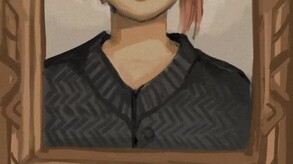
The Painting is a short but emotionally focused visual novel that uses simplicity as one of its greatest strengths. Developed and published by Tymedust Games, it originated as an entry for the O2A2 VN Jam 2022 before later arriving on Steam. The restrictions associated with that project are important to understanding the finished experience, particularly its script of fewer than 1,000 words and its deliberately limited collection of visual and narrative assets. Rather than attempting to disguise those limitations, The Painting embraces them, creating a tightly constructed story about grief, memories, love, and the lingering emotional presence of someone who has been lost.
At the center of the story is a grieving man whose memories of happier days begin returning to him. The premise is straightforward, but the game is more interested in emotion than complicated plotting. It explores the way memories can become simultaneously comforting and painful after a significant loss. Moments that might once have seemed ordinary acquire greater importance because they represent experiences that cannot be recreated. This gives the narrative a reflective quality, with the protagonist seemingly caught between accepting his present circumstances and emotionally revisiting a past that remains vivid in his mind.
The Painting is structured as a kinetic visual novel, so players should expect a completely narrative-driven experience rather than a game built around choices or branching routes. There are no complicated dialogue decisions, character statistics, puzzles, combat systems, or exploration mechanics. Instead, the player progresses through a predetermined sequence of scenes. This lack of interaction could disappoint anyone expecting the traditional decision-making associated with many visual novels, but the linear format suits the story. The developer is able to control exactly when information is presented and how quickly each emotional moment follows the previous one.
Its exceptionally short length is perhaps its most significant characteristic. The entire experience can generally be completed in approximately 10 to 15 minutes. For players accustomed to visual novels lasting dozens of hours, that may initially sound too limited to be worthwhile. However, The Painting is better understood as an interactive short story rather than a conventional full-length game. Its restricted word count forces the writing to remain concentrated on the central subject. There is almost no room for unrelated exposition or unnecessary subplots, allowing the narrative to establish its emotional premise, develop it, and reach its conclusion without overstaying its welcome.
That brevity inevitably comes with disadvantages. There is limited time to establish the protagonist and other important figures with the depth that a longer visual novel could provide. The emotional connection therefore depends heavily on whether the player quickly identifies with the situation being presented. Someone who immediately connects with the themes of memory and loss may find the experience surprisingly affecting, while another player could reach the ending before becoming sufficiently invested. The predetermined narrative also means there is little reason to replay the game in search of alternative outcomes.
The hand-drawn artwork complements the intimate nature of the story particularly well. The visual presentation does not attempt to overwhelm the player with elaborate environments or excessive animation. Instead, the restrained imagery reinforces the sensation of looking through fragments of personal memory. There is an appropriately delicate quality to the presentation, which fits a story concerned with experiences that survive only through recollection. The artwork feels connected to the narrative's themes rather than functioning merely as decoration between passages of text.
Music and presentation also contribute to the atmosphere. Because The Painting has so little time to establish its emotional identity, every component needs to support the intended mood quickly. The combination of text, imagery, transitions, and audio creates an experience that feels deliberately contemplative. The absence of complicated mechanics allows players to concentrate almost entirely on what the protagonist is remembering and what those memories represent. This makes the game feel closer to experiencing an illustrated recollection than participating in a traditional adventure.
One of the stronger aspects of the narrative is its understanding that grief does not necessarily revolve around dramatic moments. Sometimes the smallest memories become the most difficult ones to revisit because they represent normal experiences that once seemed permanent. The Painting builds much of its emotional identity around this idea. Rather than creating an enormous tragedy filled with complicated twists, it examines the quieter psychological consequences of absence. The past cannot be changed, yet it remains powerful enough to shape the protagonist's present emotional state.
The minimalist design also demonstrates what can be accomplished under strict development limitations. The O2A2 VN Jam restrictions could easily have resulted in something that felt incomplete, but Tymedust Games instead treats those boundaries as part of the project's identity. The limited script encourages economical storytelling, while the restricted visual resources help maintain a consistent aesthetic. It is a good example of how limitations can sometimes force creators to identify the essential elements of an idea and eliminate everything that does not directly support them.
From a technical perspective, The Painting is highly accessible. Its modest hardware requirements make it suitable for systems without powerful gaming components, and it supports Windows, macOS, and Linux-based environments. The Steam release is also free to play, which makes its extremely short duration much easier to accept. There is little commitment required from the player beyond setting aside a few minutes and being willing to engage with a quiet, emotionally driven story.
The Painting ultimately works best when judged according to what it deliberately sets out to accomplish. It is not trying to provide extensive gameplay, dozens of characters, multiple endings, or a lengthy campaign. Instead, Tymedust Games delivers a concentrated visual novel about the relationship between grief and memory. Its short duration and lack of meaningful interaction prevent it from offering the depth of a larger visual novel, but those same qualities contribute to its unusually focused presentation.
For players who enjoy experimental visual novels, melancholic storytelling, hand-drawn independent games, and brief narrative experiences, The Painting is easy to recommend. Its greatest weakness is simply that there is not much of it, and players wanting substantial interaction will find very little traditional gameplay. Yet as a small emotional vignette, it succeeds through restraint, sincerity, cohesive presentation, and an understanding of how powerful ordinary memories can become after loss. Taking its narrative focus, artwork, atmosphere, accessibility, and effective use of strict creative limitations into consideration, while accounting for its extremely short runtime and minimal interactivity,
Rating: 8/10



 <1,000 words (10-15 minutes of playtime).