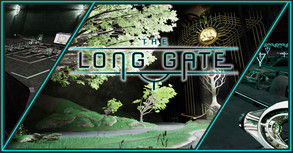
Explore mysterious caverns and solve the puzzles of the ancient machines that fill them.
Modeled estimate, not a reported figure. How we estimate →
Media

About

Key Features:
Three different classes of puzzles: digital, analog, and quantum
Optional levels of puzzle hints
A beautiful original soundtrack
Mysterious locations to explore and hidden secrets to discover
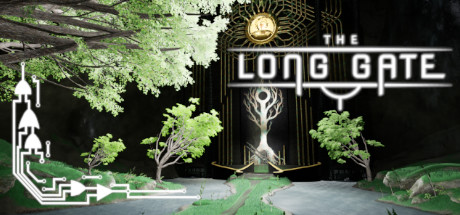
The Long Gate is a challenging and beautiful single-player, first-person, puzzle game. On a mission from the enigmatic creators of this place, you will explore ancient caverns filled with mysterious devices and traverse relaxing oases of nature while learning to solve the three primary types of puzzles that wind through them. Repair the ancient circuits and unravel the mystery of what happened to their creators.
Nearly all The Long Gate’s puzzles are based on real world technologies, and it contains accurate depictions of quantum circuits and a 4-bit quantum computer, verified by scientists at D-Wave Systems, the world’s first commercial quantum computer company. To progress through the game, you will learn the basic principles that form the backbones of each puzzle type. You do not need a technical background to finish the game, but if you have an interest in any STEM field these puzzles will be particularly interesting to you.
Levels and many puzzles can be completed in any order and many have more than a single possible solution for you to discover, and mastering a circuit type will provide keys to new areas and secrets. If you ever get stuck on a puzzle you can explore somewhere else, then come back later, or you can open the settings menu and turn on the hints.
The Long Gate also features an original soundtrack by musician Nick Newman.
Stats
All-time low is the lowest price we've recorded for this game since we started tracking it.
Languages: English**languages with full audio support
Engagement
Reviews
Themes across 40 recent reviews and how positive each mention is. A keyword signal, not full sentiment analysis.
Reviews
This is a very cool and interesting game! I haven't finished it yet but the puzzles are fun and I'm excited to see where things go.
Ok, so I've just finished the game for the first time (replaying soon because I still need that sweet, sweet 100% engineer mode achievement!) but I wanted to get my immediate feedback at 14.4hrs in onto paper :P Firstly, a bit of my background. At time of writing, I'm a researcher in Computational Chemistry, and have a keen interest in quantum computing and electronics. I mention this as I think I'm not your typical audience, as not every gamer will have my experience with these kinds of things. Onto the review! Spoilers abound from here on out so don't read on if you care about those! -------- [spoiler] The Art Style: I absolutely love it! The art deco/futuristic vibes are great, and work really well in all three areas. The Digital area is nice- very minimalist, allowing me to focus on what's actually going on. The Analog area is simply gorgeous. I think my favourite art, however, has to be the qubits. I love how they're visualised! The hub world with the nature intertwined was also beautiful. Gameplay and Accessibility: Gnerally fun. I enjoyed the three choices of difficulty level- it was fun to try and complete the digital levels on engineer mode, even though finding the door to the programmable display took a friend to tell me where it is (who, I believe, asked on the steam forums!) The hub world was great to seperate everything out, and the layout of the puzzles was generally good. I enjoyed the interactive pull-button-things, and they gave a good break in between puzzles to encourage me to stop and think. The addition of an FOV slider was a great addition- I get motion sick with some games like this (Talos being one) so I'm glad that was added as it really helped. Moving pieces around in Digital and Analog was a little annoying at the start, but I gradually got used to the quirks of moving things. Finally, I loved discovering the three little "easter eggs" around the place! I didn't have many problems with my colourblindness either, which was excellent. Finally, the audio was beautiful and I can't get enough of it. My top three puzzles: 3. Analog: The Computer Puzzle. Took a minute to realise I only had 10 commands! It was a really good learning moment- I tried something, it didn't work, I realised why- I had to reformulate my original plan. More stages of this might get tedious, but it could be cool to have more input sequences with different command lists needed; e.g. 55, 89, 144, 233 (Fibbonacci numbers, a real "what do these have in common" until you realise it!). 2. Digital: Floor 8. To finish the rest of Digital, only to come across floor 8 and discover it to be a giant mess of wires and complexity: then slowly unpacking it, working out that it's 4 memory registers and a binary adder, then working out what values to add together and in what order... oh, yes, when it worked! Only one thing can beat that feeling, which is... 1. Quantum: The opening two puzzles in the Quantum section. I really enjoyed learning how these worked and how Quantum computing had been implemented into the game. I do have some feedback more generally on this though, so I'll leave it there for now. My bottom three puzzles (Apart from number one, which I'm still salty about, these still are a solid 7/10 so it's not like these are bad!): 3. Quantum: As I said I'll touch more on this in a second, but I was and wasn't a fan of the big quantum computer. I still loved the design, though, and finding the D-Wave logo on the back of it made my day :P 2. Analog: 5 buttons, Rotating Circles in a box. I still don't know how I got the second signal to light up to complete the puzzle, or why it didn't light up when I lined up all of the openings with the left side the first 4 times. 1. Analog: The pile-of-sugar-like waveform on the right side of the play area (by the exit of the signals). Urgh, I spent over three hours tweaking, testing and retesting this one. This was such a hurdle. Ironically, the variable waveforms posed less of a challenge, even though for a friend of mine they proved to be much more difficult. Thoughts on Quantum Section: So, this may be a specific gripe from me and me alone, but... the Quantum section left me the teenciest bit disappointed. During the final few Analog puzzles, I was thinking about the Quantum stuff coming up- and getting all hyped up about it! I spent the late evening refreshing my memory of the Bloch sphere, Toffoli gates, bit swaps, and all that fun stuff. I went to bed thinking about how the space would be represented- a holoraphic 3d model of a sphere showing where on the Bloch sphere the qubit is at any one point? Passing those bits through quantum gates and changing them to bias an outcome... ooh, the possibilities (pun intended)! So this morning I open up my laptop to finish off the game and... Ok, 1 qubit, manipulation and biasing, ok... two coupled qubits, ok... 4 qubits... ok, this is getting tedious... and then it just... ends. I checked the 2 coupled qubits, and I'm pretty sure that for values of 1,0,-1 for all three settings (2 Qubits and Correlator) they're fully deterministic, which was... saddening. I'm pretty sure that most of this is because I've got some experience with QM previously, and that the descision not to do something like this was a practical one both from a coding perspective and also from an audience perspective. You don't want to create a situation where you either have a degree in physics or can't complete the game- and that's ok. I hyped up the end in my mind to an unrealistic point, but I can't help but feel like something's been missed. I hate to say this is a critisism- there are legitimite reasons for not doing the end like this! However... Three things I'd hypothetically want in a paid DLC, if this was to ever happen: 1. Better/More (potentially optional) Quantum puzzles. The Long Gate: Quantum Conundrum has a ring to it, no? 2. More time-dependent puzzles in the Analog section. Manipulating analog time waveforms to create a new state. The idea of standing waves- oh, I've got a time-dependent peak moving left to right, and my output is a... it's a peak that grows and shrinks... and I've got a device labelled "delay" and a device labelled "negate"... and an adder, of course. What if I... oh, that's cool! I can add them together and get a steady state! 3. Mixed puzzles. Quantum Gates operating to produce digital outputs that control analogue signals, which represent the wavefunction for a quantum system... and all that nice stuff. Combine the three things we've learned! Story: Whilst there's no overt story, I've got a whole page of notes on things I picked up on that have my storytelling brain in overdrive right now! [/spoiler] Overall: Thank you, David, for a great experience! I'm definitely glad I picked The Long Gate up. Looking forwards to your next project! :D
Related
Related
Trends
Concurrent players on Steam, sampled daily since tracking started.
Hours played at review time, across 40 reviews with recorded playtime.
positive critical· bar length = how often the theme comes up
I really enjoyed this game, despite its sometimes clunky implementation. The logic puzzles themselves were excellent, and I had a lot of fun learning how the different electronic gates worked. The atmosphere created in the game is wonderful, a delightful mix of mystery and the contrast between technology and nature. The puzzle components were well designed, and I found most of the puzzle logical to follow. The hints are somewhat useless, and a bit more thought could be given to guiding the player through necessary gameplay mechanics, such as setting the binary value on the device. What really lets the game down is the interface. The slides that are utilised everywhere in the game are too coarse, with no little to no indication of the actual value being represented. This was especially annoying in the quantum level, where the slider would show 0, but the output of the 4-qubit system would indicate a value other than zero, making some of those puzzles very tedious to solve. On the whole, with an update or two to solve a handful of these issues, this would become a game I recommend to anyone.
Interfaces are obtuse, puzzles are extremely basic digital logic circuits.
Disclaimer: I've only completed the Digital area and the right half of the Analog area. Also I'm writing this when I'm really tired. This game has a beautiful aesthetic and fun ideas, but the puzzle design can be very obscure and/or cheesable. (Picking up and placing down a powered wire connector has weird effects; some puzzles can be solved while leaving entire sections unpowered.) Latch gates really need more introduction/explanation for beginners. There's also QoL issues such as: - Having to click twice to plug into stuff when clicking once should be enough for both the positioning and activating. - An inconvenient process for downloading bit strings to your tool. Perhaps this is to dissuade players from brute forcing inputs (or to contribute to immersion), but I really wish I could just pull up a UI to edit the bit string instead of having to go to the designated room. Also, 3D perspective makes it a little hard to distinguish rows. - Controls are sparsely explained. How was I supposed to know that attempting to go to my current floor would go up 1 floor, which is the only way to reach the top floor? (Speaking of the elevator, the value for floor 0 is 0001 when it could easily have been 0000...) - The console in the rightward Analog room has sliders which require you to get really close in order to move. Also, sliders in general can be hard to see/notice. - Sometimes the lighting makes it hard to tell whether a wire is powered or not. There's a lot of cool stuff, but it's just not the most playable. If you're looking for a unique experience and have spare money, then maybe this is worth a look.
A very good game with lots of clever puzzles. It is also very pretty at times and has cool graphics
정말 재미있습니다 비기너부터 엔지니어까지 두루 즐길 수 있는 올해 최고의 갓겜입니다 ^^
Buen juego. Un ambiente misterioso con un poco de exploración y muchos puzzles. Muy entretenido el aspecto de que todo está basado en circuitos electrónicos analógicos, digitales y cuánticos... le da un toque diferente. Al momento de jugarlo recién salía a la venta, por lo cual le falta un poco de pulido en el aspecto del control de los mecanismos que se vuelve un poco tedioso. También es muy corto, pero fue entretenido jugarlo y recordar las clases de electrónica de la universidad. Por el precio de venta, vale la pena.
Pretty hard puzzle game, but fun once you get the logic.
Игра имеет огромный потенциал, и лично я буду с нетерпением ждать вторую часть. Но сейчас, рекомендовать данную игру (как готовый продукт) я не могу. По ощущениям, данная игра - это скорее грубо сделанный набросок будущей игры. И проблема тут даже не в убогой графике, неудобном управлении, или плохо спроектированных уровнях. Тут дело в самих головоломках! Причем это тот случай, когда возможности игры позволяют сделать "супер круто", а сделано "тяп-ляп". Ибо сам функционал головоломок - отличный! Я бы даже сказал функционал очень крутой! Но сами головоломки спроектированы очень плохо. Вот мои мысли: 1) нет линейно возрастающего усложнения головоломок. Он скачкообразный, причем может быть как в плюс, так и минус. Для раздела "аналоговая техника" - там последний уровень вообще имеет запредельную сложность (причем все усугубляется еще тем, что там длинная цепочка из устройств, многие из которых требуют настройки, и у каждого из них ПЛАВНАЯ регулировка, но выдаваемый результат всей этой цепочки должен с оч.высокой точностью совпадать с эталонным). 2) в разделах "квантовых вычислений" и "аналоговая техника" - обучение фактически отсутствует. Ибо объяснения, как влияет значение "coupler" на состояние двух кубитов, что за 2 строчки результатов, и что означают проценты - этого просто нету! В аналоговой технике отсутствует объяснение принципа работы LPF и HPF. Да, я понимаю, что это все весьма сложные вещи для объяснения, особенно в игровой форме - но ведь разработчики даже не пытались! Вот в чем проблема. 3) многие отдельные головоломки свалены "в одну кучу" - когда из 3-5 головоломок делается одна большая головоломка чтобы вместить ее на одну карту. Иногда это сделано хорошо, но в большинстве случаев - это просто ужасно! Это превращает весь уровень в невнятное месиво, и заставляет тыкать наугад. 4) головоломок мало. С квантовыми вычислениями - две. С транзисторами - только одна.
Momentum
Pace estimated from the game's recent review growth (our daily snapshots) at its own sales-per-review ratio — a momentum signal, not booked sales.
Audience
Estimated from the language of this game's reviews — a proxy for where players are, not official Steam demographics.
Related
| Three kingdoms story: Conussia | $12.9K | 140 | 51% | $6.99 |
| CastleMiner Warfare | $12.9K | 96 | 52% | $5.99 |
| Adverse Effects | $12.9K | 186 | 89% | $2.49 |
| Pixel Galaxy | $12.9K | 190 | 86% | $2.99 |
| O3DX | $12.9K | 64 | 56% | $7.99 |
| League of Evil | $12.9K | 64 | 80% | $7.99 |