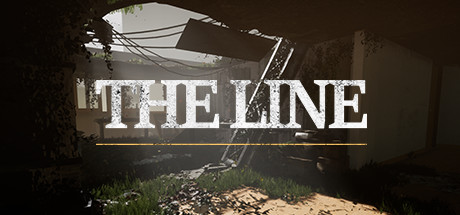
The Line, developed and published by Game Studio 148, is a quiet, introspective first-person narrative experience that leans heavily into atmosphere and mood rather than traditional gameplay complexity. Built as a solo-developed project, it carries a clear sense of personal vision, presenting a post-apocalyptic world shaped by environmental collapse and human adaptation. Rather than focusing on action or survival mechanics, it chooses a more reflective approach, inviting players to explore a subdued, flooded landscape and absorb its story at a measured pace.
The premise centers on a future where rising sea levels have reshaped the planet, leaving only fragments of civilization scattered across partially submerged environments. Survivors have organized themselves into small groups tasked with locating others and guiding them toward safer areas, forming a loose structure that gives the game its title. This setup provides a grounded framework for the narrative, but the story itself unfolds gradually through narration and environmental details rather than direct interaction. Much of the experience is about observation—taking in the remnants of what once was and piecing together the broader context through subtle cues.
Gameplay follows a minimalist structure typical of walking simulators. Players move through linear spaces, occasionally interacting with objects or solving simple puzzles that serve to guide progression. These puzzles are intentionally straightforward, functioning more as pacing devices than as meaningful challenges. They help maintain engagement without disrupting the overall flow, but they do little to add depth to the experience. As a result, the game places nearly all of its weight on atmosphere and storytelling rather than mechanics.
The strongest aspect of The Line is its tone. The world feels quiet, almost eerily still, with an emphasis on isolation and reflection rather than danger or urgency. The absence of traditional threats allows players to focus entirely on the environment and the narrative being conveyed. Voice-over narration plays a significant role, providing insight into the setting and the protagonist’s perspective. While this approach helps establish context, it can also make the experience feel somewhat passive, as much of the storytelling is delivered to the player rather than discovered through interaction.
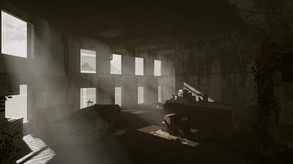
Visually, the game adopts a simple but effective style that supports its themes. The environments, though not highly detailed, convey the sense of a world overtaken by water and time. Structures appear worn and abandoned, reinforcing the idea of a civilization in decline. However, the limited visual complexity can also make certain areas feel sparse, and the lack of variety may become noticeable over the course of the playthrough. The presentation reflects the constraints of a solo-developed project, prioritizing atmosphere over technical polish.
The pacing is deliberately slow, encouraging players to take their time and engage with the world on a more contemplative level. This can be rewarding for those who appreciate narrative-driven experiences, as it allows the themes to settle and resonate. However, the lack of dynamic gameplay or evolving mechanics means that the experience can feel static, particularly for players who prefer more interactive or varied forms of engagement. The relatively short runtime helps mitigate this, ensuring that the game does not overextend its ideas.
In terms of replayability, The Line offers little beyond its initial playthrough. Its linear structure and limited interactivity mean that most of what it has to offer is experienced in a single session. This reinforces its identity as a one-time narrative journey rather than a game designed for repeated exploration or experimentation.
Ultimately, The Line is a modest but thoughtful project that prioritizes mood and reflection over complexity. It succeeds in creating a distinct atmosphere and presenting a world that feels quietly melancholic, even if it lacks the depth and interactivity to fully sustain its ideas. For players who enjoy short, contemplative experiences and are willing to engage with a slower pace, it offers a meaningful, if understated, journey. For others, its minimal gameplay and limited scope may make it feel underdeveloped.
Rating: 6/10