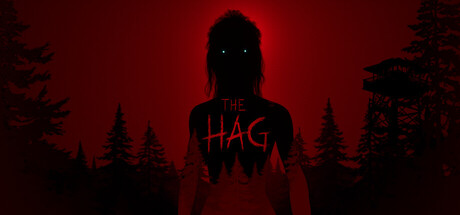
A missing engineer must be found. The communication towers must be restored. When the lights go out, the Hag will find you.
Modeled estimate, not a reported figure. How we estimate →
Media

About
The lone engineer stationed at a remote lookout has vanished, and all four communication towers have gone offline. You are sent to investigate.
What you find is not abandonment. It’s a hunt. And light is your only protection.

Your job is simple. Reboot the four communication towers. Your flashlight and stamina regenerate over time, but it would be wise to use these sparingly.
If the forest around you goes quiet, The Hag is nearby. She moves when you aren't looking directly at her and the light from your flashlight scares her away, so be sure to always check your surroundings and have plenty of power for your flashlight.
Scattered throughout the forest are The Hag's totems for you to collect. Keep a look out for their green lights but be cautious, their glow matches her eyes. Find all 24 for the true ending.

I wanted to make a short spooky game (roughly 2 hours) that didn't waste your time with pointless dialogue, red herring jump scares, and filler sequences but instead let you jump straight into paranoid horror. You are always being watched. You are always being followed. Check your corners. Check behind you. And don't waste your flashlight.
Cheers!
Stats
All-time low is the lowest price we've recorded for this game since we started tracking it.
Languages: English**languages with full audio support
Reviews
This is a really bad game. An awful, no good, very bad game. You wander the woods in pitch black looking for eggs with a limited use flashlight. Then a lady shows up at some point if you're REALLY looking for her and she jumpscares you.
The Hag, developed and published by TheLonelyGameDev, is a tightly focused indie horror experience that builds its entire identity around vulnerability, limited vision, and the constant dread of being watched. Rather than relying on complex systems or elaborate storytelling, it commits to a single core idea and uses it to generate tension from start to finish. The result is a game that feels stripped down and deliberate, aiming to create unease through restriction rather than spectacle. The premise places the player in a dark forest with a clear objective: locate and reactivate a set of communication towers while investigating a disappearance. It begins as a simple task, but the environment quickly reveals itself to be hostile. The forest is almost entirely engulfed in darkness, and the only reliable source of visibility is a flashlight with limited power. This immediately establishes the central tension of the game. Every decision to use the light becomes meaningful, as it provides safety at the cost of draining a resource that cannot be used indefinitely. Gameplay revolves around movement, observation, and careful resource management. There is no direct combat system, and the player is not equipped to confront the threat that inhabits the forest. Instead, survival depends on awareness and restraint. The entity that stalks the player operates under a simple but effective rule: it advances when it is not being observed. This creates a constant need to look behind, scan the surroundings, and remain alert to subtle changes in the environment. The flashlight becomes both a defensive tool and a source of anxiety, as relying on it too much can leave the player exposed later. What makes the experience effective is how it uses minimalism to its advantage. The game does not overwhelm the player with information or mechanics. Instead, it creates tension through absence. The silence of the forest, the narrow cone of light, and the uncertainty of what lies just beyond view all contribute to a sense of unease that persists throughout the experience. Moments where nothing happens can feel just as intense as encounters with the entity, as the player is left anticipating what might come next. The visual design reinforces this approach. The environment itself is simple, but the heavy use of darkness ensures that even basic spaces feel threatening. The flashlight dictates what the player can see, turning visibility into a mechanic rather than a given. This limitation enhances immersion, as players are forced to navigate with incomplete information. While the visuals lack detail in a traditional sense, they succeed in supporting the game’s atmosphere and core concept. The overall structure of the game is compact, with a relatively short playtime that can be completed in a single sitting. This brevity works in its favor, as the central mechanic remains effective without becoming overly repetitive. However, it also highlights the game’s limited scope. Objectives remain largely the same throughout, and there is little in the way of evolving gameplay or new systems introduced as the player progresses. Once the core loop is understood, the experience becomes more predictable, which can reduce its impact. Replay value is modest, with optional collectibles offering a slightly more complete outcome for those willing to explore more thoroughly. Beyond that, there are few incentives to return, as the game does not offer branching paths or significantly different outcomes. It is designed as a contained experience, meant to be played through rather than revisited repeatedly. Despite its simplicity, The Hag succeeds in delivering a consistent and focused horror experience. It understands its strengths and builds around them, using limited mechanics to create a sense of tension that is sustained through atmosphere and player awareness. At the same time, its lack of variety and depth prevents it from expanding beyond its initial concept. In the end, The Hag is a minimalist horror game that excels at creating unease through restriction and atmosphere. It offers a short but memorable experience for players who appreciate focused design and psychological tension, but it may feel too limited for those seeking a more complex or varied horror title. Rating: 7/10
Related
Related
Trends
Concurrent players on Steam, sampled daily since tracking started.
Creeped me out in the first five minutes. Will try again in the daytime. Really cool concept.
Momentum
Pace estimated from the game's recent review growth (our daily snapshots) at its own sales-per-review ratio — a momentum signal, not booked sales.
Related
| Glasses and Girls | $315.6 | 51 | 82% | $0.99 |
| Food and Girls | $315.6 | 51 | 86% | $0.99 |
| Bongo Quest | $315.6 | 51 | 45% | $0.49 |
| Dances and Girls | $322 | 52 | 83% | $0.99 |
| Carnival and Girls | $334.4 | 53 | 85% | $0.99 |
| Anime Sunset Ride | $334.4 | 54 | 67% | $0.49 |
Related
| 7 Days to Die | $425.3M | 403.6K | 87% | $44.99 |
| Mount & Blade II: Bannerlord | $309.8M | 294K | 88% | $49.99 |
| Palworld | $279.6M | 447.5K | 94% | $20.99 |
| The Forest | $254.8M | 678.6K | 96% | $19.99 |
| Ready or Not | $238.1M | 339K | 78% | $49.99 |
| Clair Obscur: Expedition 33 | $233.9M | 273.3K | 95% | $47.99 |