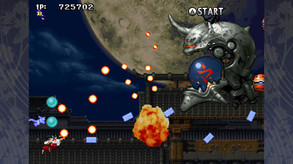
Tengai, developed by City Connection and Zerodiv and published by City Connection, is a stylish horizontal shoot ’em up that captures the intensity and artistry of 1990s arcade design. Originally released under the title *Sengoku Blade*, this reissue brings one of Psikyo’s most distinct shooters to modern platforms, preserving its sharp action, dazzling sprites, and signature blend of speed and precision. It stands as both a love letter to the golden age of arcades and a reminder of how timeless a well-crafted shooter can be. While it may appear straightforward at first glance, Tengai’s blend of classic gameplay, beautiful presentation, and tight control makes it an experience that continues to captivate players decades after its debut.
The game immediately sets itself apart through its unique aesthetic and setting. Instead of the usual futuristic or sci-fi backdrop common in shooters, Tengai takes place in a fantastical version of feudal Japan filled with magic, flying war machines, and supernatural warriors. The world is brought to life through vibrant hand-drawn sprites and richly detailed backgrounds that scroll smoothly across the screen, immersing players in a realm where samurai and sorcery coexist. Each level is designed with a painterly touch, from flaming battlefields to ornate temple skies, and every boss encounter feels like a visual spectacle, pushing the limits of 2D animation with massive, multi-phase monsters that fill the screen. The art direction, with its emphasis on traditional Japanese motifs twisted into mecha-inspired chaos, gives Tengai a distinct identity within the shooter genre, blending cultural flavor with arcade excess.
At its core, Tengai embodies the principles of pure arcade gameplay—simple to learn but endlessly challenging to master. Players choose from several characters, each offering a different attack style and secondary weapon, which dramatically alters how each stage plays out. The cast includes a stoic monk, a deadly shrine maiden, a playful ninja, and even a mechanical samurai, each with their own personality and fighting technique. The character variety adds replayability, encouraging experimentation as players discover which fighting style best suits their reflexes. The combat system is instantly gratifying: enemies swarm from all directions, bullets flood the screen, and precise movement becomes essential for survival. The game’s pace is relentless, yet it maintains a sense of balance—each enemy pattern, power-up placement, and boss phase feels deliberately timed to test awareness without feeling unfair.
The boss encounters are where Tengai truly shines. Each one is a cinematic event, combining creativity with mechanical precision. From transforming dragons to mechanical fortresses, every battle offers a multi-stage showdown filled with evolving attack patterns and increasingly dense bullet spreads. These fights demand focus and adaptability, but victory always feels earned. What sets Tengai apart from many of its contemporaries is the way it constantly shifts its rhythm—quiet moments of preparation are followed by explosive crescendos of chaos. The sensation of dodging through a sea of bullets and retaliating with a perfectly timed bomb is as exhilarating today as it was in arcades decades ago.
The game’s mechanical structure is lean and efficient. Players collect power-ups to enhance their weapons and gather bombs for emergency escapes, both of which become critical during later stages when the screen is filled with danger. The horizontal orientation gives Tengai a different flavor from Psikyo’s usual vertical shooters, changing how threats appear and how movement is managed. The controls are tight and responsive, emphasizing quick reactions and spatial awareness. Though the core mechanics are simple, mastery requires a deep understanding of enemy patterns, stage layouts, and the fine balance between aggression and caution. The Steam version preserves this arcade authenticity, offering difficulty settings that cater to both newcomers and veterans, as well as a score-attack mode that encourages repeated playthroughs for higher rankings.
Visually and aurally, Tengai remains one of the most striking shooters of its era. The pixel art bursts with personality, and the animation of every explosion, projectile, and boss transformation conveys an energy that feels handcrafted. The sound design enhances the action with crisp effects that punctuate every shot and explosion, while the soundtrack alternates between traditional Japanese melodies and upbeat action themes that mirror the pacing of each stage. The overall presentation gives the game a sense of rhythm and atmosphere that feels almost theatrical, transforming every level into a miniature performance of spectacle and tension.
Though Tengai offers a robust challenge and exhilarating gameplay, it is also very much a product of its arcade roots. Each run lasts only a few stages, and the story, while charming in its simplicity, is little more than a pretext for the action. The brevity of the experience means it can be completed in a single sitting, though true mastery requires many hours of repetition and refinement. For players expecting modern narrative depth or progression systems, the structure may feel barebones, but for purists of the genre, its compact design is part of its appeal. Every moment of gameplay is focused and deliberate, with no unnecessary distractions.
Tengai’s biggest strength lies in its timeless playability. It’s a reminder of why arcade shooters endure—the satisfaction of instant feedback, the thrill of risk and reward, and the pure joy of honing skill through repetition. While newer bullet-hell games have expanded on the genre’s mechanics, Tengai’s design represents a perfect balance between accessibility and depth. The difficulty curve encourages learning rather than punishing experimentation, and the short stages ensure that every attempt feels meaningful. The addition of multiple characters and randomized stage order further increases replay value, making it a game that rewards persistence and curiosity.
In the end, Tengai stands as a vibrant relic of arcade history that remains surprisingly fresh in the modern era. It combines visual artistry, responsive gameplay, and a distinct cultural aesthetic into a package that continues to engage players across generations. Whether you’re a long-time fan of Psikyo shooters or someone new to the genre, Tengai delivers an experience that is both nostalgic and timeless. It captures the thrill of a perfectly executed run, the satisfaction of narrowly dodging destruction, and the beauty of pixel art pushed to its limits. It’s not just a revival of a classic—it’s a celebration of what made the arcade age so special, and a testament to how pure gameplay, when crafted with care, never truly goes out of style.
Rating: 8/10