Position your pieces carefully to max out your score in this Balatro-inspired chess roguelike. Enhance your pieces, purchase powers, and win bonuses from optional challenges, but be careful - your board only has so much room.
Modeled estimate, not a reported figure. How we estimate →
Media

About

Position your pieces carefully to max out your score in this Balatro-inspired chess roguelike. Enhance your pieces, purchase powers, and win bonuses from optional challenges, but be careful - your board only has so much room.
Build a unique chess board every run
Choose from different pieces with different synergies
Increase your score with 100 different tiles
Every tiles has its own unique effect
Discover powerful combinations

Grow your collection by discovering and unlocking new pieces, tiles, boards and coins

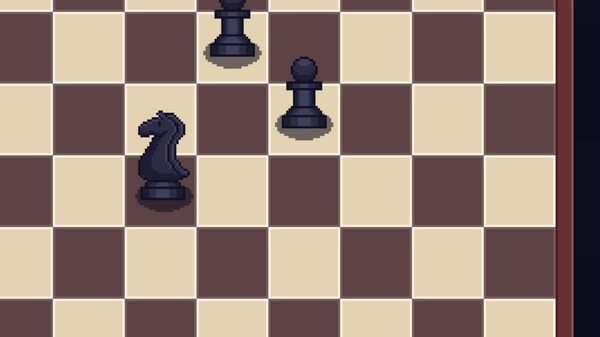
Several chess pieces to add to your board
100 tiles, each with its unique ability
10 boards with different modifiers to choose from every run
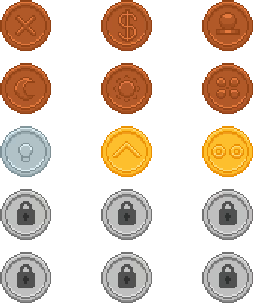
25 coins that can modify your pieces, board and impact every run
8 difficulty levels that provide unique and increasingly harder challenges
20 bosses that make every run a new challenge
Stats
All-time low is the lowest price we've recorded for this game since we started tracking it.
Languages: English
Engagement
Hours played at review time, across 42 reviews with recorded playtime.
Reviews
Themes across 42 recent reviews and how positive each mention is. A keyword signal, not full sentiment analysis.
positive critical· bar length = how often the theme comes up
Reviews
I wouldn't refund even if I had less than 2 hours, but this game is just missing the flexibility Balatro has. The bosses are pretty much all "if you rng'd the wrong build your build is now dead", as it's hard to get a strong econ, hard to get good board-fixing, and because econ is bad scaling is hard to pivot and largely inaccessible. The neighbor bosses and the bosses punishing the use of enhanced pieces and tiles are by far the most harmful and egregious. The weakness of sources of comparae parallel scaling to hands, jokers, and deckfixing the way Balatro had it probably the biggest problem with this game. Also, this game's version of the ox is garbage because it occurs after hand resolution to force $0 rather than allowing you to rebound if your econ is well-managed.
not very fun, the only thing chess-like about it is the shape of the pieces.
Though the game's design is inspired heavily off of Balatro, Tabulo has enough of a distinct identity and gameplay to be able to stand on its own in the roguelike genre. The physical board presents a unique strategical element missing in similar games, as you're able to physically move your pieces around to maximize the points gained from them scoring and being scored by other pieces. Like actual chess, higher-ranked pieces have higher score values, with the King offering the most but at the downside of only being able to score neighboring pieces around it. Furthermore, instead of jokers, it adds onto the strategy by allowing a theoretically-unlimited number of tiles you can place down, so long as you can arrange them around the chess pieces on your board. As you complete runs, you unlock different chess boards that have different effects. Some are simple stat changes, such as increasing starting money or number of playable pieces, but my favorites are the ones that directly impact the gameplay of the board itself, by introducing new, non-standard chess pieces to put down, such as dice, xiangqi [my favorite], or checkers. It's an aspect that I really enjoy and wish could get expanded upon in the future, as its by far the game's most unique element.
it's chess balatro. i kinda wish the art style didn't crib from balatro QUITE so much, but the game is fun and the art for the tiles (i.e. jokers) are charming
Tabulo is a tightly focused strategy roguelike that takes the visual language and basic logic of chess and reshapes it into a score-driven puzzle experience built around optimization, synergy, and long-term planning. Developed and published by Noah Games, it does not ask players to defeat an opponent or pursue checkmate. Instead, it challenges them to think of chess pieces as tools in a broader mathematical and spatial system, where placement, modifiers, and board conditions matter far more than traditional notions of attack and defense. The result is a game that feels immediately familiar on the surface, yet quickly reveals a depth that comes from reinterpreting classic ideas in a completely new context. At the center of Tabulo is a run-based structure where each attempt begins with the selection of a board that defines the basic constraints and scoring tendencies of the session. Boards vary in layout and rules, subtly reshaping priorities by favoring certain formations, directions, or clustering behaviors. From there, players place chess pieces onto limited spaces, with each piece contributing points based on how it interacts with surrounding tiles, other pieces, and active modifiers. Rooks, bishops, knights, and other familiar units no longer exist to threaten enemies but to generate value through positioning, lines, adjacency, and coverage patterns. The true strategic depth emerges from the game’s extensive modifier systems. Tiles can dramatically alter how pieces score, changing directions of influence, multiplying values, or introducing conditional bonuses that reward careful planning. Coins function as powerful run-altering modifiers, similar to jokers in other modern roguelike score games, and can redefine optimal strategies entirely. Some amplify specific pieces, others reward certain formations, and a few encourage risk-taking by offering huge bonuses at the cost of flexibility. Learning how these systems interact is key, and much of the satisfaction comes from discovering unexpected synergies that turn an average board into a high-scoring engine. Progression within a run is carefully paced. After each scoring phase, players are given opportunities to upgrade pieces, acquire new tiles, or purchase coins using earned currency. These decisions often involve trade-offs between immediate gains and long-term potential, especially given the ever-present limitation of board space. Because placement is permanent and space is finite, every decision carries weight. A powerful tile added too early might block future growth, while waiting too long can result in falling behind score thresholds. This tension gives Tabulo a strong puzzle-like rhythm, where foresight matters as much as adaptability. Boss encounters punctuate runs and serve as strategic checkpoints rather than traditional fights. These challenges introduce special conditions or heightened score requirements that test whether a build is cohesive or overly reliant on a narrow interaction. Bosses force players to reassess assumptions, sometimes exposing weaknesses in otherwise successful strategies. Combined with multiple difficulty levels, these encounters ensure that mastery involves understanding the system holistically rather than exploiting a single trick. Presentation is intentionally restrained. The visual design emphasizes clarity and readability, ensuring that complex scoring interactions are easy to track even as the board fills with effects. Animations and audio cues highlight scoring moments without overwhelming the player, keeping focus firmly on decision-making. This minimalist approach suits the game’s analytical nature, making it feel closer to a strategic tabletop puzzle than a flashy digital spectacle. While the core mechanics are strong, Tabulo’s ambition occasionally reveals areas that could benefit from further refinement. Some interface elements can feel dense, particularly when multiple modifiers are active at once, and new players may initially struggle to understand why certain placements score better than others. However, this learning curve is also part of the game’s appeal, rewarding experimentation and repeated runs as understanding deepens. Each failure feels less like a setback and more like data for the next attempt. Ultimately, Tabulo succeeds by reframing chess not as a contest between two minds, but as a system to be optimized and bent toward maximum efficiency. It blends the satisfaction of puzzle-solving with the replayability of roguelike progression, offering a compelling experience for players who enjoy numbers, patterns, and emergent strategy. For fans of score-chasing games, optimization puzzles, and modern roguelikes that transform familiar mechanics into something novel, Tabulo stands out as a smart, focused, and deeply replayable entry in the genre. Rating: 8/10
First this clone of Balatro, but done with chess moves vs. poker. In all ways this feels like a knock off, from far less polished visuals to the scoring glitches like Balatro has some combos. The problem is in Tabvto when you hit an looping combo that is going to result in score in the billons, the game slowly counts it all up for over 15 min. In Balatro the same even gets the game to exponentially speed up the scoring, so you get the really big number in under a minute. All of the ruff edges, the lack of things to unlock, and the general feel of Tabvto makes me want to play Balatro. Also I am about half done with Balatro and in far fewer hours I have unlocked every board, every challenge, and ever unlock in Tabvto. What really knocks this to a negative to me are one of the bosses you can randomly get at any point in the game. It sets your score to 0 if you score a modified piece. The problem is you want to modify your strongest pieces to get a higher score, so this at higher levels is basically a game over. Oh and if you don't modify your pieces, you can't get to those higher levels.
It's evident from the graphics and gameplay that this game takes a lot of inspiration from Balatro, and while I don't think it will soar to the heights of Balatro it definitely offers some fun at a reasonable price and the demo gives you a nice amount of content to get a good feel for the game and at least on PC your progression carries over which is nice. Having only played on the easiest difficulty so far, it does seem like there is some variety in strategies although difficult to say if that continues to harder difficulties. That's not to say there aren't some downsides to the game. The runs are a little short and the first couple of rounds are fairly trivial in all settings. While the game isn't Early Access, I could also see other Balatro style features being implemented where you can buy point upgrades for particularly types of pieces akin to Balatro planets. It would be nice to see some quality of life improvements, namely steam achievements and statistics. Ultimately, it's a fun game, I'm doubtful that it has a huge longevity but a pleasant experience especially as you discover the new pieces of the game.
This game is essentially balatro but with chess and it is done very well. The gameplay loop is just as addictive as the loop of balatro but appeals to the chess lovers. The game is amazing and I have recommended it to many friends already.
Click click, number go up, brain happy. Balatro like, sometimes feels too easy to run combos. However, PLEASE fix Royal Order and Jester interaction.
Fun game, lots of room to improve. Biggest issue is the lack of support for steam deck controls at the moment. It does play but you have to use the joystick to lift the pieces onto the board and it can be hard to get them precise. Otherwise love seeing balatro inspired games done right!
Related
Related
Trends
Concurrent players on Steam, sampled daily since tracking started.
Momentum
Pace estimated from the game's recent review growth (our daily snapshots) at its own sales-per-review ratio — a momentum signal, not booked sales.
Audience
Estimated from the language of this game's reviews — a proxy for where players are, not official Steam demographics.
Related
| 《奇门遁甲》 | $17.7K | 289 | 89% | $2.99 |
| Kingdom Tales: Dragons & Us | $17.7K | 60 | 53% | $9.99 |
| Gridrunner Revolution | $17.7K | 85 | 84% | $9.99 |
| Sakura Forest Girls 2 | $17.7K | 63 | 84% | $9.99 |
| The Sum of All Fears | $17.7K | 64 | 78% | $9.99 |
| Bravada | $17.7K | 60 | 82% | $9.99 |